BaseMTG · Guides
TCGplayer Market Price Explained: What the Number Means
TCGplayer market price comes from completed sales, not the cheapest listing. How it differs from Listed Median, shown with TCGplayer's own Moat example.
TCGplayer market price is the number many players notice first, but it is built from completed sales, not from the cheapest listing. That distinction matters when a product has only a few active listings or when the remaining listings sit far above the prices at which copies have sold.
TCGplayer shows several price points because each one answers a different question. Market Price summarizes recent sales, while Listed Median summarizes current asking prices.
TL;DR: Market Price is based on completed TCGplayer.com sales and is updated as transactions complete. Listed Median uses current listed prices only, so it can sit far above or below the sales-based figure, especially on older products with low quantities. TCGplayer does not publish the Market Price time window, sale count, or weighting used for a particular product.
What Is the TCGplayer Market Price? (quick answer)
TCGplayer market price is TCGplayer's sales-based value for a collectible, averaged across multiple recent transactions. TCGplayer says it draws from thousands of transactions daily across thousands of individual sellers and ignores outliers that would distort a traditional low-mid-high scale. The help pages add that it is compiled from recent sales completed on TCGplayer.com, updates as transactions complete, and reflects the best suggested retail price.
Key Takeaways
- Market Price comes from completed recent sales, not current listing prices.
- Listed Median is based only on listed prices and can vary from actual paid prices on older products with low quantities.
- Most Recent Sale is one transaction for the selected filters, not a multi-sale measure.
- Volatility uses sales volume and standard deviations over 30 days, and counts orders rather than copies.
- TCGplayer does not state Market Price's time window, sale count, or weighting.
Overview: The Price Points on a TCGplayer Page
Each label on a TCGplayer product page uses a different input.
| Price point | What TCGplayer says it measures | Based on |
|---|---|---|
| Market Price | A best suggested retail price compiled from recent completed sales; it averages prices across multiple recent transactions and ignores outliers. | Actual recent TCGplayer.com sales. |
| Most Recent Sale | The price of the most recently sold product for the filters on the page. | One completed sale, with selected condition or card version considered. |
| Listed Median | The median of all listed prices for a product. TCGplayer warns it can differ significantly from what people actually pay, especially on older, lower-quantity products. | Current listings only. |
| Market Price Volatility | A Low, Medium, High, or Indeterminate label for how the price range behaves. | Sales volume and standard deviations over a 30-day period; calculated per order. |
| Current Quantity | The quantity listed on the product page. | Listed quantity, excluding Listings with Photos that might include multiple copies. |
| Current Sellers | The number of individual sellers listing the selected product. | Individual sellers with a listing. |
All of these price points reflect the printing and condition filters selected on the product page. The help pages explain that Market Price uses multiple recent transactions, but they do not publish the sales time window, the number of sales used for a given product, or the weighting behind the result. "Thousands of transactions daily" describes TCGplayer's overall data stream, not the sample size for any one card.
GODEEPER: For a separate look at price timing, read Reality Fracture Card Prices: 9 of the Top 10 Fell →
Analysis: Why Market Price and Listed Median Disagree
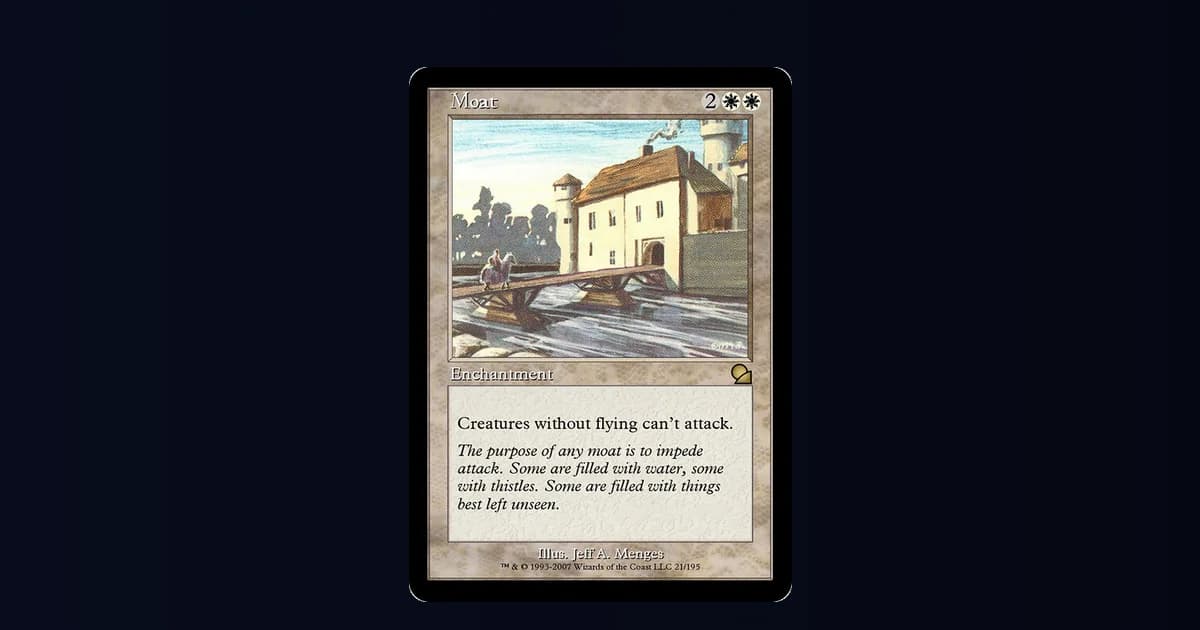
The two figures disagree because they use different inputs: Market Price comes from recent completed sales, Listed Median from current listings. TCGplayer's Moat example shows the gap: its sample price data lists Market Price at $354.66 and Listed Median at $654.72. Those figures are TCGplayer's sample data, not a current price.
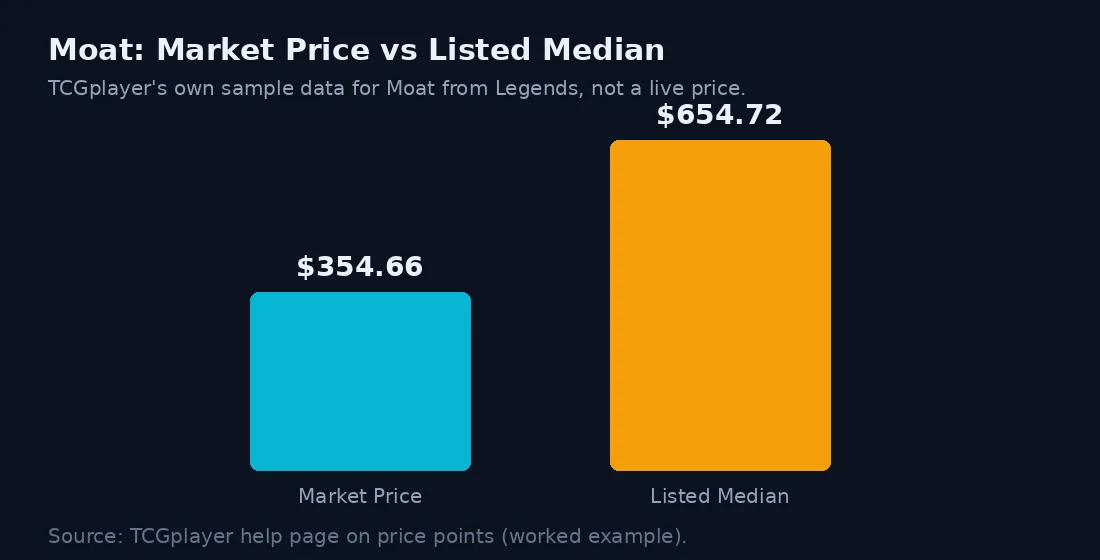 TCGplayer's worked example for Moat from Legends. These are sample figures from the help page, not a current price.
TCGplayer explains the mechanism. Only a few sellers still list Moat from Legends. When a new seller lists near the Market Price, that copy sells. The remaining listings are priced far higher, so the current listing pool can leave a high Listed Median even while completed sales sit much lower.
TCGplayer's conclusion for this sample is that the true value falls somewhere between the two figures. The help page gives no fixed sales window, sale count, or weighting, so a reader cannot reproduce Market Price from the page alone.
GODEEPER: For another look at reprint-related price risk, read Secret Lair Reprint Risk: The Reserved List Framework →
How to Read a TCGplayer Price Page
- Pick the exact printing and condition before interpreting a price point. TCGplayer says displayed price points reflect selected printings and conditions, and Most Recent Sale can also account for card version.
- Read Market Price as a summary of recent completed sales. It is updated as transactions complete and is presented as TCGplayer's best suggested retail price.
- Compare it with Listed Median, which uses current listings only. A large gap can occur on older products with lower quantities because the listed pool may differ significantly from what people actually pay.
- Check the volatility label and its definition. Low means the relative price stays around the same level, Medium changes slightly more, High changes more significantly, and Indeterminate means there was not enough sales volume within 30 days to score it.
- Check Current Sellers and Most Recent Sale as a sanity check. Current Sellers counts individual sellers with a listing, while Most Recent Sale is the latest sold price for the selected filters.
What Market Price Does Not Tell You
Market Price does not reveal a published time window or a fixed sample size for the displayed figure. TCGplayer says it averages multiple recent transactions, but its help pages do not say how far back the calculation reaches or how many sales feed a particular product's result.
Its sales source is TCGplayer.com only. TCGplayer defines Market Price from sales completed on TCGplayer.com, so the definition describes that marketplace's transactions only.
For a thin card, an Indeterminate volatility label means there was not enough sales volume within the 30-day period to score volatility. The displayed number then rests on limited recent sales.
Frequently Asked Questions
What is TCGplayer market price? TCGplayer market price is a value based on completed sales on TCGplayer.com. TCGplayer says it averages prices across multiple recent transactions, treats sold prices as a key data point, and ignores outliers that would distort a traditional low-mid-high scale. It is presented as the best suggested retail price.
Is TCGplayer market price the lowest price? No. TCGplayer market price is compiled from recent completed sales, while Listed Median is calculated from current listed prices only. TCGplayer does not define Market Price as the lowest listing, an average of every listing, or a guaranteed sale price. Its wording is best suggested retail price, so it is a reference point.
How often does TCGplayer market price update? TCGplayer market price updates as transactions complete, according to TCGplayer's help page. The page does not publish a fixed schedule, sales window, or number of sales used for an individual product. That means the public definition explains the trigger for updates, but not a timetable or a precise sample size behind any displayed number.
What is the difference between market price and listed median? The difference is the data source. Market Price is compiled from recent completed sales on TCGplayer.com, while Listed Median is the median of all listed prices for a product based on listings only. On older products with lower quantities, TCGplayer says Listed Median can differ significantly from what people actually pay.
What does TCGplayer price volatility mean? TCGplayer price volatility is a 30-day scale based on sales volume and standard deviations of the price range. Low means the price stays around the same relative level; Medium changes slightly more; High changes more significantly; Indeterminate means there was not enough sales volume within 30 days to score it. Orders count as data points.
Does market price change by condition or printing? Yes, the displayed price points reflect selected printing and condition filters on the product page. Most Recent Sale also accounts for selected condition or card version. The displayed result is tied to the filters selected for that product page, so the relevant comparison is between figures shown for the same selected result.
Related Reading
- MTG Card Price Guide: Values, Reprints, and Selling: Read it for broader card-market context.
- MTG Reserved List Explained: 572 Cards, Never Reprinted: Read it for a separate explanation of the Reserved List topic.
- Reality Fracture Precons Ranked: Which of the 6 to Buy: Read it for a ranking of the six Reality Fracture precons.
References
About the author

Card Market & Collecting Analyst
Covers the MTG card market: set-review value calls, reprint-risk analysis, and buy/sell timing around spoiler season and Secret Lair drops. Not a financial advisor, calls it like a longtime speculator who has been wrong plenty of times too.
- Tracks TCGplayer market-price data across every new set
- Covers reprint announcements and their price impact
- Follows Universes Beyond crossover sets for crossover-collector demand
Keep reading
Reality Fracture Card Prices: 9 of the Top 10 Fell
Guides · 11 min
MTG Reserved List Explained: 572 Cards, Never Reprinted
Guides · 12 min
Secret Lair Reprint Risk: The Reserved List Framework
Guides · 12 min
MTG Card Price Guide: Values, Reprints, and Selling
Guides · 4 min
Multiverse Reforged Precon Upgrades: 6 First Swaps (2026)
Guides · 12 min
Rakdos Standard Deck Guide: Stingerquill Aggro (2026)
Guides · 14 min
Jund Standard Deck Guide: Sackville-Bagginses Sacrifice
Guides · 14 min
Boros Dragons Standard Deck Guide: Smaug and Sarkhan
Guides · 14 min
Disclaimer
This article is published for informational and entertainment purposes. It does not constitute professional financial, legal, or technical advice. Game performance, online services, patch schedules, and store listings change. Verify critical details (pricing, system requirements, regional availability) with publishers and storefronts before you buy. Affiliate links, where present, help support our editorial work and are labelled in our affiliate disclosure.