Loading…
Loading…
BaseMTG · Guides
MTG card price guide covering how values are set, reprint risk, and where to check prices. Learn to grade condition and time sales around new sets.
This MTG card price guide treats prices as ranges tied to a date, not fixed numbers, and states plainly when something looks like a reprint-risk buy rather than a safe long-term hold.
TL;DR: Prices reflect rarity and demand together, not either alone. Reserved List cards can't be reprinted, so their supply only shrinks; anything else that spikes in price is a real reprint-risk candidate for a future Secret Lair or Commander precon. Buy after the first week or two post-release, once hype-driven prices settle, and always grade your own cards honestly before selling.
A card's price reflects rarity and demand together. Being rare doesn't guarantee value if nobody plays the card; being a competitive staple doesn't guarantee a high price if the card is common or was printed in huge supply. Reserved List cards (a fixed list Wizards has pledged never to reprint) behave differently from an ordinary rare, since their supply can only shrink over time.
Foil and nonfoil printings of the same card trade at genuinely different prices, and the gap isn't fixed: it depends on how many players actually want a foil copy for a specific deck versus how many copies exist. A niche card in a popular Commander color can carry a bigger foil premium than a much more expensive Standard staple that mostly gets played in nonfoil decks, since fewer people are chasing the foil copy of the expensive card in the first place. Supplemental products (Secret Lair, Commander precons, Universes Beyond crossovers) also tend to use unique borderless or extended-art treatments, and those treatments often carry their own separate price line from the plain version of the same card.
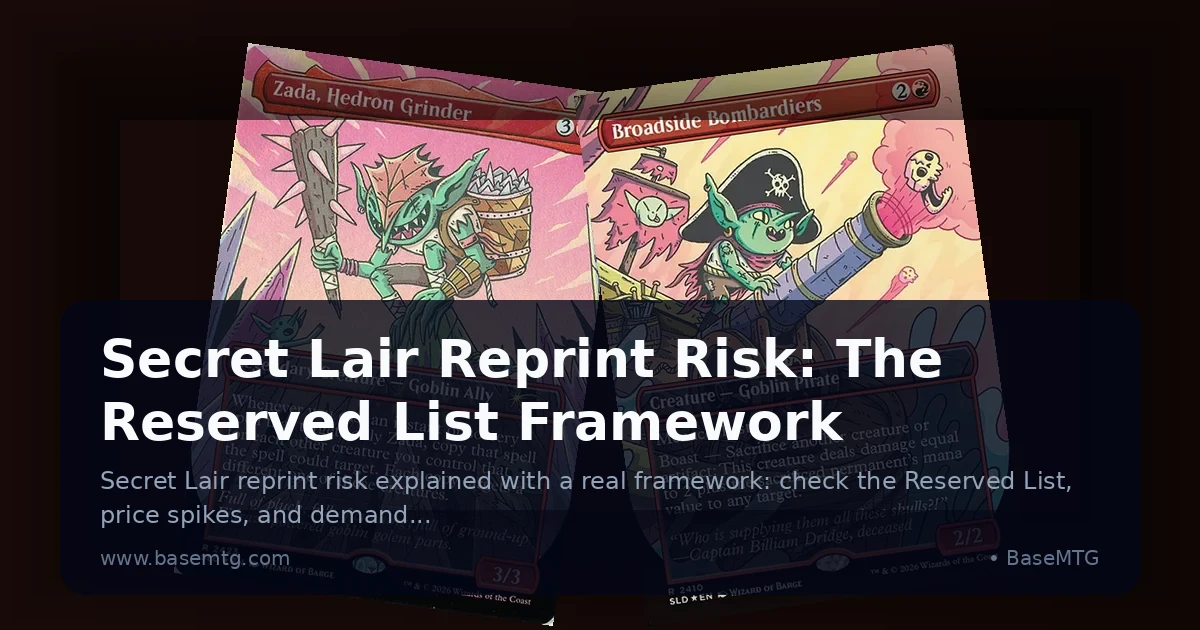
Secret Lair drops and Commander precons are Wizards' most common reprint vehicles for cards that have spiked in price without Reserved List protection. A card jumping in value shortly after a strong tournament result or a new synergy piece is exactly the kind of card that tends to show up in a Secret Lair a few months later, which is why buying singles at a post-spike price carries real risk.
About the author

Card Market & Collecting Analyst
Covers the MTG card market: set-review value calls, reprint-risk analysis, and buy/sell timing around spoiler season and Secret Lair drops. Not a financial advisor, calls it like a longtime speculator who has been wrong plenty of times too.
Disclaimer
This article is published for informational and entertainment purposes. It does not constitute professional financial, legal, or technical advice. Game performance, online services, patch schedules, and store listings change. Verify critical details (pricing, system requirements, regional availability) with publishers and storefronts before you buy. Affiliate links, where present, help support our editorial work and are labelled in our affiliate disclosure.
Value calls for each new 2026 set (which cards are worth buying early, which look like reprint bait, which are overhyped from spoiler season alone) get linked here as sets release and prices settle, starting with the 2026 set release schedule itself.
Spoiler-season hype and settled market price are two different things, and confusing them is the single most common mistake buying into a new set. A card that looks build-around during preview week can turn out to have a much narrower home than early coverage suggested, and its price tends to correct downward within a few weeks of release once real deck lists and tournament results replace speculation. Waiting even one or two weeks past a set's launch, rather than buying during preview week itself, avoids paying a hype premium on cards that settle lower.
Condition affects resale price more than most new sellers expect. Grading services exist for high-value cards, but for ordinary trading and selling, an honest self-assessment against a standard condition scale (near-mint, lightly played, moderately played, heavily played, damaged) is enough to price a card fairly. If you're buying into a specific Commander precon, check individual card condition the same way you would for singles.
Sleeving a card the moment it enters your collection is the cheapest form of condition protection there is, and it matters more for older cards than new ones: a card printed decades ago on older cardstock scuffs and whitens more easily than a fresh copy off a recent print run. For anything you plan to actually play rather than hold, a penny sleeve inside a deck box is enough; save toploaders and rigid cases for cards you're storing long-term or shipping to a buyer.
What determines a Magic card's price? Rarity and demand together, not either alone. A rare card that's also a competitive staple carries real value, and reprint status matters too: a card on the Reserved List (never reprinted) holds value differently than a card Wizards could reprint in any future set.
Where can I check current MTG card prices? TCGplayer shows live marketplace listings by condition. MTGGoldfish and MTG Stocks track price history and daily movement by card and by set, which is more useful than a single listing for spotting a real trend versus a one-off spike.
What is reprint risk? The chance a card's price drops because Wizards reprints it in a new product, increasing supply. Secret Lair drops and Commander precons are common reprint vehicles, so a card without Reserved List protection that's spiked in price is a real candidate for a future reprint.
How much does card condition affect price? Significantly. Visible whitening, scuffing, or bent corners can cut a card's sale price to a fraction of a pristine copy of the same printing, so grading your own cards honestly before listing them matters as much as knowing the base market price.
Should I buy a card during its first week on the market? Be cautious. First-week prices for a newly released set are typically volatile, driven by early hype and limited supply, and often settle lower within a few weeks as more copies enter circulation. Treat early prices as a range with a date attached, not a stable number.

cEDH Staples Guide: Fast Mana, Tutors, and Interaction
12 min read