Loading…
Loading…
BaseMTG · Guides
Reviewing
Magic: The Gathering
Secret Lair reprint risk is not a prophecy about the next drop. It is a way to separate cards with a real path to new supply from cards whose scarcity is protected by a formal rule. This is market commentary, not financial advice, and every price observation should carry a date because a single listing is not a market.
TL;DR: Start with the Reserved List, then look for a dated price spike, a clear demand catalyst, and a plausible Secret Lair or Commander theme. Non-Reserved List cards with those signals are real reprint candidates, but a candidate is not a forecast. The 2026 Goblin Storm Commander deck shows how Wizards can bundle that kind of demand into a $149.99 product that sold out within an hour.
Secret Lair reprint risk is the chance that a non-Reserved List card receives another printing through a Secret Lair drop, Commander product, or a similar Wizards product. The risk becomes more credible when a card has recently become expensive, has a strong demand story, and fits a theme Wizards can package for a specific audience.
The Reserved List is a specific, fixed list of Magic cards that Wizards of the Coast has formally pledged never to reprint. A card on the Reserved List cannot legally be reprinted by Wizards under any circumstance. That gives buyers and sellers one binary, checkable boundary: the card is on the list, or it is not.
Everything outside that list belongs to a different category. A card can be old, scarce, expensive, or culturally important and still remain eligible for a future printing. It can also be printed again and again without Wizards announcing a timetable. The absence of a reprint is not a promise that one will never happen.
This distinction matters because market discussions often use words such as “safe,” “untouchable,” or “protected” for cards that only have a favorable history. Those words describe sentiment, not a formal guarantee. If a card is not on the Reserved List, the correct statement is that its reprint risk exists, even when the timing and product are unknowable.
The first check should therefore be mechanical. Confirm the exact card against the official Reserved List before studying price charts, recent tournament lists, or social media speculation. If the card is listed, the reprint-risk analysis stops at Wizards’ formal boundary. If it is not listed, move on to the factors that make a future printing commercially useful.
GODEEPER: Card values follow rarity and demand together, the same two forces behind reprint risk. MTG Card Price Guide: Values, Reprints, and Selling →
Was this guide helpful?
About the author

Card Market & Collecting Analyst
Covers the MTG card market: set-review value calls, reprint-risk analysis, and buy/sell timing around spoiler season and Secret Lair drops. Not a financial advisor, calls it like a longtime speculator who has been wrong plenty of times too.
Disclaimer
This article is published for informational and entertainment purposes. It does not constitute professional financial, legal, or technical advice. Game performance, online services, patch schedules, and store listings change. Verify critical details (pricing, system requirements, regional availability) with publishers and storefronts before you buy. Affiliate links, where present, help support our editorial work and are labelled in our affiliate disclosure.
The useful framework has three core tests. A card is a meaningful reprint candidate when it is not on the Reserved List, has experienced a recent price spike, and has a strong explanation for the new demand. That explanation is often a tournament result, a format change, a new set mechanic, or a synergy piece that makes an older card newly useful.
Rarity and demand work together. Rarity limits how much supply already exists. Demand determines how many people are competing for that supply. A low-rarity card with broad demand can become expensive enough to attract attention, while a rare card with no buyers can remain cheap. Reprint risk follows the combination, not rarity alone.
The cause of the spike matters as much as the size of the move. A short-lived social-media push may fade before Wizards has a reason to build around the card. A durable tournament result or a new synergy can create a larger and more legible audience. Legible demand is easier to package. Wizards can put a card into a themed Secret Lair, a Commander precon, or another product aimed at the players who already want it.
Recent price movement is still only evidence, not proof. A spike says that the market is repricing the card. It does not say that a product team has selected it, that a file is scheduled, or that the next drop will contain it. The strongest conclusion is narrower: a newly expensive, non-Reserved List card with visible play demand has a clearer path to a future reprint than a card that has always been cheap or is already widely available.
Frequent reprints change the assessment. When a card has been printed several times recently, Wizards has already supplied copies to the market, so the immediate need for another printing is usually lower. That does not make the card immune. It simply removes one part of the candidate case. A card with many recent printings needs a stronger demand shock or a particularly good thematic fit before its reprint risk looks elevated again.
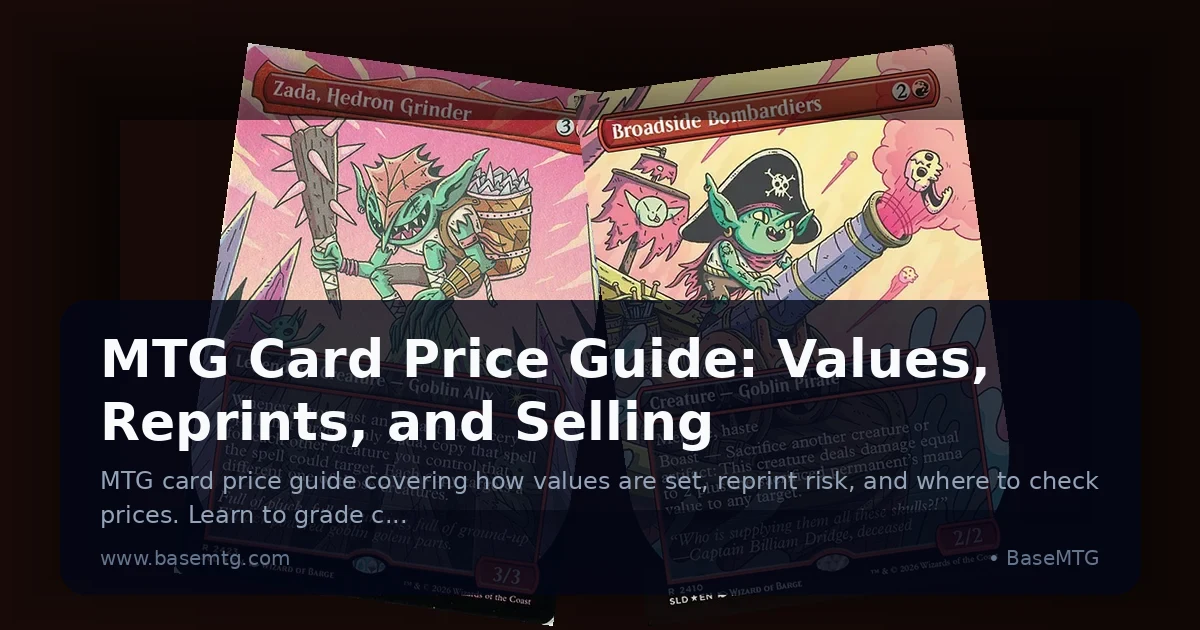
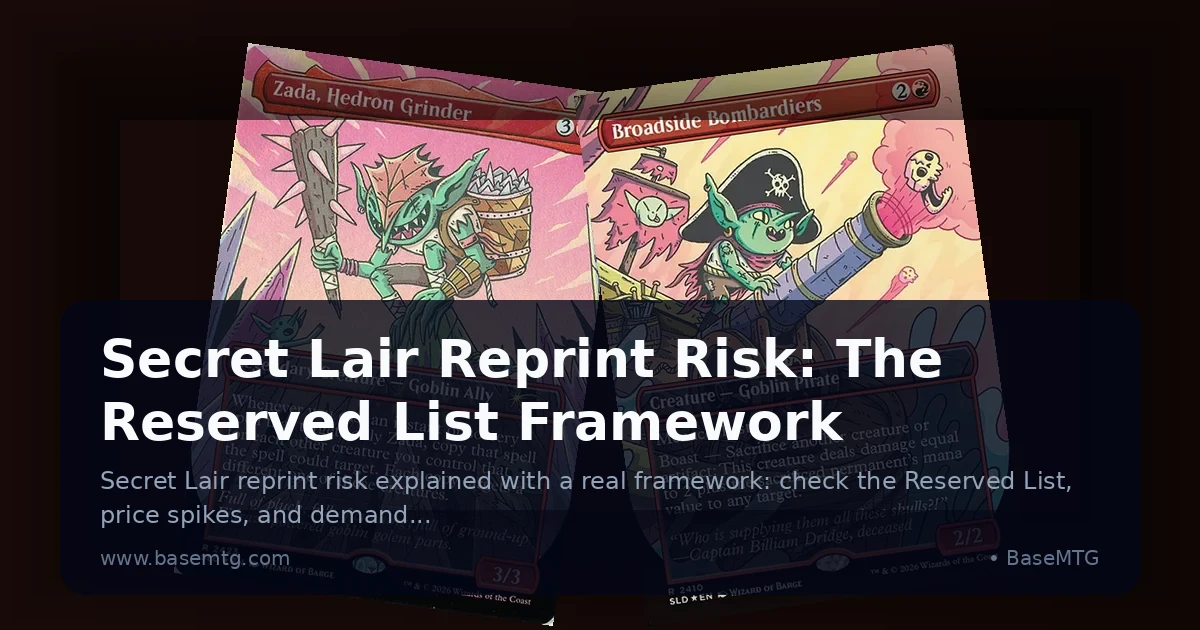
Secret Lair Commander Deck: Goblin Storm is a real, confirmed 2026 product. It became available on secretlair.wizards.com on May 18, 2026, at a $149.99 price and sold out within an hour. It is a 100-card Commander deck led by Zada, Hedron Grinder, Krenko, Mob Boss, and Pashalik Mons. The deck pairs Goblin aggression with the Storm mechanic.
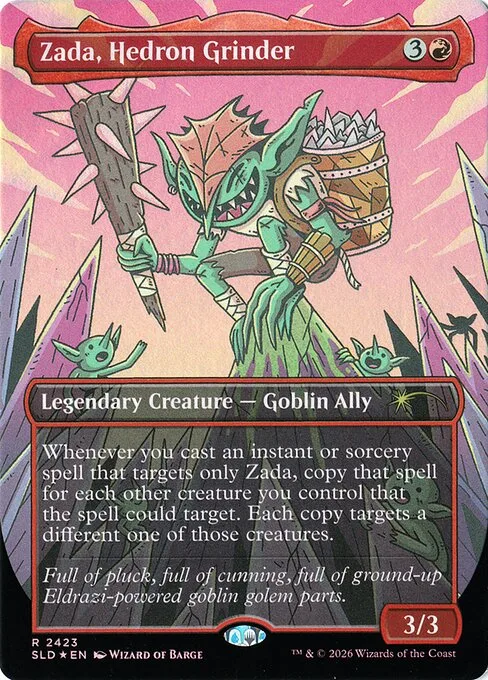 Zada, Hedron Grinder is one of Goblin Storm's three commanders, shown here in its borderless 2026 Secret Lair printing.
The product is useful because it makes the reprint vehicle visible. Wizards did not need to present a random assortment of cards. It could gather cards that make sense to players interested in a recognizable strategy, then sell the strategy as one premium package. That packaging can create demand for cards that were already familiar, cards that fit the theme especially well, and cards whose appeal increases when several pieces arrive together.
Of the 100 cards, 37 feature new artwork. That group includes 22 borderless basic Mountains and 12 borderless foils. Coverage named Broadside Bombardiers, Grapeshot, and Roaming Throne among the cards receiving the treatment. Those details matter for two reasons. First, the product can add new copies or new versions of cards without looking like a plain inventory restock. Second, the collector appeal and the gameplay appeal can arrive in the same release, with different buyers valuing different parts of the package.
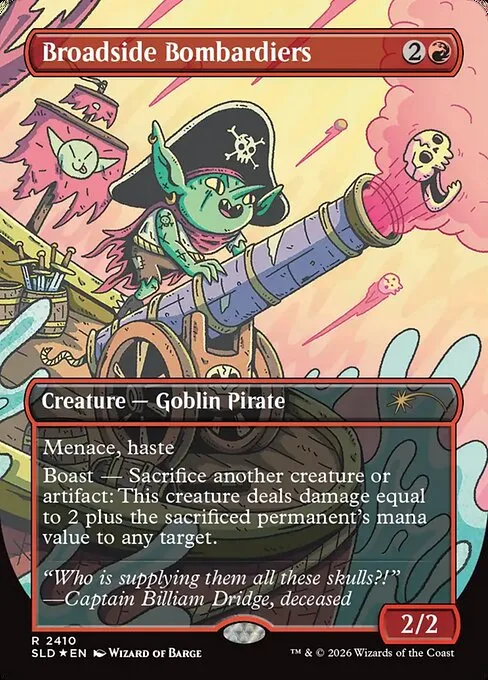 Broadside Bombardiers is one of the 12 borderless foils Goblin Storm used to package new versions of existing cards.
This is what a Secret Lair Commander reprint vehicle actually looks like in practice. A demand story is turned into a tribe-and-mechanic package, the package carries a defined price, and selected cards receive special presentation. The market impact for each included card can differ. A new version may compete with existing copies, attract collectors who did not previously want the card, or shift attention toward the deck as a whole. The result is not a universal price rule. It is a new supply event whose effect depends on the card, the version, and the strength of demand after release.
Goblin Storm is also a useful guardrail against overprediction. It confirms that this type of product exists and that synergy pieces can be included in it. It does not identify the next Secret Lair target. The correct use of the example is to study the mechanism, then apply the same checks to another card without naming that card as a definite future reprint.
GODEEPER: Goblin Storm is also a real Commander precon, built around the same deckbuilding rules covered in the full format guide. MTG Commander Deck Guide: Building, Budget, and cEDH →
1. Check the Reserved List first. Confirm the exact card on the official list before doing any market analysis. If it is on the list, Wizards’ formal commitment creates the hard boundary described above. If it is not, mark the card as eligible for future reprint consideration and continue. “Old” or “expensive” is not a substitute for this check.
2. Measure the recent spike and identify why it happened. Record the market as a dated low-to-high range, not a single listing. Compare that range with an earlier dated range and note whether the move followed a tournament result, a new synergy piece, a format change, or a short hype cycle. A large move without durable demand may be less useful than a smaller move backed by repeat play. The purpose is to understand the demand signal, not to declare a new permanent value.
3. Check recent reprints and current supply. Count the meaningful printings the card has received recently and separate ordinary versions from special treatments where relevant. Multiple recent reprints generally lower near-term risk because demand is already being met with new copies. If the card remains expensive despite those printings, that persistence is useful evidence, but it is still not a guarantee of another product appearance.
4. Test the thematic fit. Ask whether the card belongs naturally in an upcoming or plausible future Secret Lair or Commander theme. Look for a clear tribe, mechanic, color identity, deck role, or audience that can be explained in one sentence. A card that only fits through strained logic is a weak candidate. A card that supports several plausible themes has more possible product paths, but do not turn those paths into a forecast about a named card.
5. State the conclusion as a probability. Write down the evidence and the unknowns. “Higher candidate risk” is a reasonable conclusion when the card is eligible, recently repriced, driven by durable demand, and easy to package. “Lower current risk” can be reasonable after several recent reprints or a weak theme fit. Neither phrase means “will be reprinted” or “will not be reprinted.” Revisit the conclusion when a new printing, tournament result, or product announcement changes the evidence.
What is the Reserved List? A specific, fixed list of Magic cards that Wizards of the Coast has formally pledged never to reprint. A card on the list cannot legally be reprinted under any circumstance, making it the one hard, checkable boundary for reprint risk.
What makes a card a Secret Lair reprint candidate? Three signals together: the card isn't on the Reserved List, it has experienced a recent dated price spike, and there's a clear reason for the new demand, such as a tournament result or a new synergy piece.
What was Secret Lair Commander Deck: Goblin Storm? A real $149.99 Commander precon that released May 18, 2026, led by Zada, Hedron Grinder, Krenko, Mob Boss, and Pashalik Mons. It sold out within an hour and included 37 cards with new artwork, including 12 borderless foils.
Does a recent reprint mean a card is now safe from another one? Not automatically, but it usually lowers near-term risk. Multiple recent printings mean Wizards has already supplied fresh copies to the market, reducing the immediate need for another one.
Is this reprint-risk analysis financial advice? No. This is market commentary based on observable signals like the Reserved List and dated price history, not a recommendation to buy or sell a specific card.
cEDH Staples Guide: Fast Mana, Tutors, and Interaction
12 min read