Loading…
Loading…
BaseMTG · Guides
MTG Commander deck guide covering precon upgrades, budget builds, and cEDH staples. Learn deck ratios, color identity rules, and synergy deck building.

This MTG Commander deck guide covers Magic's most-played format by table count, and precisely because there's no single "best deck," it focuses on process: how to evaluate a commander, how to hit sensible deck ratios, and when a precon upgrade beats a scratch build.
TL;DR: Commander is a 100-card singleton format built around one legendary commander, played at 40 life with 3-4 players per table. A starting deck ratio is roughly 36-38 lands, 10-12 ramp, 8-10 draw, 8-10 removal, and 7-10 win conditions. Precon upgrades are the fastest budget entry point; cEDH sits at the format's high-power extreme, built around fast mana and combo protection rather than casual synergy.
Commander (also called EDH, Elder Dragon Highlander) is a 100-card singleton format built around a legendary creature or planeswalker that can act as your commander. It's most commonly played 3-4 players at a table rather than 1v1, with a starting life total of 40 instead of 20. Power level varies enormously by playgroup, from casual precon-level decks to cEDH tables built entirely around turn-2 and turn-3 combo wins.
Every card in the other 99 has to fit your commander's color identity, which includes hybrid and Phyrexian mana symbols in a card's cost but not symbols that only appear in reminder text. That rule is why a card like Kitchen Finks, with a {G/W}{G/W} hybrid cost, counts as both green and white for identity purposes even though a single copy is only ever cast for one or the other, while a card whose only colored symbol shows up inside italicized reminder text doesn't add that color at all.
A typical Commander deck starts from a rough skeleton before any synergy gets layered on: 36-38 lands, 10-12 pieces of mana ramp, 8-10 card draw or card advantage effects, 8-10 pieces of removal or interaction, and 7-10 actual win conditions. That skeleton flexes based on curve and color count. A three- or four-color deck usually wants more fixing lands and ramp than a mono-color deck does, and a deck with a genuinely low curve can trim a land or two in favor of another spell.
Wizards of the Coast ships new Commander precons alongside most major sets, and they're the fastest on-ramp into the format: a working mana base, a coherent game plan, and a legal 100-card deck out of the box. Upgrading one usually means cutting the weakest 10-15 filler cards (often undersized creatures with no synergy) for cards that support the deck's actual plan, plus adding a handful of format staples like cheap ramp and interaction.
About the author

Commander & Standard Deck Analyst
Commander and cEDH grinder covering deckbuilding, precons, and the Standard/Commander metagame. Plays out of a local game store scene, reads spoilers the day they drop.
Disclaimer
This article is published for informational and entertainment purposes. It does not constitute professional financial, legal, or technical advice. Game performance, online services, patch schedules, and store listings change. Verify critical details (pricing, system requirements, regional availability) with publishers and storefronts before you buy. Affiliate links, where present, help support our editorial work and are labelled in our affiliate disclosure.
cEDH decks are built around generically powerful cards that work across many different commanders, not around one commander's specific synergy: fast mana, efficient tutors, and cheap interaction that protects a combo from being disrupted. If a casual deck's power ceiling is "this creature gets very big," a cEDH deck's power ceiling is closer to "this combo wins the game from an empty board on turn 3."
Between casual precon-level and cEDH sits most of the format: decks built around a specific synergy (tribal creature types, a keyword mechanic, a card-type theme) chosen because it's what the commander rewards. A well-built synergy deck often outperforms a deck of "generically good cards" at the same budget, because every card is doing double duty toward the same plan.
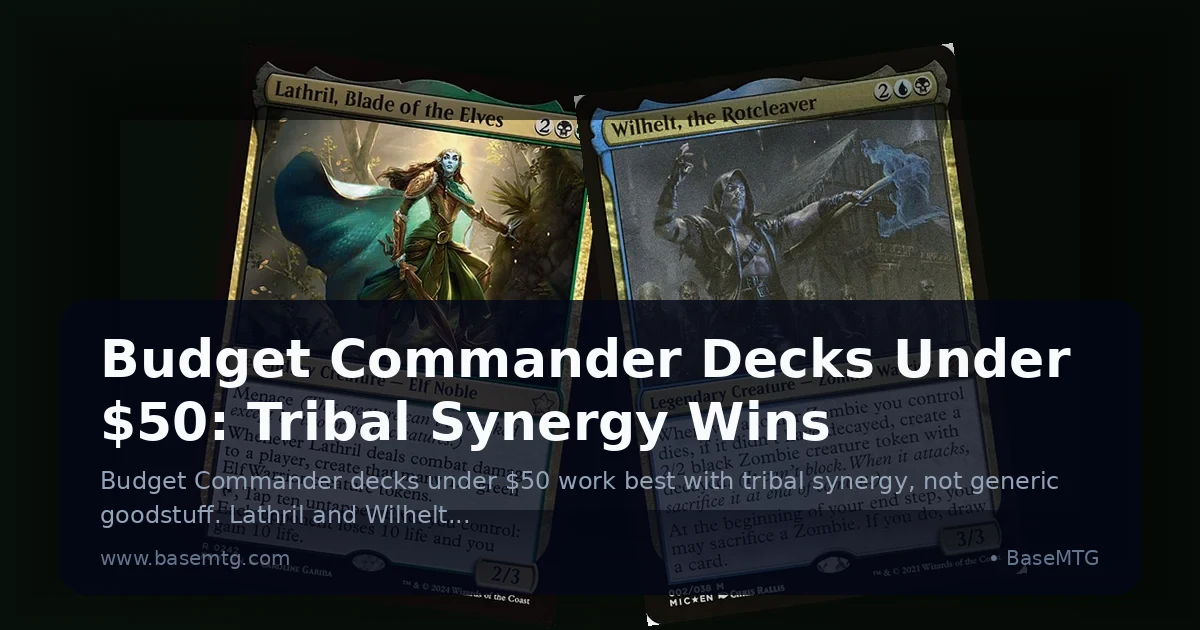
Tribal synergy is one of the most budget-friendly ways to build this way: a commander like Lathril, Blade of the Elves rewards a deck built almost entirely around one creature type, so cheap, on-theme commons and uncommons from a dozen different sets can slot in for a few cents each and still pull real weight. A combo-oriented commander instead wants fewer, more specific pieces: the deck cares less about raw card count in the theme and more about protecting the handful of cards that actually assemble the combo.
How many cards are in a Commander deck? Exactly 100 cards total, including your commander. It's a singleton format, so outside of basic lands you can only run one copy of any given card by name, unlike Standard's 4-copy limit.
What is a good Commander deck ratio? A common starting ratio is 36-38 lands, 10-12 ramp pieces, 8-10 card draw effects, 8-10 removal spells, and 7-10 win conditions. Adjust down on lands if your ramp count is high, and up if your curve runs expensive.
What does color identity mean for Commander deck building? Every card in your 99 must only use mana symbols that also appear somewhere on your commander, including in reminder text, not just its casting cost. A card with zero colored symbols (most artifacts and colorless spells) fits any commander.
What is cEDH? Competitive EDH: Commander played at maximum power level, built around fast combos and efficient interaction rather than casual synergy themes. cEDH staples get reused across many different commanders because they're generically powerful, not because they fit one specific deck's theme.
Should I upgrade a Commander precon or build from scratch? Upgrading a precon is the faster, cheaper way to a functional deck: the mana base and core game plan already work, so you're mainly swapping weak filler cards for stronger synergy pieces. Building from scratch gives more control but costs more time and money to reach the same power level.