Loading…
Loading…
BaseMTG · Guides

Reviewing
Magic: The Gathering
Most mana-base advice starts with a number, then treats that number like a law. A better MTG mana base guide starts with your deck's curve, uses the math behind that curve, and then handles color requirements as a separate problem.
TL;DR: For a 60-card deck, Frank Karsten's starting point is 19.59 + (1.90 x your deck's Average Mana Value), which you round to a practical land count. That usually puts aggro near 17 lands, midrange near 24, and control around 25-27, because those archetypes generally have different curves. Commander starts around 37-40 lands plus 10-12 dedicated ramp spells, while Limited commonly starts at 17 lands.
For a 60-card constructed deck, start around 17 lands for aggro, 24 for midrange, or 25-27 for control, then adjust for the deck's actual curve. The more useful answer comes from Frank Karsten's formula: 19.59 + (1.90 x Average Mana Value), rounded to a sensible whole number.
Those archetype numbers are starting points, not deckbuilding commandments. An aggressive deck that intends to spend most of the game casting cheap spells can function with fewer lands than a control deck that needs to keep making land drops and cast expensive spells. The land count should describe what your deck is trying to do, not what a deck with a similar label usually does.
This is also why a mana base has two jobs that shouldn't be mixed together. The first question is how many lands you need. Your curve, represented by Average Mana Value, drives that number. The second question is which colors those lands need to produce. The colored mana symbols, or pips, in your spells drive that calculation. A deck can have the right total number of lands and still fail because it can't make the right color at the right time.
For a first pass, calculate the land count from the whole nonland section, look at the shape of the curve, and then review the colored costs of the spells you expect to cast early. If the deck is consistently missing land drops, add a land or reconsider the curve. If it has lands in hand while the spells are cheap, trim carefully. Test games will tell you whether the theoretical number fits the deck's actual play pattern.
Frank Karsten, a Magic Pro Tour Hall of Famer, developed the most respected mathematical approach to land count. For a 60-card deck, the base land requirement is:
19.59 + (1.90 x Average Mana Value)
Average Mana Value, or AMV, is simpler than it sounds. Add the mana value of every nonland card in the deck, then divide that total by the number of nonland cards. Lands don't enter that average because they don't have a mana value in the same way spells and permanents do. The result gives you a useful description of how much mana the deck's spells generally ask for.
Here's the formula worked through with a deck whose Average Mana Value is 2.8:
19.59 + (1.90 x 2.8)
= 19.59 + 5.32
= 24.91
That comes to about 25 lands after rounding. The calculation is more defensible than saying every deck should run a fixed number because it connects the land count to the cards you actually want to cast.
Treat the result as a base requirement, not a command to copy without thinking. A deck with an AMV of 2.8 can still want a different final number if its spells have unusual timing requirements, if it uses a substantial amount of mana acceleration, or if its plan changes how long it needs to keep making land drops. The formula gives you a grounded starting point. The deck's play pattern tells you how to finish the job.
 Every mana base starts with basic lands like this Forest, the simplest possible single-color source.
GODEEPER: Color identity determines which lands and colored spells a Commander deck can even run. MTG Color Identity Explained: Hybrid and Phyrexian Mana →
Was this guide helpful?
About the author

Commander & Standard Deck Analyst
Commander and cEDH grinder covering deckbuilding, precons, and the Standard/Commander metagame. Plays out of a local game store scene, reads spoilers the day they drop.
Disclaimer
This article is published for informational and entertainment purposes. It does not constitute professional financial, legal, or technical advice. Game performance, online services, patch schedules, and store listings change. Verify critical details (pricing, system requirements, regional availability) with publishers and storefronts before you buy. Affiliate links, where present, help support our editorial work and are labelled in our affiliate disclosure.
For a 60-card deck, the familiar archetype ranges line up reasonably well with the Karsten formula:
Aggro decks usually have the lowest curve. They want to deploy threats early, spend mana efficiently, and end the game before they need to cast many expensive cards. That low AMV is why an aggro list can start with a lower land count. It isn't that aggro decks somehow need less mana. They need less total mana in the cards they plan to cast.
Midrange decks sit in the middle because their plan asks them to use mana across more stages of the game. They need early plays, but they also expect to cast larger threats, removal, and value pieces later. Around 24 lands is a useful starting range for that shape of deck, with the final number depending on the actual list.
Control decks generally run the most lands of the three. They need to continue making land drops while holding up interaction, and their curve often includes more expensive answers, card advantage, or finishers. A control deck that stops developing its mana can fall behind even when it has the right spells in hand, which is why the 25-27 range makes sense as a starting point.
These numbers aren't three competing doctrines. They're shorthand for three common curve profiles. A low-curve midrange deck may land closer to the aggro end, while a spell-heavy aggro deck with expensive top-end cards may need more. Use the formula to identify the baseline, then ask what the deck needs to do on the turns when its plan is supposed to work.
Commander is a 100-card singleton format, so its mana base needs a different starting point. For a normal precon-power-level deck, aim for roughly 37-40 lands and 10-12 dedicated ramp spells. Ramp effectively acts like extra lands by helping you produce more mana, but it shouldn't be treated as a reason to cut lands without considering the deck's curve and game plan.
That land count is proportionally higher than the usual 60-card constructed ranges even when the average curve looks similar. Commander games are multiplayer and tend to run longer, so you need to keep hitting land drops for more turns. You also have to develop a mana engine that can support your own plan while multiple opponents are still presenting threats. Missing an early land drop can leave you behind for a long stretch of the game.
The 10-12 ramp spells provide another way to advance your mana, but they don't all play the same role as lands. A ramp spell may need a particular color, may be vulnerable to interaction, or may compete with another spell you wanted to cast that turn. Lands are the stable foundation, while ramp accelerates the deck after that foundation is in place.
An Average Mana Value around 2.5-3.5 is a useful target for a normal precon-power-level Commander deck. That range isn't a promise that every list in it will run smoothly. A deck near the lower end may be built to pressure the table quickly, while a deck near the upper end may be relying on ramp and powerful late-game plays. Look at the entire curve, including how much mana the commander and the key payoff cards require.
A fast, low-curve aggressive Commander deck can use a lower land count than that general starting range, assuming its spells and ramp support the plan. A big-mana deck built around ramp payoffs usually wants more lands, not fewer, because it needs to cast both the acceleration and the expensive cards that acceleration is meant to support. The same principle from 60-card deckbuilding still applies: the plan determines the final number.
Singleton construction also makes consistency matter. You can't rely on many copies of one ideal mana card appearing every game, so the full collection of lands, ramp, and fixing needs to work together. When tuning a Commander list, check whether your opening hands can make the colors you need, whether your land drops keep pace with your spells, and whether your ramp is helping the deck do its actual job.
Count the colored mana symbols, or pips, in the spells you expect to cast in your first several turns. Build your land colors roughly in proportion to those pip demands, not simply in proportion to how many cards of each color you play. Then check that your key early plays can be cast on time.
This is a separate calculation from total land count. First decide how many lands the curve calls for. Then examine the colored costs of the spells, with special attention to the cards you need early. A color that appears on many cards may not need the largest share of your mana if those cards mostly use generic mana. A color that appears on fewer cards can still need strong support if its important spells ask for multiple pips.
Think about pip pressure, not just card counts. One colored symbol creates a different requirement from a spell that asks for several symbols of the same color. Early double-pipped spells are particularly important because they can determine whether a hand that has lands can actually cast its first meaningful play. Your most important early cards should shape the color balance more than cards you expect to cast only after the game has developed.
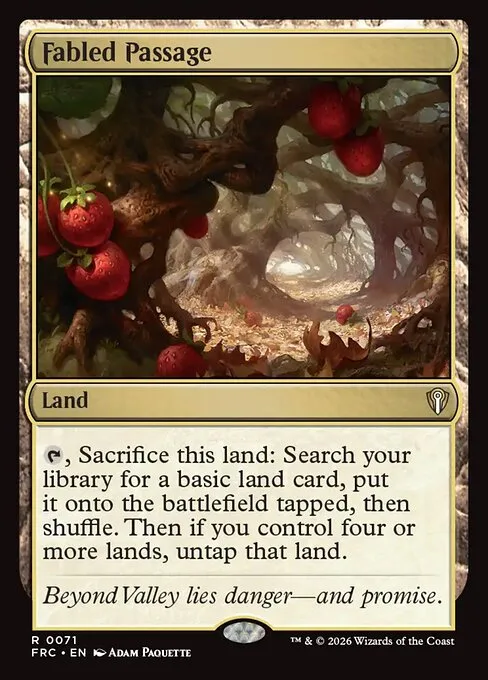 A fixing land like Fabled Passage can cover more than one color requirement, unlike a basic land.
The lands themselves matter too. A basic land produces one color, while a fixing land may cover more than one requirement. That flexibility can make a multicolor mana base more functional, but it doesn't erase the need to review which colors are available at each point in the game. Lands that produce colorless mana or have utility text still occupy slots that could have supplied a needed color.
Color balance should also reflect sequencing. If the deck has an early spell in one color and a later payoff in another, the important question is whether the mana base supports the early play without making the later spell unrealistic. Make a short list of the spells you most want to cast in the first several turns, count their pips by color, and use that list to challenge your initial land mix.
Avoid assuming that the number of cards in each color tells you the right number of colored sources. Cards can have different costs, different timing, and different importance to the plan. The pip count gives you a better starting signal, but you still need to look at the actual lands, the order in which the deck wants to cast spells, and any colorless requirements.
GODEEPER: Fast mana and mana rocks can substitute for some of your land count once your curve calls for acceleration. cEDH Staples Guide: Fast Mana, Tutors, and Interaction →
1. Calculate your Average Mana Value. Add up the mana value of every nonland card in your deck, then divide by the number of nonland cards. This single number drives your base land count through the Karsten formula.
2. Apply the Karsten formula. Plug your AMV into 19.59 + (1.90 x AMV) for a 60-card deck, or use the archetype ranges (17 aggro, 24 midrange, 25-27 control) as a faster approximation if your curve fits one of those shapes.
3. Count your colored pips separately. List the spells you expect to cast in your first several turns and count how many symbols of each color they need. This number, not your total card count per color, should drive your land color split.
4. Adjust for format. If you're building Commander, start from 37-40 lands plus 10-12 ramp spells instead of the 60-card ranges, since multiplayer games run longer and need sustained land drops.
5. Test and refine. Play real games and track whether you're missing land drops, flooding on lands, or unable to cast your key spells on curve. Adjust the count or color split based on what actually happens, not just the math.
How many lands should a 60-card Magic deck run? Use Frank Karsten's formula: 19.59 + (1.90 x your deck's Average Mana Value). This typically lands around 17 for aggro, 24 for midrange, and 25-27 for control, depending on your actual curve.
How many lands does a Commander deck need? Roughly 37-40 lands plus 10-12 dedicated ramp spells for a normal precon-power-level deck. Commander games run longer and are multiplayer, so you need to keep hitting land drops for more turns than a 60-card deck does.
What is Average Mana Value? The total mana value of every nonland card in your deck divided by the number of nonland cards. It's the key input to Frank Karsten's land count formula.
How do I decide how many lands of each color to run? Count the colored mana symbols, or pips, in the spells you expect to cast in your first several turns, and weight your land colors proportionally to that pip count, not to how many cards of each color you're running.
Does ramp count as extra lands? Functionally, ramp spells act like extra mana sources, but they aren't a full replacement for lands. They can be answered by interaction, and they still need to be cast, so they should be added on top of a solid land base, not instead of one.

Standard Metagame Tier List: Top 3 Decks (Sept 2026)
11 min read