Loading…
Loading…
BaseMTG · Guides
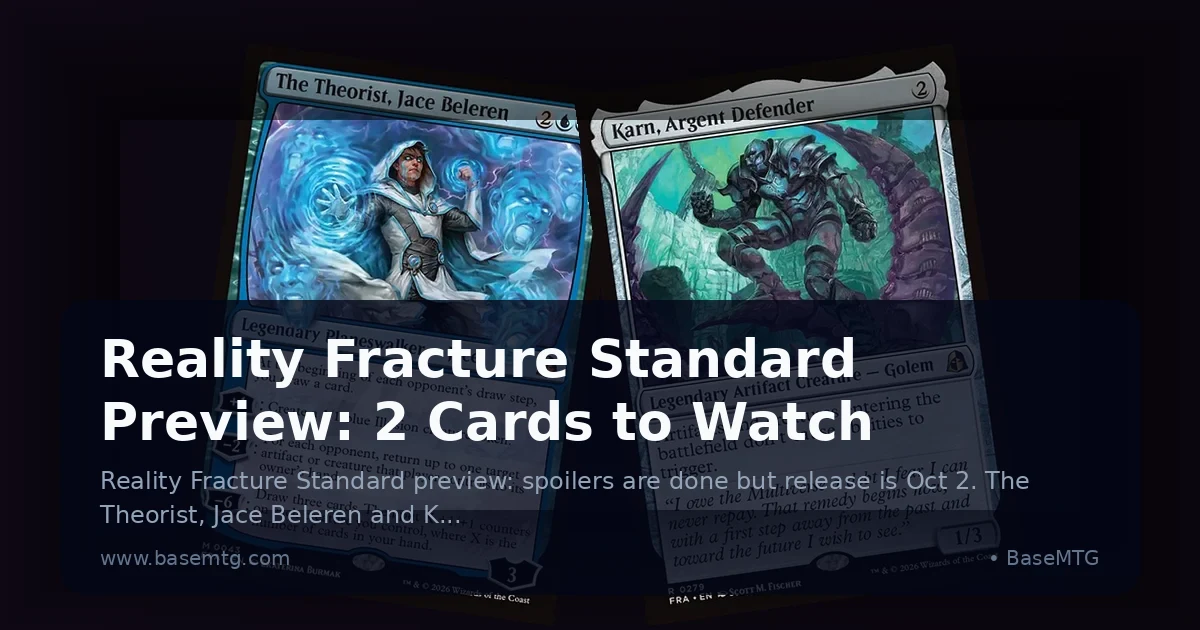
Reality Fracture Standard preview: spoilers are done but release is Oct 2. The Theorist, Jace Beleren and Karn, Argent Defender lead the early watch list.
Reviewing
Magic: The Gathering
This Reality Fracture Standard preview covers a useful but awkward spot for Standard players. The full spoiler is public, yet the set won't be legal or on paper shelves until October 2, which leaves enough information for real analysis but no tournament results to hide behind.
TL;DR: Reality Fracture releases on October 2, 2026, with digital release on MTG Arena and Magic Online expected on September 29. Spoilers ran from September 8 through September 17, so this is the rare window where the spoiler season is over but the set itself hasn't arrived. The two confirmed cards drawing the most Standard attention are The Theorist, Jace Beleren and Karn, Argent Defender.
Reality Fracture releases in paper on October 2, 2026, with digital release on MTG Arena and Magic Online expected on September 29. Spoiler season ran from September 8 through September 17, so the full spoiler is already complete even though the set isn't legal or on shelves yet.
About the author

Commander & Standard Deck Analyst
Commander and cEDH grinder covering deckbuilding, precons, and the Standard/Commander metagame. Plays out of a local game store scene, reads spoilers the day they drop.
Disclaimer
This article is published for informational and entertainment purposes. It does not constitute professional financial, legal, or technical advice. Game performance, online services, patch schedules, and store listings change. Verify critical details (pricing, system requirements, regional availability) with publishers and storefronts before you buy. Affiliate links, where present, help support our editorial work and are labelled in our affiliate disclosure.
Reality Fracture Commander Preview: Colorshifted Cards
Guides · 11 min
Most set coverage falls into one of two buckets. During spoiler season, writers report cards as they appear, often before the shape of the set is clear. After release, set reviews can lean on actual games, draft data, league results, and tournament lists. Reality Fracture lands between those stages. We know all 461 cards, but we don't know which cards survive contact with the existing format.
That distinction matters because this isn't a normal fresh-start Standard environment. Reality Fracture is the closing chapter of the three-year Metronome story arc, built around a "What If?" alternate-universe premise involving Jace Beleren and the Echoverse, a copy of the Multiverse with its worst chapters edited out. The story may explain the set's identity, but the competitive question is more practical: what earns space in a format that isn't rotating?
Standard has no rotation in 2026. FRA therefore adds to an 18-set-legal pool instead of replacing an older block of cards. A new card has to compete with established mana bases, familiar interaction, and lists that have already received weeks or months of tuning. That makes the pre-release window valuable. We can identify likely pressure points, but we shouldn't pretend that a compelling text box is a result.
This is why the right format is a preview, not a verdict. We can move past announcement headlines and examine roles, but no Reality Fracture card has tournament data yet. Any tier, deck share, or win-rate claim would be invented. The useful question is what each confirmed card asks of a deck and whether the existing field rewards that request.
GODEEPER: The current Standard tier list is the baseline for judging where new Reality Fracture tools might fit. Standard Metagame Tier List: Top 3 Decks (Sept 2026) →
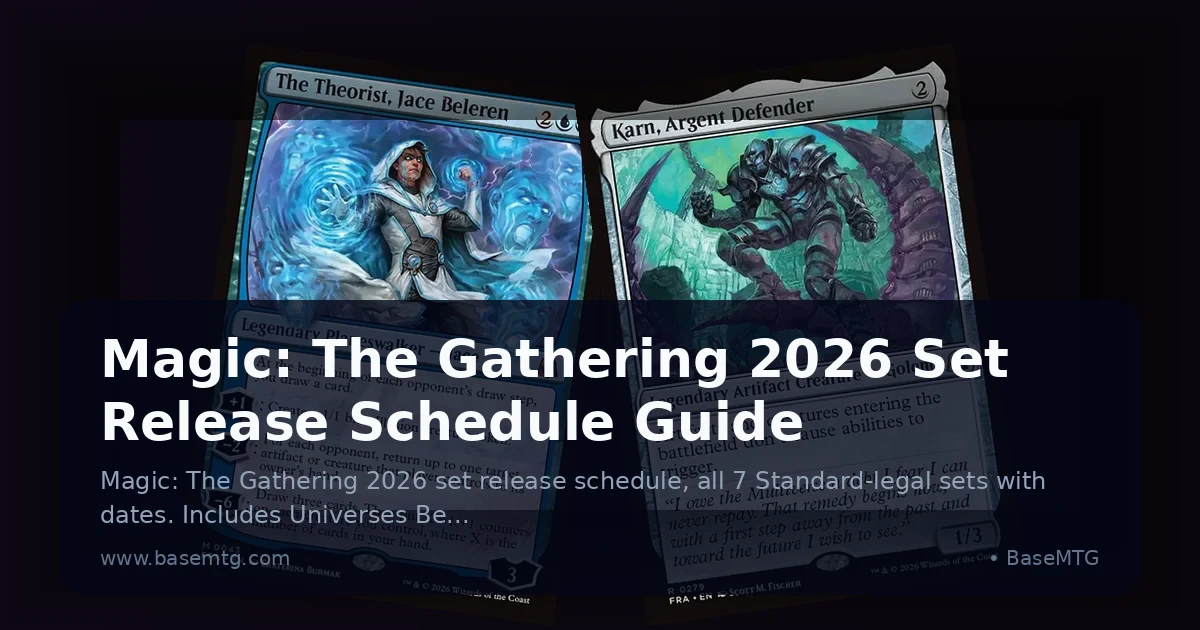
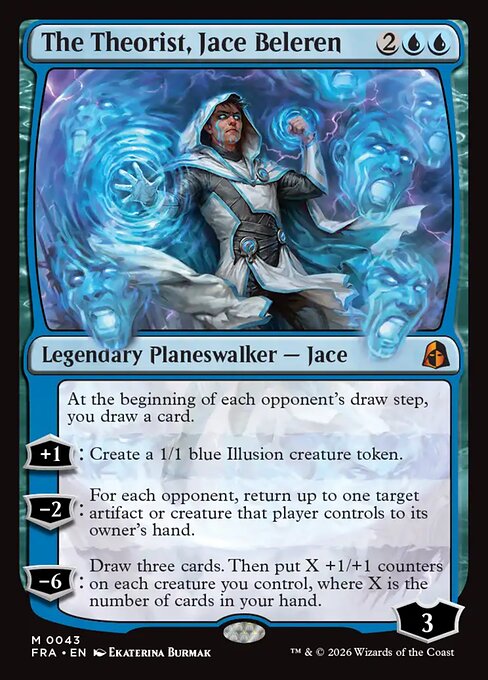 fra-43fra-43Shop on TCGplayer The Theorist, Jace Beleren is a Planeswalker that costs {2}{U}{U}. It has a powerful static ability plus card-advantage effects, which gives us a clear way to evaluate it without pretending we know more of the Oracle text than the preview confirms. Pre-release speculation: Jace is asking a deck to invest four mana in a permanent that can shape the game immediately and keep producing value if it stays in play.
Pre-release speculation: That profile makes The Theorist look like a control value engine rather than an automatic inclusion in every blue deck. Four mana and two blue mana symbols are meaningful commitments in a format with no rotation. A control deck can accept that commitment if Jace's static ability changes the opponent's normal plan and the card-advantage effects keep the exchange favorable. A deck that only wants a cheap answer or a temporary tempo play may not have the same incentive.
Pre-release speculation: Creature-light Izzet Spellementals is the clearest existing matchup to watch. Analysts already see The Theorist as potentially good against that archetype because a creature-light opponent may give a Planeswalker more room to generate value than a board-heavy deck would. That isn't the same as saying Jace automatically beats Izzet Spellementals. The matchup will depend on whether the Izzet deck can pressure the four-mana investment, answer the permanent efficiently, or force the controller to spend its cards before the value engine matters.
Pre-release speculation: Four-Color Control is the other natural home to test. The appeal is straightforward: a broad control shell can potentially use The Theorist's static ability and card-advantage effects as a source of sustained material while its other spells handle whatever the opponent presents. The risk is also straightforward. Four-Color Control already has to justify its colors, its curve, and every non-answer in a long game. Jace will need to improve those structural decisions, not merely add another attractive way to spend four mana.
For now, the responsible conclusion is limited. Pre-release speculation: The Theorist has a credible control identity and a particularly interesting matchup angle against creature-light Izzet Spellementals. It also has a plausible value-engine role in Four-Color Control. Neither observation establishes a tier placement. Until the set is legal, Jace is a candidate for testing, not a proven Standard staple.
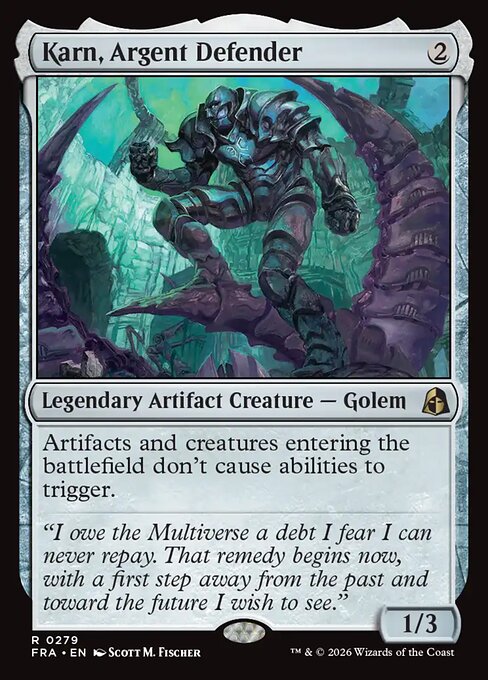 fra-279fra-279Shop on TCGplayer Karn, Argent Defender is a colorless Legendary Artifact Creature that costs {2}. Its defining competitive feature is that it shuts down creature and artifact enters-the-battlefield triggers. Pre-release speculation: That is a compact answer to a broad class of effects, and it gives Karn a much clearer job than many speculative preview cards have.
Pre-release speculation: The two-mana cost is the first reason Karn could matter in Standard. A card that comes down early can affect the opponent before their engine has generated its first return. The colorless identity is the second reason. Karn isn't asking a deck to add another colored source, though every deck still has to decide whether a colorless creature belongs in its curve and whether the effect is relevant often enough to justify the slot.
Pre-release speculation: Karn's appeal may extend beyond Standard, which is why analysts see multi-format potential. The ability is narrow when the opponent doesn't rely on creature or artifact enters-the-battlefield triggers, but it becomes much more meaningful when those triggers are central to a deck's plan. That creates a familiar tension: a powerful hate effect can be excellent in the right pairing and underwhelming when the metagame moves away from the thing it answers.
Pre-release speculation: Test Karn matchup by matchup. Compare games where its shutdown ability matters with pairings where it has little text. If the body remains acceptable in weaker cases, it may have a broader role; otherwise, it may be a targeted option. We don't know yet.
Pre-release speculation: Reality Fracture's first impact will be measured against existing decks, not an immediate replacement of the current field. Mono-Green Landfall, Dimir Midrange, and Izzet Spellementals provide three different tests, and the lack of rotation means they remain the baseline that FRA must beat or reshape.
Pre-release speculation: Against Mono-Green Landfall, The Theorist's biggest question is whether a four-mana Planeswalker can survive the deck's development pattern. If Mono-Green Landfall can keep presenting meaningful pressure, Jace may need a control shell with enough early support to make the investment safe. If the matchup slows down and the game reaches a stage where card advantage decides the exchange, The Theorist could become more attractive. That is a matchup hypothesis, not a prediction of a favorable record.
Pre-release speculation: Karn's role against Mono-Green Landfall is even more dependent on the exact games. If the deck's important turns rely on creature enters-the-battlefield triggers, Karn could interfere with those turns while arriving early enough to matter. If the deck's pressure comes from other parts of its plan, the same ability may not justify a slot. The full spoiler tells us what Karn does, but only playtesting can show how often that text lines up with the green deck's actual draws.
Pre-release speculation: Dimir Midrange presents a different problem. It can make a value engine prove itself while applying pressure of its own, and it can punish a control deck that spends a turn on a permanent without gaining enough back. The Theorist may be most interesting here as a card that forces Dimir to respect a longer game, but it may also be vulnerable to the archetype's ability to trade resources efficiently. The question isn't simply whether Jace generates cards. It's whether those cards arrive soon enough and whether the Planeswalker changes the exchange before Dimir has converted its pressure into a winning position.
Pre-release speculation: Karn against Dimir Midrange is likely to be a more conditional test. If the deck's threats and artifacts depend on enters-the-battlefield triggers, shutting those triggers down could make Karn an efficient disruption piece. If its plan is mostly built around other forms of interaction and pressure, Karn may be a two-mana creature with an ability that doesn't affect the relevant game. That makes the matchup a useful way to measure the ceiling and the floor of the card.
Pre-release speculation: Izzet Spellementals is the cleanest place to compare the two designs. The Theorist could have a natural role if the creature-light version of the archetype gives a control Planeswalker room to operate. Karn's relevance depends on a separate condition: whether the Izzet deck's key creature or artifact enters-the-battlefield triggers are important enough for its shutdown ability to matter. Those are different kinds of pressure. Jace may ask the opponent to answer a growing source of advantage, while Karn may ask the opponent to play through a rule change.
The 18-set pool keeps the standard high. Pre-release speculation: Established options may already do these jobs well, so both cards need to offer something at a lower cost or with fewer deckbuilding demands.
That is the honest Reality Fracture preview as of September 22. The spoiler is complete, the release date is close, and these two confirmed cards give Standard players real testing hypotheses. But there are no results yet. Pre-release speculation: The Theorist, Jace Beleren may become a notable control engine, and Karn, Argent Defender may become a flexible answer with appeal outside Standard. Whether either claim survives the first weeks of play is exactly what the release window is for.
GODEEPER: For the full 2026 release schedule this set fits into, see the set-by-set breakdown. Magic: The Gathering 2026 Set Release Schedule Guide →
When does Reality Fracture release? October 2, 2026 in paper. Digital release on MTG Arena and Magic Online is expected September 29, a few days earlier. Spoiler season already ran September 8 through 17, so the full set is known ahead of release.
Is The Theorist, Jace Beleren good in Standard? It's too early to say for certain since the set hasn't released. Pre-release speculation points to it as a control value engine, with creature-light Izzet Spellementals and Four-Color Control as the most-cited early testing grounds.
What does Karn, Argent Defender do? It's a colorless two-mana Legendary Artifact Creature that shuts down creature and artifact enters-the-battlefield triggers. Analysts see multi-format appeal, though its Standard relevance depends on how much the format leans on those triggers.
Why does 2026's no-rotation format matter for Reality Fracture? New cards have to earn a slot in an 18-set-legal pool instead of replacing a rotated-out block. That raises the bar for any Reality Fracture card competing against the format's established Mono-Green Landfall, Dimir Midrange, and Izzet Spellementals shells.
Are these Standard predictions confirmed? No. Every playability claim in this article is explicitly pre-release speculation. No tournament data exists yet since the set hasn't released, and any specific win rate or tier claim before real games are played would be fabricated.
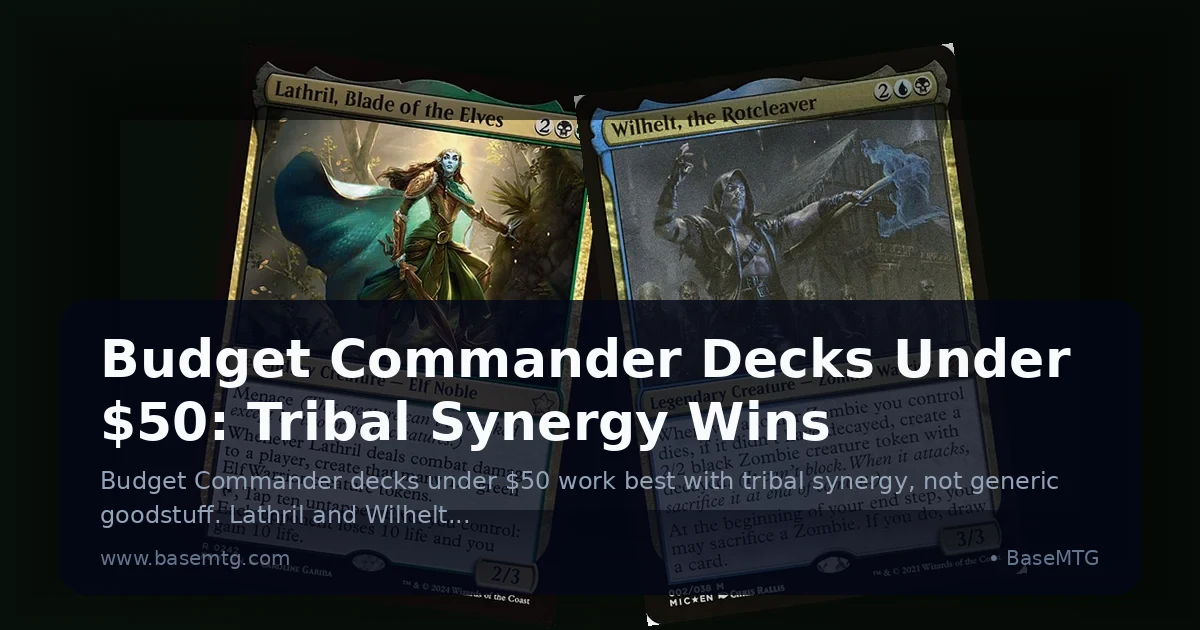
Budget Commander Decks Under $50: Tribal Synergy Wins
12 min read