Loading…


BaseMTG · Guides
Reality Fracture Commander Preview: Colorshifted Cards
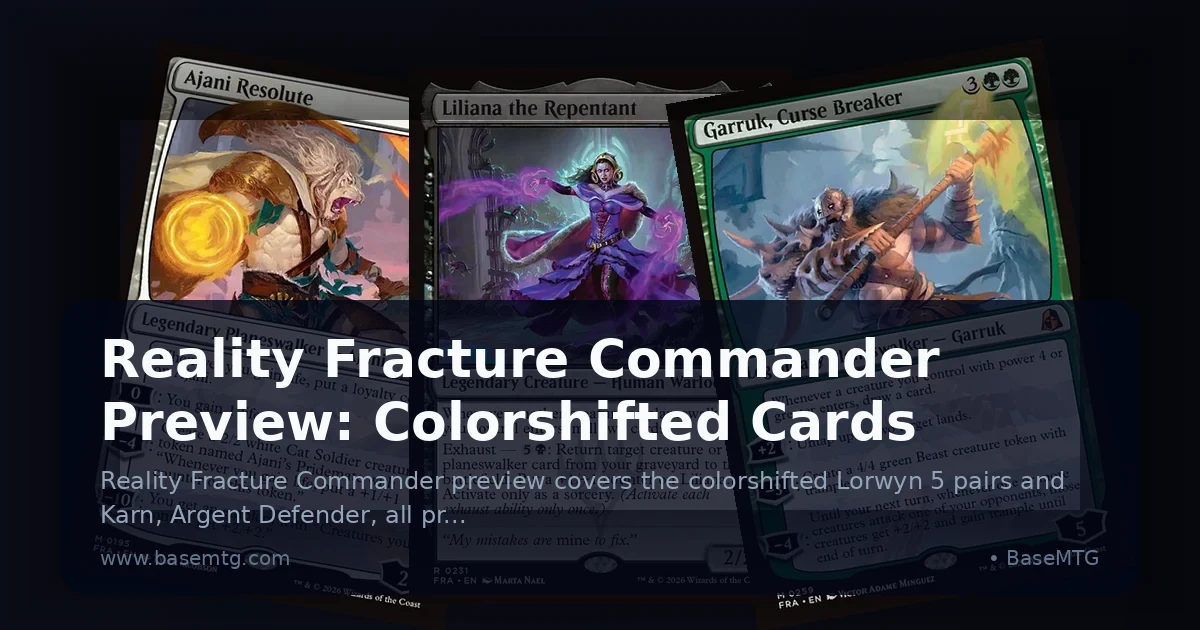
Reality Fracture Commander preview covers the colorshifted Lorwyn 5 pairs and Karn, Argent Defender, all pre-release speculation until the set is out.
11 min readBy Reid Marsh
Reviewing
Magic: The Gathering
This Reality Fracture Commander preview arrives ahead of the set's October 2, 2026 release, and the most interesting angle to examine isn't a routine list of likely staples. The set's unusual experiment is a group of colorshifted pairs from the Lorwyn 5, backed by Karn, Argent Defender, a two-mana colorless Legendary Artifact Creature that asks a very different question about how decks use enters-the-battlefield triggers.
TL;DR: Reality Fracture's colorshifted-pair gimmick puts alternate-universe versions of familiar characters beside versions closer to their classic identities. Most of these pairs are planeswalkers, but the Liliana pair is printed as Legendary Creatures instead. That means deckbuilders have to evaluate the actual card's color identity and text instead of using a famous name as a shortcut. Karn, Argent Defender is a {2} colorless Legendary Artifact Creature that shuts down creature and artifact enters-the-battlefield triggers, but any Commander verdict remains pre-release speculation until the set is available and these cards have been played.
Key Takeaways
- Reality Fracture, set code FRA, releases on October 2, 2026, after a spoiler season that ran from September 8 through September 17.
- In this set, "colorshifted" means an alternate-universe version of a character is printed in different colors from that character's classic identity.
- The confirmed Lorwyn 5 pairs are Ajani Resolute and Ajani Unrelenting, Liliana the Repentant and Liliana the Faultless, and Garruk, Curse Breaker and Garruk, Veiled Butcher.
- Pre-release Commander speculation: each pair could be worth evaluating as two separate cards, because the character name doesn't tell you which decks can legally play either version or what role the card will fill.
- Pre-release Commander speculation: Karn, Argent Defender could matter as a flexible colorless card in the 99 or as a possible build-around, but the final text and actual play patterns will decide that.
What Are Reality Fracture's Colorshifted Pairs? (quick answer)
Here, "colorshifted" means the alternate-universe version of a familiar character is printed in different colors from that character's classic identity, reflecting Reality Fracture's alternate-timeline premise. The three confirmed pairs are Ajani Resolute with Ajani Unrelenting, Liliana the Repentant with Liliana the Faultless, and Garruk, Curse Breaker with Garruk, Veiled Butcher. For pre-release Commander evaluation, the important point is that each name represents an actual card to read on its own, not a promise that both versions belong in the same kinds of decks.
GODEEPER: Color identity is the first filter for any card you consider as a build-around or commander. MTG Color Identity Explained: Hybrid and Phyrexian Mana →
The Lorwyn 5 Colorshifted Pairs, Explained
Most of these colorshifted pairs are planeswalkers, but not all of them: the Liliana pair is printed as Legendary Creatures instead, which matters for Commander since a legendary creature can potentially serve as a commander in a way a planeswalker generally cannot. The gimmick makes more sense in the story context. Reality Fracture centers on Jace Beleren and the Echoverse, a copy of the Multiverse with its worst chapters edited out. The set also closes the three-year Metronome arc, so the alternate versions aren't appearing in a vacuum. They belong to a world built around revision, omission, and the question of what changes when a familiar history is rewritten.
That framing gives the colorshifted planeswalkers a useful job. They aren't simply new treatments of old characters, and the term doesn't describe a new deckbuilding rule. It describes a version of a character whose colors have changed because the timeline has changed. A colorshifted card can still look familiar at a glance, but its legal home, mana requirements, and strategic role must come from the printed card in front of you.
Ajani Resolute and Ajani Unrelenting
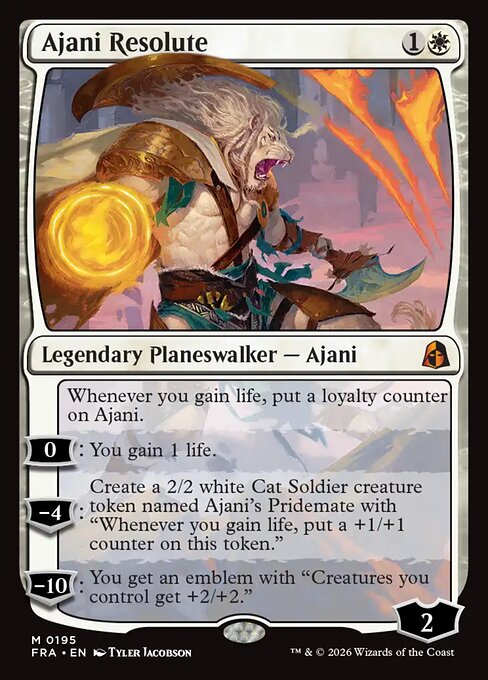 fra-195fra-195Shop on TCGplayer Ajani Resolute facing
 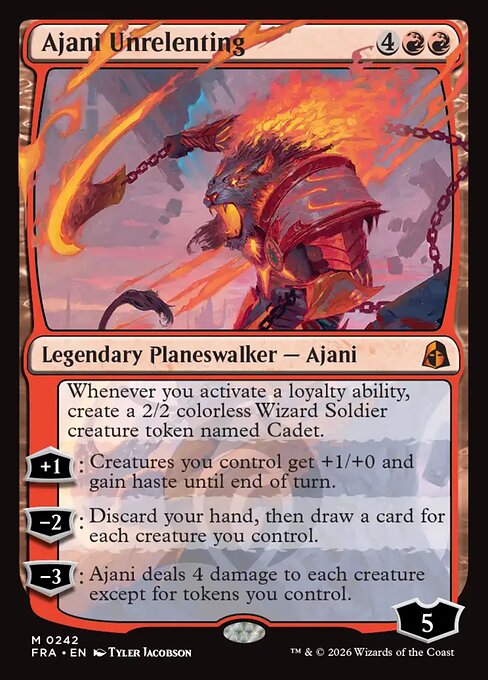 fra-242fra-242Shop on TCGplayer Ajani Unrelenting is the cleanest introduction to the idea. Both names point to the same well-known character, but the pair tells you not to assume that recognition is enough. The adjectives create a contrast for the set's alternate-world story, while the actual cards will determine whether that contrast is expressed through colors, costs, abilities, or some combination of those elements.
That distinction matters most when a player is looking at a planeswalker as a potential build-around. A familiar character name can make it tempting to start with an old Ajani deck, an old Ajani evaluation, or an assumed color identity. That approach skips the information Reality Fracture is trying to foreground. Read Ajani Resolute and Ajani Unrelenting as independent cards first, then ask how each one fits the decks that can legally include it.
Pre-release Commander speculation: the two Ajanis could be worth evaluating for different shells even though they share a character, but there isn't enough verified information to call either one a staple, a commander, or a replacement for another Ajani. The useful comparison will come from their full text and color identity after release, not from the names alone.
Liliana the Repentant and Liliana the Faultless
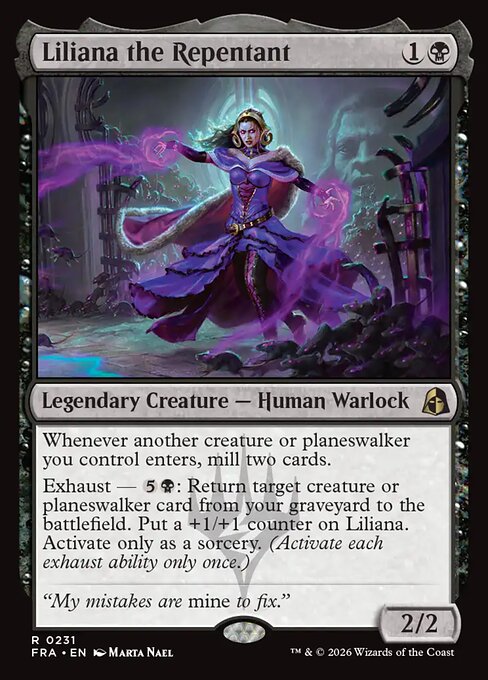 fra-231fra-231Shop on TCGplayer Liliana the Repentant and
 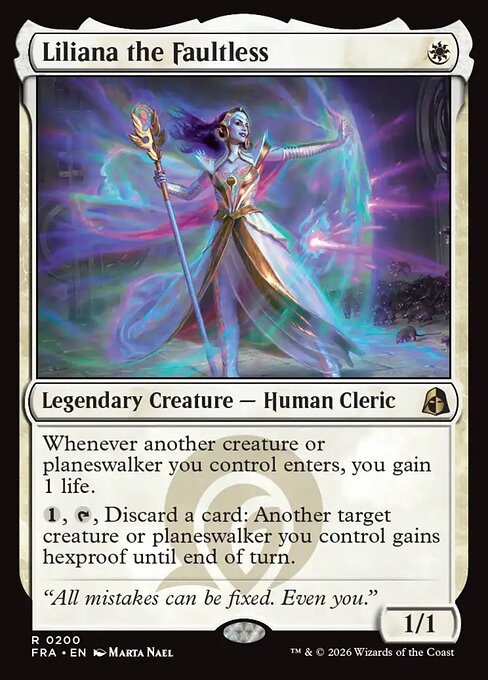 fra-200fra-200Shop on TCGplayer Liliana the Faultless push the same concept through a different pair of labels, with one structural difference from the two Planeswalker pairs: both Lilianas are printed as Legendary Creatures, not Planeswalkers. That means either one is a candidate to be evaluated as a commander in its own right, not just as a card for the 99. The names suggest a version of Liliana shaped by a different moral or personal history, which fits a set where the timeline itself has been edited. That is strong flavor, but flavor isn't a substitute for rules text when you're deciding whether a card belongs in a deck.
The practical lesson is to separate character recognition from card evaluation. A player may have an established idea of what a Liliana card usually does or which colors usually feel natural for the character. A colorshifted version asks that player to discard the shortcut and check the actual identity, cost, loyalty abilities, and restrictions. None of those details should be filled in from the name before the card is read.
Pre-release Commander speculation: either Liliana could be worth evaluating as a commander given its Legendary Creature type, or for a deck whose color identity and game plan match the final card, but it would be premature to describe one as an automatic graveyard piece or a value engine. The pair is interesting because it gives the same character two possible entry points into deckbuilding, not because the names guarantee a particular archetype.
Garruk, Curse Breaker and Garruk, Veiled Butcher
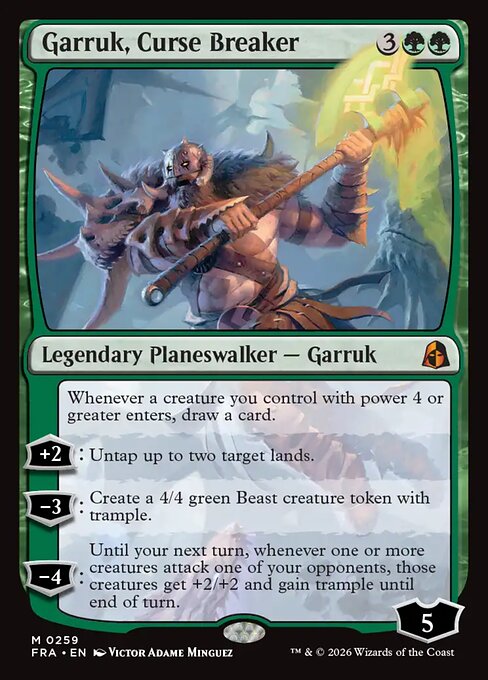 fra-259fra-259Shop on TCGplayer Garruk, Curse Breaker and
 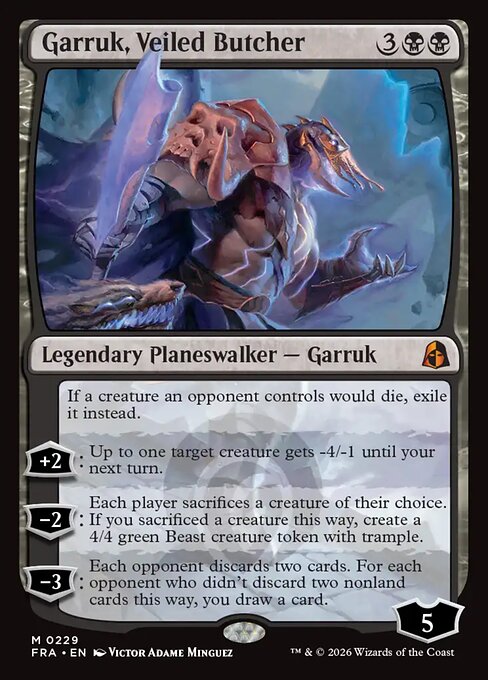 fra-229fra-229Shop on TCGplayer Garruk, Veiled Butcher make the colorshifted concept feel especially deliberate. The names are evocative, but they don't tell you which version is closer to Garruk's classic identity, which colors either version uses, or what each planeswalker actually rewards. Those answers belong to the revealed cards, not to the adjectives in the title.
For deckbuilders, this pair is a reminder that a colorshift is more than a cosmetic change. It changes the set of decks that can consider the card and may change what kind of support the card needs. If one version fits a deck because of its printed color identity while the other does not, the shared character is still useful for comparison, but it doesn't make the cards interchangeable.
Pre-release Commander speculation: Garruk, Curse Breaker and Garruk, Veiled Butcher could be worth evaluating as separate candidates for different Commander shells. Until the full cards have been played, the responsible conclusion is simply that the pair tests whether players can evaluate a familiar planeswalker from its current identity instead of its historical one.
Across all three pairs, the best workflow is straightforward. Start with the actual card's color identity, then look at its mana cost and loyalty abilities, then compare its demands with the deck's existing plan. Only after that should the character's story, name, or relationship to the other card in the pair influence the decision. The What If? premise is a reason to compare the cards, not a reason to assume they are mechanically linked.
GODEEPER: For the Standard side of this same set, see which confirmed cards are drawing early competitive attention. Reality Fracture Standard Preview: 2 Cards to Watch →
Karn, Argent Defender: A Colorless Commander Piece
Karn, Argent Defender is the other preview that deserves a careful pre-release Commander read. The confirmed profile is specific: it's a colorless Legendary Artifact Creature with mana cost {2}, and it shuts down creature and artifact enters-the-battlefield triggers. That is enough to identify the card's central tension without pretending that we know text that hasn't been verified here.
For pre-release Commander evaluation, creature and artifact enters-the-battlefield triggers are a major part of how Commander decks generate value. They can turn a small creature into a removal spell, a mana source, a card-draw event, or a repeatable engine, depending on the card. A preview that shuts down those triggers could reshape a table's incentives, but the exact impact depends on how the final effect is worded, whether it applies symmetrically, and what exceptions or limits appear on the card. Those details matter, so Karn shouldn't be described as a universal lock from the short functional description alone.
For pre-release Commander evaluation, the colorless designation also makes Karn portable in a way a colored planeswalker isn't. As a card in the 99, a colorless card can be evaluated for decks across the color-identity spectrum, as long as its final color identity doesn't contain an off-color symbol. That doesn't mean every deck wants it, and it doesn't mean the card's colorless frame tells us everything about its color identity. It means the first legality check is broader than it would be for a colored card.
For pre-release Commander evaluation, the possible-commander question is different. Karn is a Legendary Artifact Creature, so its type line makes it reasonable to examine as a commander, but a commander has to be judged by its full color identity and by the deck it permits. If Karn's final identity is colorless, the resulting deck would be restricted to colorless cards rather than becoming a five-color deck. That distinction is easy to miss when "colorless" is treated as a synonym for "fits everywhere."
Pre-release Commander speculation: Karn could be worth evaluating in colorless decks that can function without creature and artifact enters-the-battlefield triggers, and it could also be worth testing as a card in a colored deck that wants a broad answer to ETB-heavy tables. The same effect could be awkward in a list that relies on its own artifact or creature triggers, and there has been no playtesting to tell us which side wins in practice. Until the full text is available and the set is released, Karn is a strong evaluation target, not a settled recommendation.
Other Notable Preview Cards
Solitary Cell is a confirmed artifact preview. Pre-release Commander speculation: its type makes it worth tracking for artifact-focused lists, but an artifact type alone isn't enough to establish a role, a power level, or a reason to include it.
Generous Revival is a reanimation effect. Pre-release Commander speculation: it could be worth evaluating for decks that want another way to bring something back, but its final cost, timing, targets, and limitations will determine whether it competes with existing options.
Cast Away Doubt is a draw spell. Pre-release Commander speculation: it could be worth evaluating in decks looking for additional card flow, though no honest ranking is possible without its full text and playtesting.
Compel Brutality is a combat trick. Pre-release Commander speculation: it could be worth evaluating for a deck that wants to influence combat, but the value of that effect will depend on its actual rate, timing, and flexibility.
Perfected Theory is another confirmed preview card, but the verified information available for this brief doesn't include a functional description. There isn't enough here to assign it a pre-release Commander role without inventing details.
Frequently Asked Questions
What does "colorshifted" mean in Reality Fracture? It means an alternate-universe version of a familiar character is printed in different colors than that character's classic identity, reflecting the set's "What If?" alternate-timeline premise.
Which colorshifted pairs are confirmed in Reality Fracture? Three: Ajani Resolute and Ajani Unrelenting, Liliana the Repentant and Liliana the Faultless, and Garruk, Curse Breaker and Garruk, Veiled Butcher.
Are the Liliana cards planeswalkers? No. Unlike the Ajani and Garruk pairs, both Liliana the Repentant and Liliana the Faultless are Legendary Creatures, which means either could be evaluated as a Commander in its own right, not just as a card for the 99.
What does Karn, Argent Defender do? It's a colorless two-mana Legendary Artifact Creature that shuts down creature and artifact enters-the-battlefield triggers, though the exact wording and any exceptions matter for how disruptive it actually is.
Are any of these confirmed as Commander staples yet? No. Every Commander-relevance claim here is pre-release speculation. Reality Fracture releases October 2, 2026, and no one has played these cards in real games yet.
Related Reading
- MTG Commander Deck Guide: Building, Budget, and cEDH: the full Commander deckbuilding rules these preview cards will have to fit into.
- Magic: The Gathering 2026 Set Release Schedule Guide: where Reality Fracture fits into the rest of the 2026 schedule.
- Doom Prevails Precon Upgrade Guide: Marvel Commander: a real, already-released Commander precon for comparison against these pre-release cards.
References
About the author

Commander & Standard Deck Analyst
Commander and cEDH grinder covering deckbuilding, precons, and the Standard/Commander metagame. Plays out of a local game store scene, reads spoilers the day they drop.
- Weekly Commander night regular, 6+ years
- Tracks EDHREC/MTGGoldfish data for every article
- Covers every Standard-legal set + Commander precon on release


Disclaimer
This article is published for informational and entertainment purposes. It does not constitute professional financial, legal, or technical advice. Game performance, online services, patch schedules, and store listings change. Verify critical details (pricing, system requirements, regional availability) with publishers and storefronts before you buy. Affiliate links, where present, help support our editorial work and are labelled in our affiliate disclosure.