Loading…
Loading…
BaseMTG · Guides
Reviewing
Magic: The Gathering
Budget Commander decks under $50 aren't a fantasy, but they do demand tighter choices than a pile of random cheap cards. In 2026, a casual table can absolutely support a $50 list when the deck is built around a tribe that makes each slot pull more than one job.
TL;DR: Yes, you can build a genuinely playable Commander deck for $50, and tribal synergy is the most reliable route. Lathril, Blade of the Elves and Wilhelt, the Rotcleaver show why a focused tribe can create bodies, card advantage, and a way to close the game without relying on a stack of expensive staples. A relevant precon can give you the cheapest practical starting point, while selective upgrades keep the finished list focused.
Yes, a $50 Commander deck can be genuinely playable at a casual table in 2026. Tribal synergy decks are the most reliable way to hit that budget because their support cards tend to be inexpensive and naturally reinforce the same plan.
A budget goodstuff pile has a basic problem: every card has to be good by itself. If you can't afford the most efficient versions of ramp, removal, card draw, and finishers, the deck ends up with a collection of merely acceptable cards that don't improve one another. You may have enough individual effects to fill a deck, but you won't necessarily have a plan that gets stronger as the game develops.
Tribal synergy changes that calculation. A cheap creature can be an attacker, a blocker, a sacrifice resource, a mana source, or a trigger for the commander. A low-cost tribal payoff can improve several creatures at once. A token generator can supply bodies for combat while also turning on a life-drain ability, a sacrifice effect, or a draw engine. Each slot does more than its printed baseline job, which is exactly what a small budget needs.
That efficiency is easier to find in established tribes because they have been printed across many sets over a long period. Elves and Zombies, for example, have received creatures, token makers, tribal payoffs, recursion effects, and support permanents in many different releases. High print runs and repeated support mean you can often find functional versions of those effects without competing for the same prices as the most sought-after generic staples.
Generic powerful staples tend to cost more because every deck wants them. Fast mana, premium removal, flexible card draw, and widely useful lands have demand far beyond one strategy. They can still be useful, but buying too many of them can consume the budget before your deck has enough cards that actually advance its main plan. At this price point, synergy is a substitute for raw efficiency.
The point isn't that every tribal card is automatically good. You still need a curve that lets you play spells, enough interaction to avoid folding to one threat, and a way to end the game. The point is that your baseline cards are doing useful work together. When you spend a slot on a cheap Elf lord, for instance, you aren't only adding one body. You're also improving the rest of the tribe and making future token production more threatening.
This is why budget building rewards commitment. If half the list is trying to make a wide creature board and the other half is a disconnected set of individually powerful effects, the deck pays the cost of both plans without receiving the full benefit of either. A focused tribe gives you a clear test for every purchase: does this card make the tribe's board, engine, or payoff more reliable?
GODEEPER: Confirm the format's core deckbuilding rules before you start picking a commander. MTG Commander Deck Guide: Building, Budget, and cEDH →
Was this guide helpful?
About the author

Commander & Standard Deck Analyst
Commander and cEDH grinder covering deckbuilding, precons, and the Standard/Commander metagame. Plays out of a local game store scene, reads spoilers the day they drop.
Disclaimer
This article is published for informational and entertainment purposes. It does not constitute professional financial, legal, or technical advice. Game performance, online services, patch schedules, and store listings change. Verify critical details (pricing, system requirements, regional availability) with publishers and storefronts before you buy. Affiliate links, where present, help support our editorial work and are labelled in our affiliate disclosure.
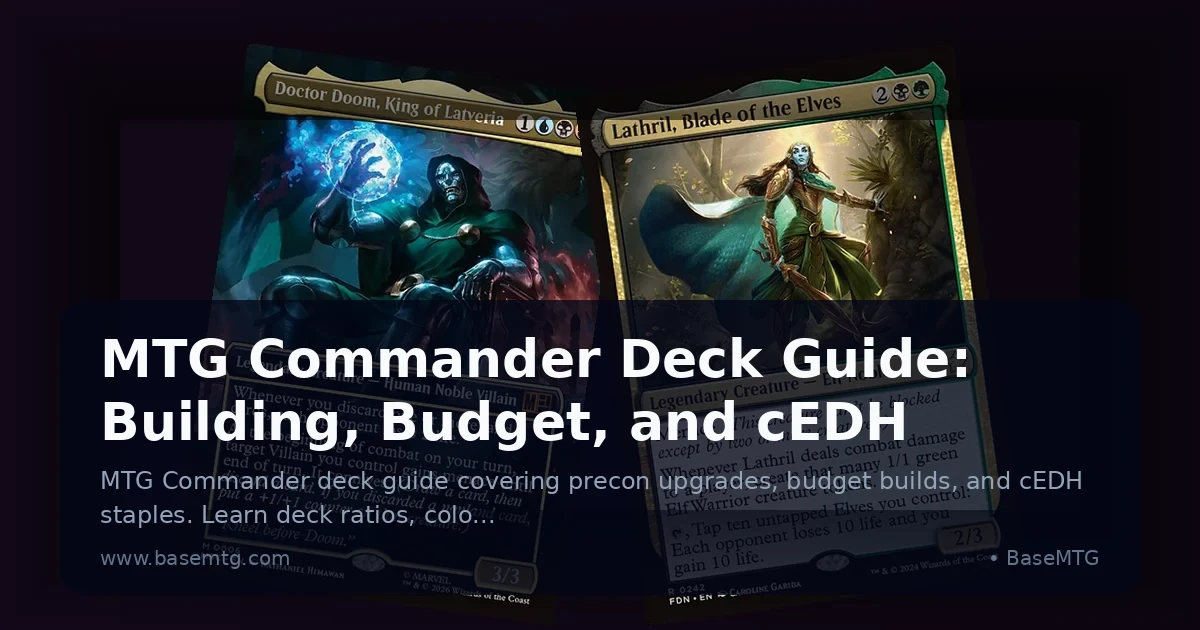
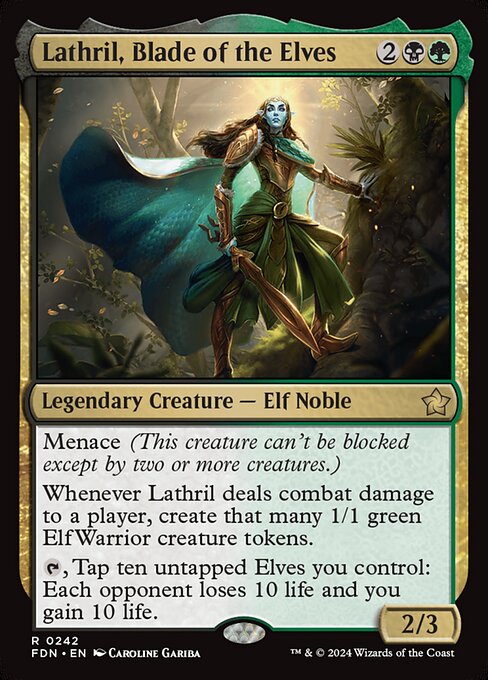 fdn-242fdn-242Shop on TCGplayer Lathril, Blade of the Elves is a real, currently budget-friendly Elf tribal commander because her abilities reward the basic things an Elf deck already wants to do. She wants to attack, connect with a player, and build a wide board of Elves. You don't need a complicated package of expensive cards to understand what the deck is asking you to do.
Whenever Lathril deals combat damage to a player, her first ability creates that many 1/1 green Elf Warrior creature tokens. Connecting once can therefore add a meaningful number of bodies to the battlefield, and those bodies become more valuable when your other tribal effects improve them. Evasion, combat support, and token production all help the same central plan, so even modest cards can contribute to a strong turn later in the game.
Her second ability is the payoff for going wide. You can tap ten untapped Elves you control to make each opponent lose 10 life while you gain 10 life. That isn't just a combat trick or a small incremental drain effect. It gives the deck a clear way to turn a crowded board into a large life swing, and it lets you threaten the table even when attacking is difficult.
Elf tribal also has unusually good budget fundamentals. The tribe has been supported across many sets, so a low-cost list can draw from cheap Elf token generators, Elf lords, creature-based mana acceleration, and combat enablers. Those categories overlap in useful ways. A creature that helps produce mana can advance your board, a lord can make every token matter, and a token generator can give you both defense and the ten Elves needed for Lathril's payoff.
The main budget trap is spending too much on cards that only look powerful outside the tribe. Lathril doesn't need every expensive green staple to be threatening. She needs enough creatures to keep the board growing, enough ways to protect or rebuild that board, and enough draw and ramp to keep playing after the first wave is answered. When most of the deck contributes to those jobs, the commander supplies a lot of the finishing power.
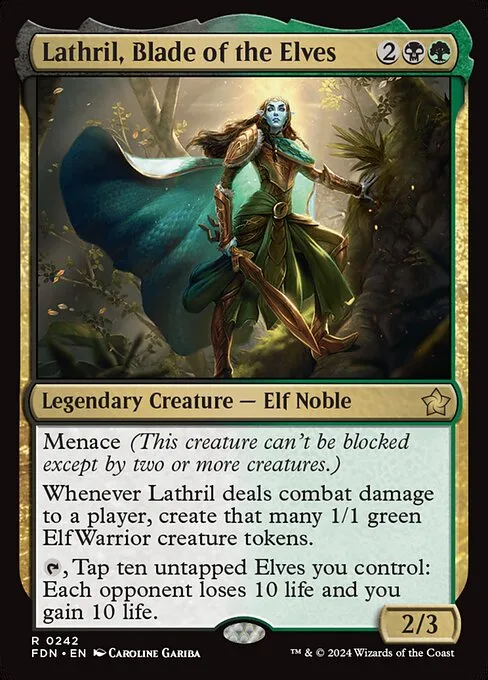 Lathril turns combat damage into Elf tokens, then those same Elves fuel her 10-life drain ability.
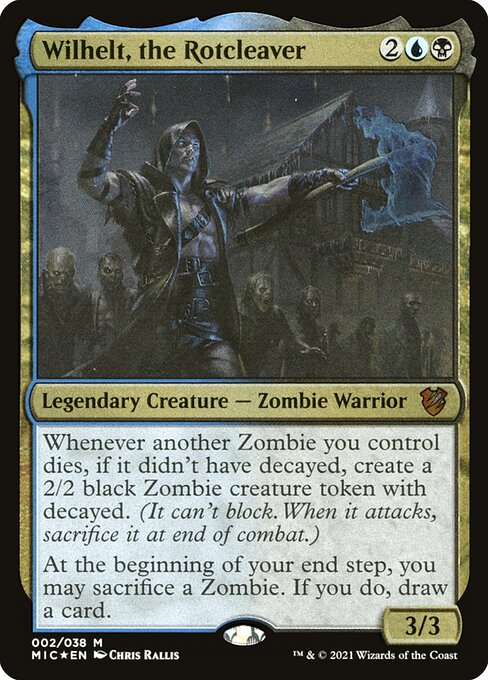 mic-2mic-2Shop on TCGplayer Wilhelt, the Rotcleaver is a real, currently budget-friendly Zombie tribal commander with a different kind of resilience. Instead of asking you to keep every creature alive, Wilhelt makes the deaths of your non-decayed Zombies productive. That distinction matters at a casual table, where removal is common and a creature deck can otherwise lose all of its momentum after one board wipe or a few well-timed answers.
Whenever another Zombie you control dies, if it didn't already have decayed, Wilhelt creates a 2/2 black Zombie creature token with decayed. The original creature is gone, but the event leaves another body behind. Decayed Zombies can't block and sacrifice themselves after attacking, so they aren't a full replacement for the creature you lost. They are still valuable: they can attack, carry sacrifice effects, provide material for other Zombie payoffs, and keep the deck from running out of creatures after trades.
Wilhelt also turns a Zombie death into card flow. At the beginning of your end step, if a Zombie died that turn, you may sacrifice a Zombie to draw a card. That gives you a reason to use the expendable bodies rather than treating them as disposable clutter. A Zombie deck can trade creatures in combat, sacrifice a body for value, or let an opponent's removal do its work, then use the resulting board and draw trigger to keep moving.
The budget support is broad because Zombies have strong tribal backing. Cheap Zombie recursion lets important creatures return or makes death less costly. Sacrifice outlets give you control over when creatures die, while sacrifice payoffs turn those deaths into damage, life swings, mana, or cards. Token makers and Zombie lords add more bodies or improve the ones already in play. You don't need every category in equal numbers, but the tribe gives you many affordable ways to connect them.
The deck's strength is that removal doesn't always reset the problem. If an opponent destroys a non-token Zombie, Wilhelt leaves you with another body, and that body can help trigger or pay for the next part of the engine. A budget Zombie list still needs a sensible mana base, draw, and interaction, but it can spend less on standalone threats because the commander turns ordinary creatures into a recurring stream of resources.
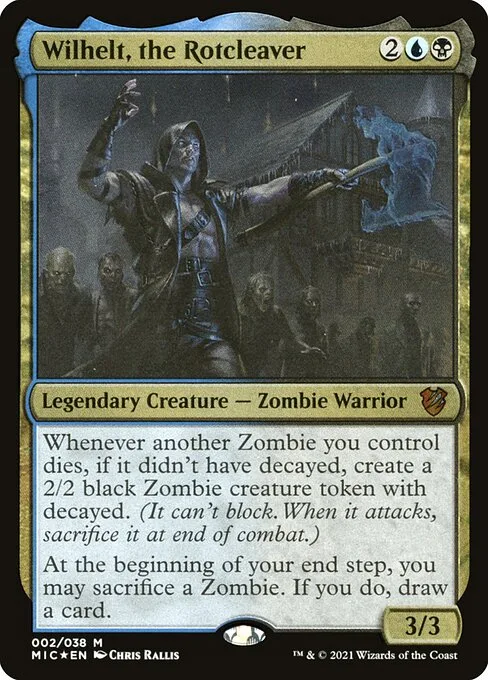 Wilhelt replaces dying Zombies with decayed tokens, then lets you sacrifice one at end step to draw a card.
GODEEPER: For a different budget-conscious approach, see how to upgrade a Commander precon instead of building from scratch. Doom Prevails Precon Upgrade Guide: Marvel Commander →
1. Pick the engine. Start with a well-supported tribe or synergy theme rather than generic goodstuff. Choose a plan that has affordable creatures, payoffs, and support effects available in several card types. Elf tribal and Zombie tribal work because the theme supplies a large pool of cards that already point in the same direction, but any established synergy can work if it has enough low-cost support.
2. Start with a relevant precon. If a relevant precon exists for your chosen commander or a similar one, use it as the foundation. A precon normally gives you a functional 100-card skeleton with lands, ramp, interaction, and a spread of cards that demonstrate the intended plan. You won't keep every card, but replacing the weakest pieces over time is usually cheaper and less frustrating than buying a full list from scratch card by card.
3. Prioritize your synergy. Put cards that support your specific engine ahead of generically powerful but off-theme cards. A cheap tribal creature that advances your board and turns on a payoff can be more useful here than a stronger standalone creature that doesn't interact with anything else in the deck. Check each slot for a job: does it make bodies, improve them, recur them, reward their deaths, protect the engine, or help you find the next piece?
4. Build a functional mana base. Don't skimp on lands just because the budget is tight. Use a sensible land count, enough basic lands, budget fixing lands where needed, and low-cost mana acceleration that helps you cast your spells on time. A deck with a strong tribal plan still fails if it misses early land drops or can't produce the colors its commander requires. Consistent mana is part of the deck's power, not a luxury reserved for expensive lists.
5. Add ramp and card draw before finishers. Ramp and card draw keep the deck consistent, so add those foundations before spending precious budget on flashy finishers. A finisher is only useful if you can cast it, and it won't matter if the deck runs out of cards before reaching the late game. Once the engine reliably develops a board and refills your hand, choose a small number of finishers that use the same tribal or synergy plan.
Can you really build a Commander deck for $50? Yes. A $50 Commander deck can be genuinely playable at a casual table in 2026, especially when built around a well-supported tribe or synergy theme instead of a pile of generically powerful cards.
Why is tribal synergy better than a goodstuff pile at low budgets? Because every card does more than one job. A cheap tribal creature can attack, block, generate a resource, or trigger the commander at once, while a budget pile of "good" cards often can't afford the most efficient versions of each individual effect.
What does Lathril, Blade of the Elves do? Whenever Lathril deals combat damage to a player, she creates that many 1/1 green Elf Warrior tokens. She can also tap ten untapped Elves to drain each opponent for 10 life while you gain 10, turning a wide Elf board into a finishing move.
What does Wilhelt, the Rotcleaver do? Whenever another Zombie you control dies without already having decayed, Wilhelt creates a 2/2 black Zombie token with decayed. At your end step, you may sacrifice a Zombie to draw a card, turning removal and combat trades into card advantage.
Is starting from a precon cheaper than building from scratch? Usually. A relevant precon gives you a functional 100-card deck with a working mana base and game plan already in place, so you're mainly replacing the weakest filler cards instead of assembling 100 cards individually.