Loading…
Loading…
BaseMTG · Guides
Reviewing
Magic: The Gathering
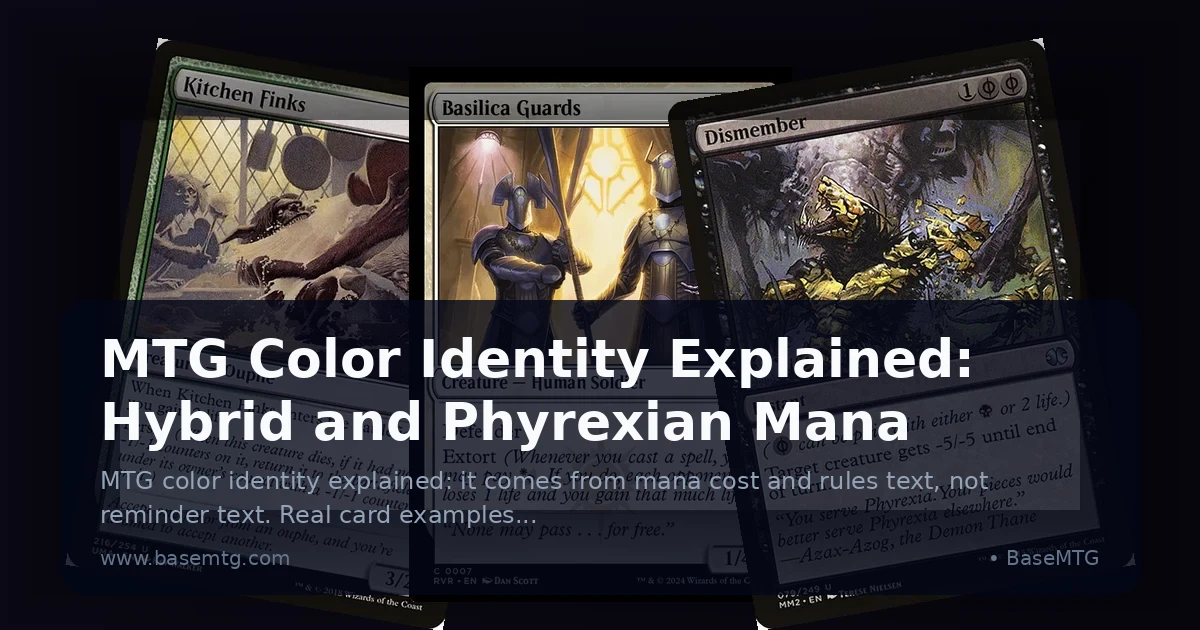
MTG color identity is one of the first rules new Commander players need to get right. It looks simple until hybrid mana, Phyrexian mana, and keyword reminder text start putting extra symbols in front of you.
TL;DR: Color identity includes the colors represented by a card's actual mana cost and rules text, but reminder text doesn't count. Hybrid mana counts as both colors, so Kitchen Finks has green and white identity even though each hybrid symbol gives you a choice when you cast it. Phyrexian mana in a real mana cost counts too, while the
{W/B}in Extort reminder text does not.
{G/W} add both colors to identity, even though you only pay one of them when casting the spell.{B/P}) counts toward identity, even if you pay life instead of colored mana.Color identity is the set of colors represented by a card's mana cost, rules text, color indicator, and certain abilities. In Commander, every card in your deck has to stay inside your commander's color identity, so a symbol that looks minor can decide whether a card is legal. The key distinction is that actual mana symbols count, while reminder text does not.
GODEEPER: If you're still sorting out the other rules basics, start with the core overview. How to Play Magic: The Gathering: Rules and Basics →
The five colors are white, blue, black, red, and green. A card's identity can include one of them, several of them, or none of them. Generic mana symbols such as {1} and {2} don't add a color, and neither does a colorless symbol. What matters is the colored information printed on the card and where that information appears.
That last part is where many quick explanations go wrong. It isn't enough to scan for colored-looking text or ask what mana you personally plan to spend. You need to identify each mana symbol and check whether it's in the card's cost, its actual rules text, or only in reminder text.
Hybrid mana is the classic color-identity trap because it gives you a choice when you cast the spell. A symbol such as {G/W} can be paid with green mana or white mana. That choice changes how you pay for the spell, but it doesn't let you choose the card's color identity.
Kitchen Finks is the clean example. Its mana cost is {1}{G/W}{G/W}, and its color identity is green and white, written as {G}{W}. Both hybrid symbols contain green and white, so both colors are part of the card's identity.
When you cast Kitchen Finks, you can pay each {G/W} with green or white mana. You can use green for both, white for both, or one of each. You'll still be casting a card with green and white color identity in every case. The payment option is flexible, but the deckbuilding identity is not.
That means Kitchen Finks can go in a Commander deck whose commander has both green and white in its identity. It can't go in a mono-green deck just because you intend to pay both symbols with green mana, and it can't go in a mono-white deck just because white is another legal payment option. The card has both colors before you choose how to pay.
The same principle applies whenever a colored hybrid symbol appears on a card. Don't read the slash as "pick one color for the card." Read it as "this one symbol contains both colors, and you may choose either payment while casting the spell." Color identity looks at the symbol itself, not the payment decision you make later.
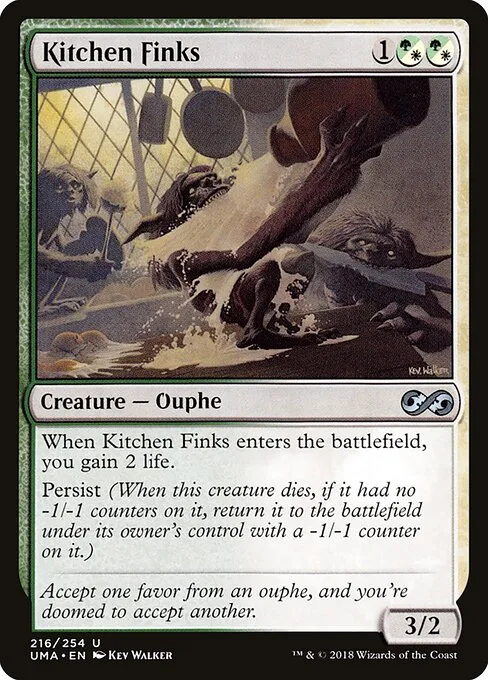 Kitchen Finks' mana cost shows two green/white hybrid symbols, the source of its green and white color identity.
This distinction also matters when you're checking a deck list from someone else. A list may look mono-colored because every hybrid card can technically be paid with the deck's main color. That isn't enough for Commander legality. If the card carries another color through its hybrid symbols, the commander needs that color too.
Was this guide helpful?
About the author

Commander & Standard Deck Analyst
Commander and cEDH grinder covering deckbuilding, precons, and the Standard/Commander metagame. Plays out of a local game store scene, reads spoilers the day they drop.
Disclaimer
This article is published for informational and entertainment purposes. It does not constitute professional financial, legal, or technical advice. Game performance, online services, patch schedules, and store listings change. Verify critical details (pricing, system requirements, regional availability) with publishers and storefronts before you buy. Affiliate links, where present, help support our editorial work and are labelled in our affiliate disclosure.
Reminder text is the italicized parenthetical text that explains a keyword or ability. It helps you play the card, but it isn't treated as the card's rules text when color identity is determined. Mana symbols printed only there are ignored.
Basilica Guards shows why this matters. Its mana cost is {2}{W}, and its color identity is white. It has Defender and Extort, with the following reminder text:
Extort (Whenever you cast a spell, you may pay
{W/B}. If you do, each opponent loses 1 life and you gain that much life.)
The {W/B} appears inside the parenthetical explanation of Extort. It isn't part of Basilica Guards' own mana cost or actual rules text for this purpose, so it doesn't give the card black identity. Basilica Guards is white identity, not white and black.
Basilica Screecher makes the comparison even clearer. Its mana cost is {1}{B}, and its color identity is black. It has Flying and the exact same Extort reminder text, including the {W/B} symbol. That reminder symbol doesn't give Basilica Screecher white identity. It remains black identity.
Players sometimes see the Extort payment and assume these creatures need a commander with both white and black. They don't. Basilica Guards can fit in a mono-white Commander deck, and Basilica Screecher can fit in a mono-black Commander deck, because the shared hybrid symbol is only in reminder text. The ability still tells you that you may pay {W/B} when you use Extort, but the explanatory text doesn't expand the card's deckbuilding identity.
The rule is about the text's function, not how prominent the symbol looks. A mana symbol in a parenthetical keyword explanation is reminder text and gets ignored. A mana symbol in the card's actual rules text is different and can count. When you're checking a card, look for the italicized parentheses and separate the reminder from the printed ability itself.
This is especially useful with keyword-heavy cards. You don't have to add every color mentioned by a keyword's standard explanation to your Commander deck's color requirements. If the card's own cost and actual abilities stay within the commander's identity, the reminder text won't make it illegal.
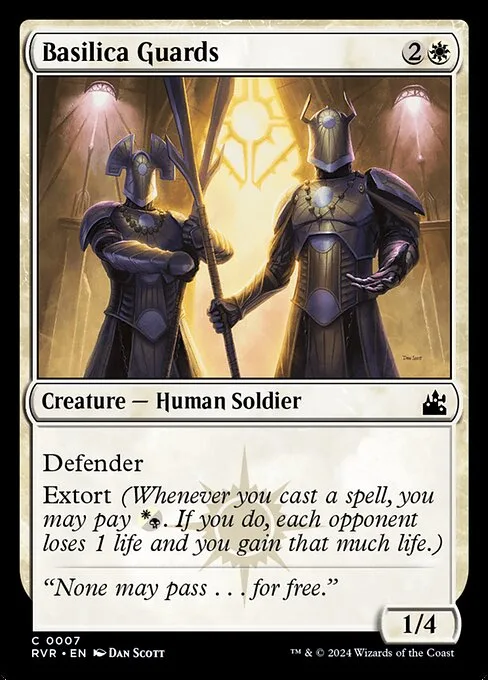 Basilica Guards costs {2}{W}. The {W/B} symbol only appears in Extort's italicized reminder text, so it stays white identity.
Phyrexian mana can look similar to the Extort example because it also lets you pay without using the matching colored mana. The important difference is that Phyrexian mana in a card's actual cost is still a mana symbol on the card. It counts toward color identity even if you choose to pay life instead.
Dismember has mana cost {1}{B/P}{B/P}, and its color identity is black. Each {B/P} can be paid with black mana or with life, but the black Phyrexian symbol is part of the actual mana cost. That makes black part of Dismember's color identity.
You can't make Dismember colorless for Commander deckbuilding by planning to pay life. The way you pay the cost doesn't erase the symbol printed in the cost. The same logic would apply if you cast it using black mana, a cost-reduction effect, or some other legal method. The identity comes from the card's printed characteristics, not from the resources you happen to use in a particular game.
Compare that with Basilica Guards. Its {W/B} symbol is present only in Extort's reminder text, so it doesn't add black. Dismember's {B/P} symbols are present in the actual cost, so they do add black. One symbol is ignored because of where it appears; the other counts because it is part of the spell's cost.
This gives you a reliable test for unusual mana symbols: first ask whether the symbol is in the real cost or actual rules text. If it is, its color matters for identity. Then ask whether the symbol is only in reminder text. If it is, ignore it for identity. Whether the symbol offers a life payment, a choice, or some other alternative doesn't change that test.
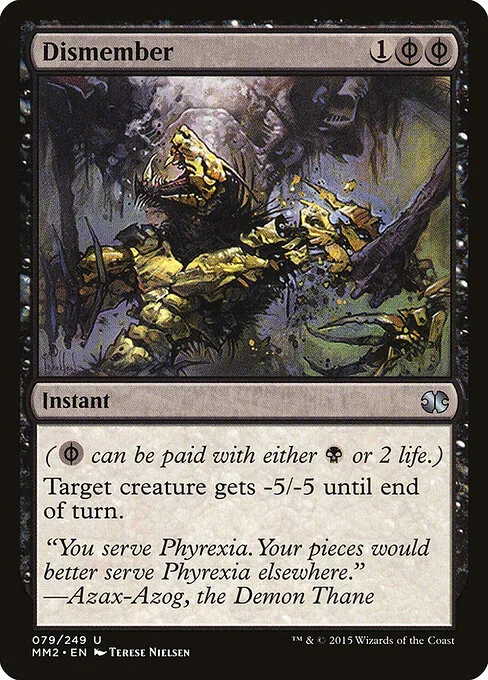 Dismember's Phyrexian black symbols sit in its actual mana cost, not in reminder text, so they count toward its black color identity.
1. Read the mana cost first. Every colored symbol in the printed mana cost counts, including hybrid symbols (which count as both colors) and Phyrexian symbols (which count as their printed color even though you can pay life instead).
2. Read the card's actual rules text next. If an activated ability, triggered ability, or static ability in the card's own printed text contains a colored mana symbol, that color is part of the card's identity too.
3. Ignore anything in reminder text. Reminder text is the italicized parenthetical that explains a keyword, like Extort's (Whenever you cast a spell, you may pay {W/B}. If you do...). Mana symbols that appear only there don't count, no matter how prominent they look.
4. Check for a color indicator. A small number of cards have an explicit color indicator (a colored dot or symbol near the name) instead of, or in addition to, colored mana symbols. That indicator sets color identity directly.
5. Compare the result against your commander. Once you know the card's full color identity, confirm every color it has appears somewhere in your commander's own identity. If it does, the card is legal for that Commander deck.
Color identity is primarily a Commander deckbuilding rule. Your Commander deck has 100 cards, including the commander, and it uses singleton construction, so you normally play only one copy of each card except basic lands. The other 99 cards have to fit within the commander's color identity. That makes a single hybrid, Phyrexian, or rules-text symbol relevant before the game even starts.
If your commander's identity includes white and green, a card with only white, only green, or both white and green can fit. A card with black identity can't, even if you don't expect to use its black ability. A card with a colored symbol in an unexpected place can therefore change a deck list's legality.
This rule is different from the basic construction rules people associate with Standard. Standard uses 60 or more cards and allows up to four copies of a card, subject to the format's card pool and other restrictions. Commander's 100-card singleton structure and color identity are what make these edge cases especially important there.
Color identity also makes deckbuilding cleaner once you understand it. You can evaluate a card before testing it, identify the colors a new card would add, and avoid discovering a legality problem after the list is built. The question isn't "Can I cast this with the mana my deck makes?" It's "Does every relevant color symbol on this card fit the commander?"
GODEEPER: For the rest of Commander's deckbuilding rules beyond color identity, see the full format guide. MTG Commander Deck Guide: Building, Budget, and cEDH →
Treating color identity as the same thing as the card's current color. A card can be colorless on the battlefield and still have a colored identity because its printed cost or rules text contains a colored mana symbol. Effects that change a card's color during a game don't rewrite the card's Commander deckbuilding identity. Check the card as printed when you build the deck.
Counting land types as colored mana symbols. A search effect can refer to Plains, Island, Swamp, or Mountain without adding white, blue, black, or red identity. Farseek is a useful familiar example: its ability can look across several basic land types, but those land names and types aren't mana symbols. The relevant colored identity comes from the card's actual colored mana symbol, not from every land type named in its instructions.
Ignoring mana symbols in actual rules text. The reminder-text rule doesn't mean all text outside the mana cost is irrelevant. If a card's own activated ability, triggered ability, or other rules text contains a colored mana symbol, that symbol can be part of its identity. The safe habit is to distinguish the real ability from its parenthetical explanation, then inspect the symbols in the real ability.
Assuming alternative payment means alternative identity. Hybrid and Phyrexian mana both give you another way to pay, but neither lets you remove a color from the card's identity. Paying green instead of white for Kitchen Finks still leaves it green and white identity. Paying life instead of black mana for Dismember still leaves it black identity. Payment flexibility affects play patterns, not Commander legality.
The fastest accurate check is to scan the mana cost first, then the actual rules text, then any color indicator or ability that defines the card's color. Ignore reminder text and flavor text. If you're unsure about a symbol, identify its exact location before making a deckbuilding decision. New "colorshifted" cards, like the alternate-universe planeswalker pairs in Reality Fracture, are exactly the kind of card worth double-checking with this method rather than assuming their identity from a familiar name.
What is color identity in Magic: The Gathering? Color identity is the full set of colors represented by a card's mana cost, its actual rules text, and any color indicator. It's separate from what colors the card costs to cast. Commander uses it to decide which cards fit a given commander.
Does hybrid mana count as one color or both for color identity?
Both. A hybrid symbol like {G/W} adds green and white to a card's color identity, even though you only pay one of those colors when you actually cast the spell. Kitchen Finks is green and white identity for exactly this reason.
Does Phyrexian mana affect color identity?
Yes. A Phyrexian symbol like {B/P} in a card's actual mana cost still counts as its printed color for identity purposes, even though you can pay life instead of that color. Dismember is black identity because of this.
Does reminder text count toward color identity?
No. Mana symbols that appear only in a keyword's italicized reminder text, like the {W/B} in Extort's reminder text, are ignored for color identity. Only symbols in the actual mana cost or rules text count.
Why does color identity matter most for Commander? Because every one of the 99 non-commander cards in a Commander deck must fit within the commander's color identity. A single overlooked hybrid or Phyrexian symbol can make a card illegal for an otherwise-legal deck.
Standard Metagame Tier List: Top 3 Decks (Sept 2026)
11 min read