Star Trek Draft Archetypes: Every Color Pair and Signpost
Every color pair gets two legendary signposts and a common Planet. On our count white-black has the most on-theme commons (11) and black-red the most removal on Wizards' list (17), while black-green's graveyard engine has no common payoff at all.
Verdict
Start in black: white-black has 11 commons that are or make artifact creatures, and black-red has 17 of Wizards' listed removal spells. Move into green-blue or red-white late, because each has only two commons that use its theme.
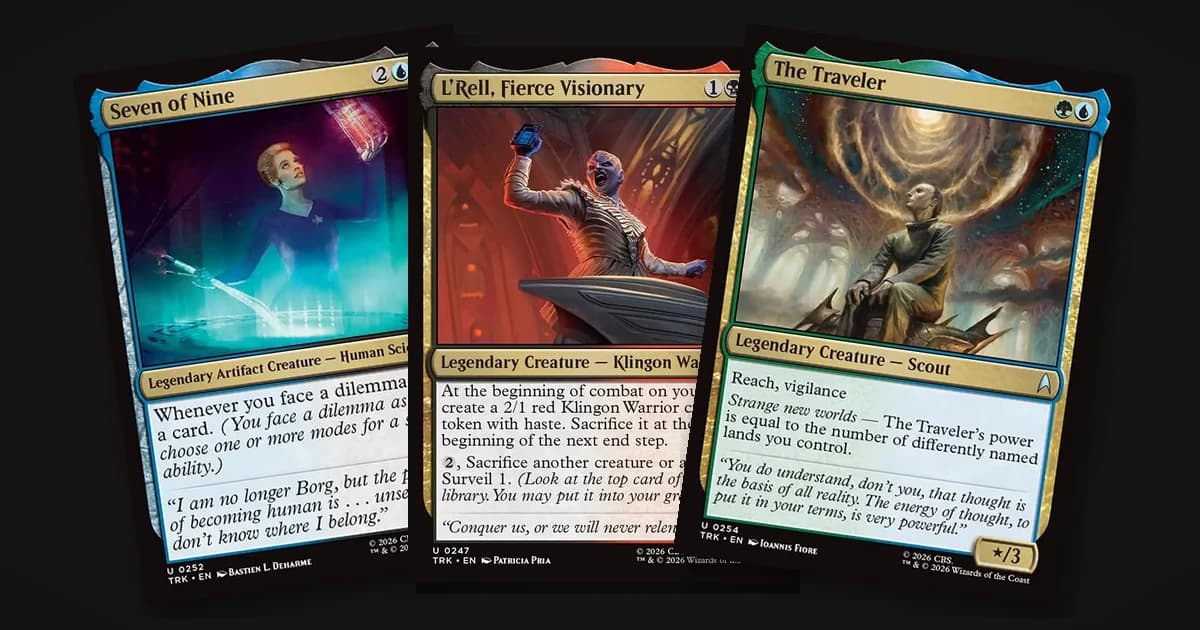
Star Trek draft archetypes come one per color pair, ten in all: white-blue Spacecraft, blue-black dilemmas, black-red Klingons, red-green landfall, green-white counters, white-black Borg artifact creatures, blue-red noncreature spells, black-green graveyard, red-white "8+ total power" and green-blue strange new worlds. Those are the themes in Wizards' Star Trek Prerelease Guide of October 30. Each pair has two legendary signpost uncommons, one gold and one hybrid, and a common Planet dual land. Draftsim's Peter Smith noted that "there are a full ten archetypes unlike most of the sets we've seen this year."
Prerelease events run November 6 to 12, MTG Arena gets the set on November 10, and the tabletop release is November 13. Nobody has win-rate data yet, so the card list is all there is to read, and we counted it: the commons behind each lane, and Wizards' own removal list added up by pair. Our reading is to take black early and to move into green-blue or red-white only when the packs say they are open. The Star Trek prerelease guide covers the event itself; this page is about the draft.
The Ten Pairs, Their Signposts and Their Planet
| Pair | Wizards' name | Gold signpost | Hybrid signpost | Common Planet |
|---|---|---|---|---|
| White-blue | Spacecraft and Artificers | Hemmer, Fixing What Is Broken | Constable Odo | Vulcan |
| White-black | Borg Artifact Creatures | Locutus, the One Who Speaks | Zero, Incorporeal Sensate | Cardassia Prime |
| Blue-black | Dilemma Control | Seven of Nine | Lore, Positronic Provocateur | Romulus |
| Blue-red | Scientists and Noncreatures | Spock, Always Your Friend | Gray and Adira, Forever Joined | Andoria |
| Black-red | Klingons and Dies | L'Rell, Fierce Visionary | The Duras Sisters | Qo'noS |
| Black-green | Archaeology Graveyard | Vash, Freelance Archaeologist | Daniels, Temporal Agent | Ferenginar |
| Red-green | Away Team Landfall | Dal R'El, Augment Orphan | Cleveland Booker, Empath | Orion |
| Red-white | Command 8+ Total Power | Kirk, Commanding Officer | Worf, Honor-Bound Warrior | Bajor |
| Green-white | Doctors and Counters | Phlox, Unorthodox Doctor | The Doctor, EMH | Risa |
| Green-blue | Strange New Worlds | The Traveler | D'Vana Tendi, Optimistic Ensign | Earth, Sector 001 |
All 20 signposts are legendary creatures, and they are the only multicolored uncommons in the main set. There is no gold common at all, so the signposts and the Planets are the clearest color-pair cards you will see in a pack. TurnZero HQ's archetype guide makes a useful point about reading them: "A late gold one says more than a late hybrid one, because a one-color drafter can take the hybrid." A Seven of Nine at pick six tells you more about blue-black than a Lore does.
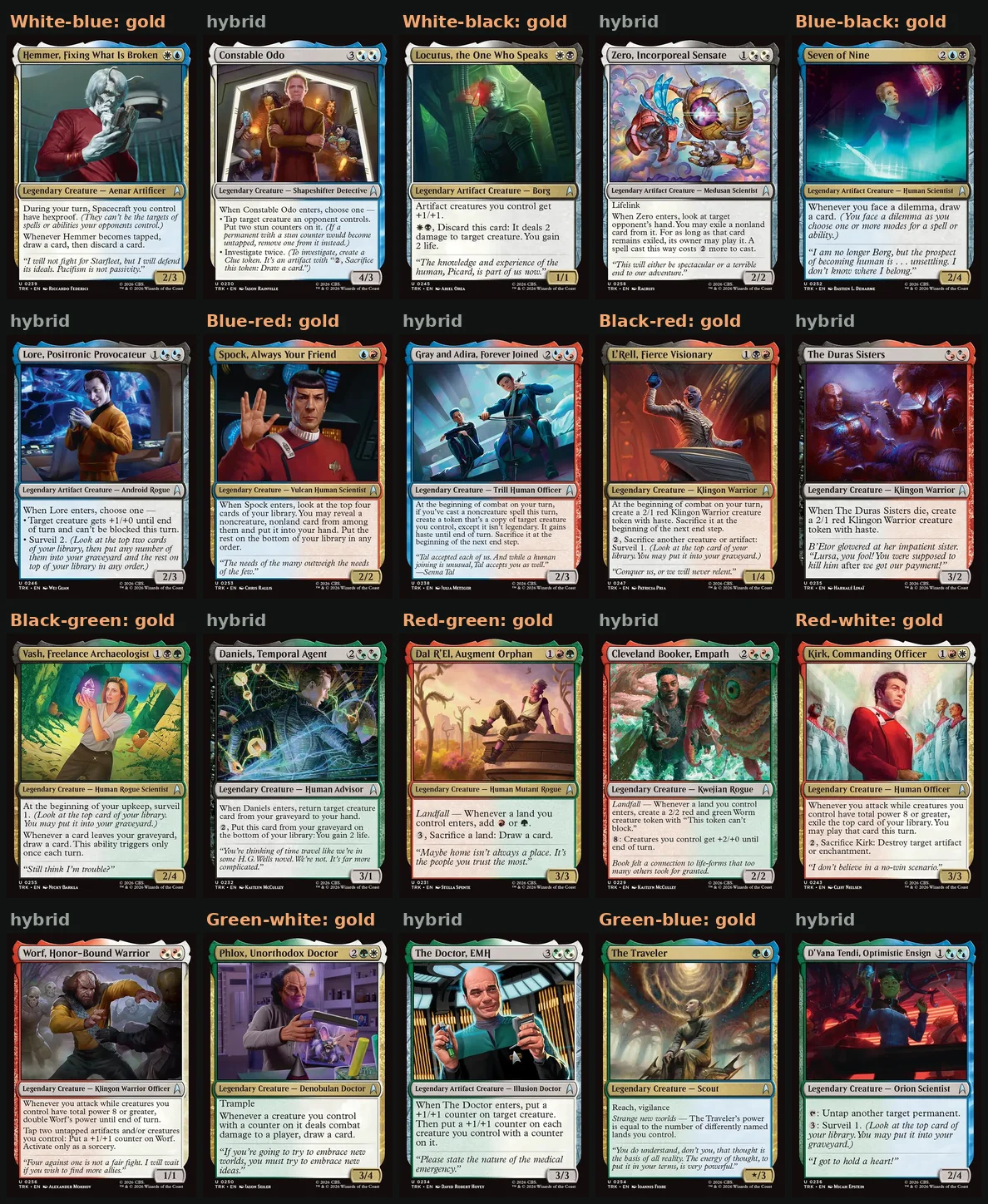 Image: BaseMTG grid of the 20 signposts, gold card first in each pair, built from Scryfall card images (card art and frames, Wizards of the Coast).
Planets in Your Prerelease Pool
The Planets are the set's ten common duals. Each enters tapped, gains you 1 life and taps for either of its two colors. Wizards' Collecting Star Trek article puts a common dual in the land slot of half of all Play Boosters: 40% non-foil and 10% traditional foil. NicolaiBolas made the same point in his October 31 draft guide: the Planets "will replace basic lands in 50% of the packs, so you'll see these all the time" (28:17).
A Prerelease Pack holds six Play Boosters, so the average Sealed pool opens three Planets, and the chance of opening none is 1 in 64. In a draft you open three packs yourself and see more as they pass. That matters most for green-blue, where every extra land name counts, and for splashes: a Planet that shares one color with your deck adds the third color in a slot that would otherwise hold a basic.
Unexplored Territory is the only common land that fetches a basic, and Limited Logic MTG did not like it in its October 24 preview: "it's a very bad evolving wilds because you actually need to pay one mana and tap it just to go search for a basic" (1:01). Each color also has a common basic landcycler for {2}, such as Horta (a 7/6 trampler) in red and Cold-Blooded Crew in green, which find a basic early and are still a creature late.
Counting the Commons Behind Each Lane
We read the 306-card main set from Scryfall on November 5. For each pair we counted the commons and uncommons in its two colors, or colorless, whose text does the lane's job: Spacecraft for white-blue, "face a dilemma" for blue-black, Klingon cards for black-red, and so on. Thirteen of the 20 signposts fall inside these counts; the other seven (Hemmer, Constable Odo, Lore, Spock, Daniels, Phlox and D'Vana Tendi) do a different job and are not counted. The removal column adds up Wizards' list of key common and uncommon removal for both colors of the pair, with the commons in brackets.
| Pair | What we counted | Commons | Uncommons | Wizards' removal (commons) |
|---|---|---|---|---|
| White-black | Artifact creatures and makers | 11 | 9 | 14 (5) |
| Green-white | Cards that put +1/+1 counters | 9 | 11 | 10 (5) |
| Black-red | Klingon cards | 4 | 7 | 17 (7) |
| Blue-red | "Noncreature spell" payoffs | 3 | 3 | 16 (9) |
| White-blue | Spacecraft | 3 | 3 | 13 (7) |
| Red-green | Landfall cards | 3 | 6 | 13 (7) |
| Blue-black | "Face a dilemma" payoffs | 2 | 4 | 15 (6) |
| Red-white | "Total power 8" payoffs | 2 | 5 | 15 (8) |
| Green-blue | "Strange new worlds" cards | 2 | 5 | 11 (6) |
| Black-green | "Leaves your graveyard" payoffs | 0 | 3 | 12 (4) |
The counts measure different things, so compare each lane with what it needs, not with its neighbor. A counters deck naturally has more enablers than a dilemma deck has payoffs. Two readings hold anyway.
First, black and red carry the removal. Wizards lists eight black and nine red removal spells, against four green ones, and two of the green four never kill a creature: Dathon and Picard at El-Adrel is a pump spell or an artifact-and-enchantment edict, and Test of Courage hits artifacts, enchantments or graveyards. Wizards' own advice is to "aim to include at least five removal spells across your two colors." Green-white, with ten across both colors, is the pair where that is hardest.
Second, black-green's engine is all uncommon. Vash, Blastoneuron and Hologram Stalker are the only commons or uncommons in the set that trigger when a card leaves your graveyard, and none of them is common.
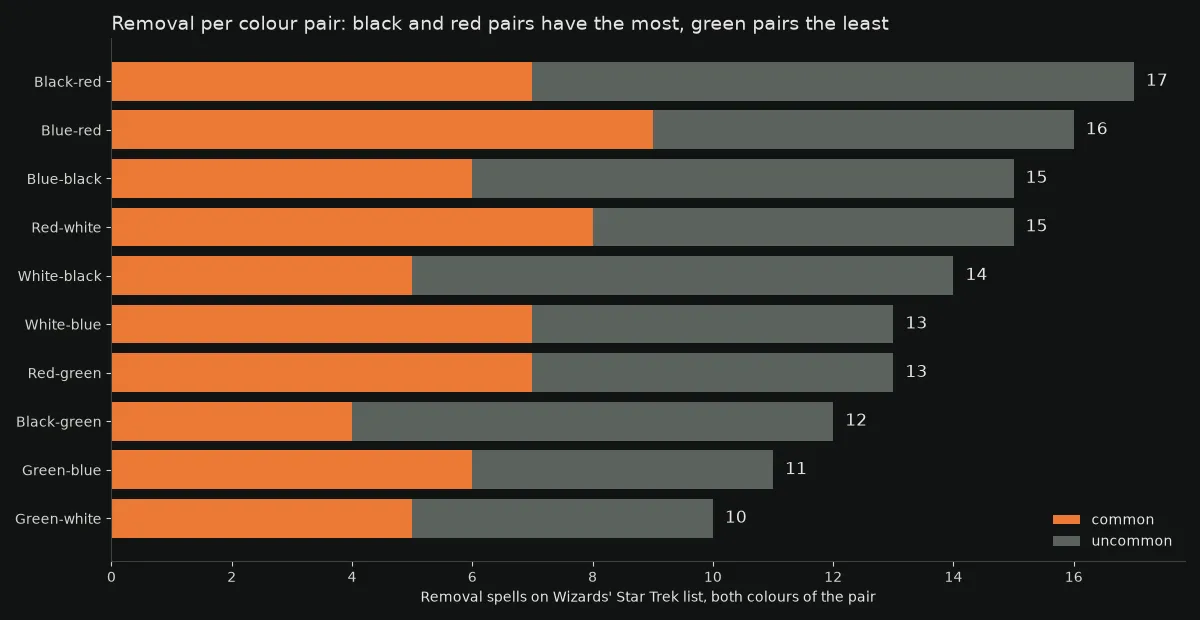 Image: BaseMTG chart of Wizards' key removal list per pair, rarities from Scryfall. Data and script: lanes.py, November 5, 2026.
Our Read: Lanes With the Most Behind Them
The three groups below are our judgment, not a ranking from data: we weigh each pair's removal on Wizards' list together with its on-theme commons. That is why blue-red, with only three payoff commons but 16 removal spells, sits in this group, and green-white, with nine commons but the least removal, does not.
White-black Borg
Locutus, the One Who Speaks costs two and gives your artifact creatures +1/+1, and the commons give it a lot to pump: 11 artifact creatures or artifact-creature makers in white, black or colorless. Vexing Drone taps an opposing creature when it enters, Tenacious Drone leaves a 1/1 Borg when it dies, and Assault Drone gives your artifact creatures +1/+0. Resistance Is Futile is never dead here: it destroys a nonartifact creature or returns an artifact creature with mana value 3 or less from your graveyard. Zero, the hybrid signpost, is an artifact creature with lifelink. This is the deepest lane at common on our count, and the one we would most like to be passed into.
Black-red Klingons
L'Rell, Fierce Visionary makes a 2/1 hasty Klingon Warrior at the start of each of your combats and sacrifices it at end of turn, which is fodder for the pair's sacrifice cards. The Duras Sisters cost two and leave a 2/1 hasty Klingon when they die. Limited Logic MTG called them "one of the strongest uncommons in the entire set" (2:20). Only four commons are Klingon cards, so the tribe itself is thin. The removal is not: 17 spells on Wizards' list, the most of any pair, including He's Dead, Jim (a four-mana instant that destroys a creature and surveils 1) and Eject the Warp Core, which becomes -6/-6 if you sacrifice an artifact or creature as you cast it.
Blue-red spells
Blue-red has the most common removal of any pair, nine of its 16, mostly red burn: Plasma Cascade deals 3 to any target, and Planetary Bombardment costs one mana and deals 2, or 4 if a creature died this turn. The payoffs are thin. Three commons care about noncreature spells: Cetacean Ops, Starfleet Spanner Jockey and Tal Shiar Analyst. Wizards' guide adds that "Spacecraft artifacts also count as noncreature spells," which gives the deck bodies that still trigger the payoffs. Spock, Always Your Friend costs two and digs four cards deep for a noncreature, nonland card. Limited Logic MTG thinks it is "probably the best premium uncommon" among the signposts (5:34). The text backs that up: a two-mana 2/2 that will usually draw you a card.
Our Read: Lanes That Need the Right Packs
White-blue Spacecraft
There are three common Spacecraft: Oberth-Class Starship (two mana, finds a Plains, flies at 6 charge counters), Suurok-Class Science Vessel (three mana, draws a card, flies at 5) and the colorless Class-F Shuttlecraft, which taps for any color. Station means tapping one of your own creatures at sorcery speed to add charge counters equal to its power. Hemmer pays you for that: he gives your Spacecraft hexproof during your turn and draws and discards a card whenever he becomes tapped. NicolaiBolas ranks Suurok-Class second among blue commons (3:13). With three ships at common and three at uncommon, you need to see several of them to make the deck.
Blue-black dilemmas
You face a dilemma whenever you choose one or more modes for a spell or ability, so a modal card such as Consider the Prime Directive (counter a spell unless they pay 3, or tap and stun a creature and draw) sets it off. At common there are only two payoffs: Melkotian Adjudicator, a three-mana 2/1 flier with vigilance that gets a +1/+1 counter per dilemma, and Obsidian Order Operative, which drains each opponent for 1. Seven of Nine draws a card per dilemma and is the card that makes the deck. Without it, blue-black is a control deck with 15 removal spells on Wizards' list, which is fine but not a theme.
Green-white counters
Nine commons put +1/+1 counters, among them Emergency Medical Hologram, Dominion Supervisor (your creatures with counters have trample) and Pure Energy, which you can cast a second time with beam me up. Phlox, Unorthodox Doctor draws a card whenever a creature of yours with a counter deals combat damage to a player, and Wizards points out that Phlox "cares about any kind of counter," so charge counters on Spacecraft count. The weak point is the removal column: ten spells across both colors, the fewest of any pair.
Red-green landfall
Three common landfall cards (Planetary Patrol, Saurian Explorer and Xindi Surveyors) and six uncommons, both signposts included. Dal R'El adds {R} or {G} when a land enters, and Cleveland Booker makes a 2/2 Worm that can't block. Horta and Cold-Blooded Crew are lands early and big creatures late, which is what a landfall deck wants from its top end. Our guess is that it will be a fair lane that rarely gets anyone's first pick.
Our Read: Lanes to Move Into, Not Force
Black-green graveyard
Vash surveils 1 every upkeep and draws a card the first time each turn a card leaves your graveyard. The commons fill the graveyard (First Contact mills four and keeps a permanent, Tal Shiar Operative can surveil when it attacks), but no common cashes in when cards leave it. That makes black-green a midrange deck with black's removal, and the engine shows up only when you have Vash, Blastoneuron or Hologram Stalker. Limited Logic MTG is "early picking green black to be one of the strongest color pairs in the format" (1:29), in a preview made before, by its own account, it had "looked at any of the commons or uncommons or rares." From the commons, we disagree: Vash is a strong card, and the lane under it is mostly black-green good stuff.
Red-white total power
Kirk, Worf and three other uncommons check whether your creatures have total power 8 or greater when you attack. The total counts every creature you control, not only the attackers. At common, only Cantankerous Captain and Tactical Officer check it. NicolaiBolas did the arithmetic: "two mana two two, three mana three three, then you play La'an, already you've got that eight power or more in play" (23:54). His tip is "avoiding trades," which is the hard part when the opponent blocks. The removal is good, 15 spells with eight at common, but the payoff density is the risk.
Strange New Worlds: How Many Land Names You Will Have
Strange new worlds counts the differently named lands you control. Two commons use it, Astute Terraformer and Suus Mahna Practitioner, plus five uncommons, including The Traveler, whose power is that number. A green-blue deck gets Forest and Island for free; every other name has to be drafted. Earth, Sector 001 is the pair's own Planet, and six more tap for green or blue (Andoria, Ferenginar, Orion, Risa, Romulus and Vulcan), so up to seven Planets can sit in the deck without hurting the mana.
To see what that buys, we shuffled four 40-card, 17-land decks 100,000 times each and counted land names on the battlefield, playing a new name first whenever we could. The model has no fetching, landcycling or New Planet tokens, so read it as the floor.
| Deck (17 lands) | Turn 3 | Turn 5 | Turn 7 | 4+ names on turn 7 |
|---|---|---|---|---|
| Forest and Island only | 1.82 | 1.91 | 1.95 | 0% |
| Plus Earth, Sector 001 | 2.02 | 2.16 | 2.27 | 0% |
| Plus Earth and 2 other Planets | 2.31 | 2.66 | 2.88 | 22% |
| Plus Earth and 4 other Planets | 2.50 | 3.12 | 3.47 | 47% |
The Traveler is a 2/3 or a 3/3 for most of a game unless you draft five Planets, and even then it averages about 3.5 power on turn seven. Cloak and Phaser costs {8}{U} minus your land names, so it still costs five or six on turn seven in the best deck here. NicolaiBolas' example of four names (Forest, Island, the dual and a New Planet) making it cost five (20:11) is reachable, but it needs the extra pieces: Final Frontier fetches a basic or a Planet onto the battlefield, David and Carol Marcus make a New Planet token, and Warp Speed finds a land and makes your lands enter untapped.
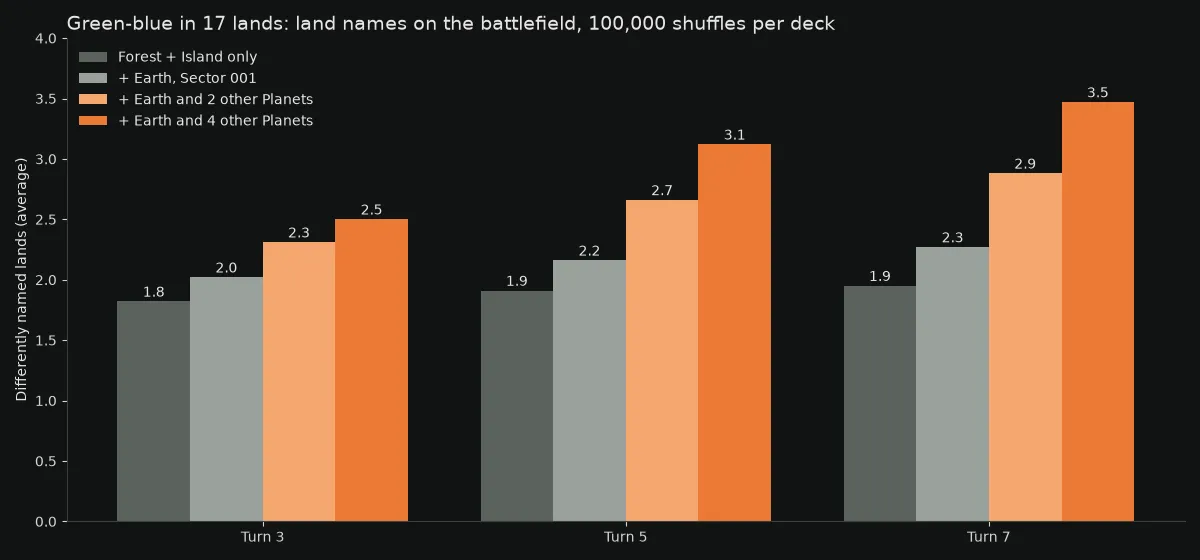 Image: BaseMTG chart from 100,000 shuffled games per deck (sng.py, seed 20261105), a projection, not play data.
What We Would Draft First
Take black removal early and let the second color come to you: white-black if Drones and Locutus keep arriving, black-red if L'Rell or The Duras Sisters do. Blue-red is the best non-black lane for removal. White-blue and green-white are fine when their commons flow, and green-white needs to pick up every removal spell it sees.
Don't force black-green, red-white or green-blue from pick one. Each has two or fewer commons that use its theme, and green brings the least removal. Some cards look like removal and aren't what you want early. NicolaiBolas flags 70,000 Light-Years from Home because it exiles a creature but lets its controller search for a basic land: "You generally don't want your removal spells to give your opponents a resource" (26:29). The same guide puts Malfunctioning Holodeck, a three-mana artifact that exiles a nonland permanent an opponent controls until the Holodeck leaves the battlefield, at the top of white's commons (1:14).
None of this has been played yet. It is a count of the card list on November 5, and the first Prerelease weekend will test it. For how the last set's lanes looked once real data arrived, see our Reality Fracture draft archetypes guide; for the cards with the highest ceiling in Star Trek, see the best Star Trek cards; and for the new mechanics in full, the Star Trek spoilers page.
References
- Wizards of the Coast, Jubilee Finnegan: "Star Trek Prerelease Guide," October 30, 2026. https://magic.wizards.com/en/news/feature/star-trek-prerelease-guide
- Wizards of the Coast: "Collecting Magic: The Gathering | Star Trek." https://magic.wizards.com/en/news/feature/collecting-star-trek
- Wizards Play Network: "Magic: The Gathering | Star Trek: Dates & Details." https://wpn.wizards.com/en/news/star-trek-dates-and-details
- Scryfall: Star Trek (TRK) card data, read November 5, 2026. https://scryfall.com/sets/trk
- TurnZero HQ: "Star Trek Draft Archetypes: All 10 Color Pairs," October 30, 2026. https://turnzerohq.com/guides/star-trek-draft-archetypes
- Draftsim, Peter Smith: "Exploring All Ten Star Trek Limited Archetypes," October 22, 2026. https://draftsim.com/mtg-star-trek-limited-archetypes/
- NicolaiBolas: "STAR TREK DRAFT GUIDE!!!" (YouTube), October 31, 2026. https://www.youtube.com/watch?v=5El5iZPZl-Q
- Limited Logic MTG: "Star Trek MTG Set Preview" (YouTube), October 24, 2026. https://www.youtube.com/watch?v=sp-ojE5F3ho
Was this guide helpful?
About the author

Spoilers & New Sets Desk
Pen name for the BaseMTG new-sets desk: spoiler season, set reviews, Universes Beyond crossovers and rules news. Cards are read from the official text, and what is confirmed is kept apart from our own reading of it.
- Spoilers, set reviews and Universes Beyond
- Card text read from official sources
- Confirmed facts marked apart from our reading
Keep reading
Star Trek Prerelease Guide: Pack Contents and 40-Card Deck
Guides · 7 min
Best Star Trek MTG Cards: Ranked for Commander and Standard
Guides · 17 min
Marvel Darkhold Destiny Release Date, Decks and Prices
News · 8 min
Star Trek MTG Release Date: Nov 13, Arena Nov 10 (2026)
News · 9 min
Star Trek MTG Spoilers: Every Revealed Card and Mechanic
News · 13 min
MTG Universes Beyond Explained: Standard Legality in 2026
Guides · 7 min
Star Trek MTG Commander Decks: 4 Decks, Prices and Dates
Guides · 18 min
The 12 Best Cards in Reality Fracture, Ranked (2026)
Guides · 19 min
Disclaimer
This article is published for informational and entertainment purposes. It does not constitute professional financial, legal, or technical advice. Game performance, online services, patch schedules, and store listings change. Verify critical details (pricing, system requirements, regional availability) with publishers and storefronts before you buy. Affiliate links, where present, help support our editorial work and are labelled in our affiliate disclosure.