MTG Color Combinations: Names, Playstyles and How to Pick
The guild and shard names are the shorthand every decklist uses. The four-color names are the ones nobody agrees on, so learn those last.
Verdict
Start in two colors: every guild has over a hundred legal commanders and the mana stays simple. Add a third when your pair is missing a tool, and treat four colors as a hobby, since two of the five have exactly one commander.
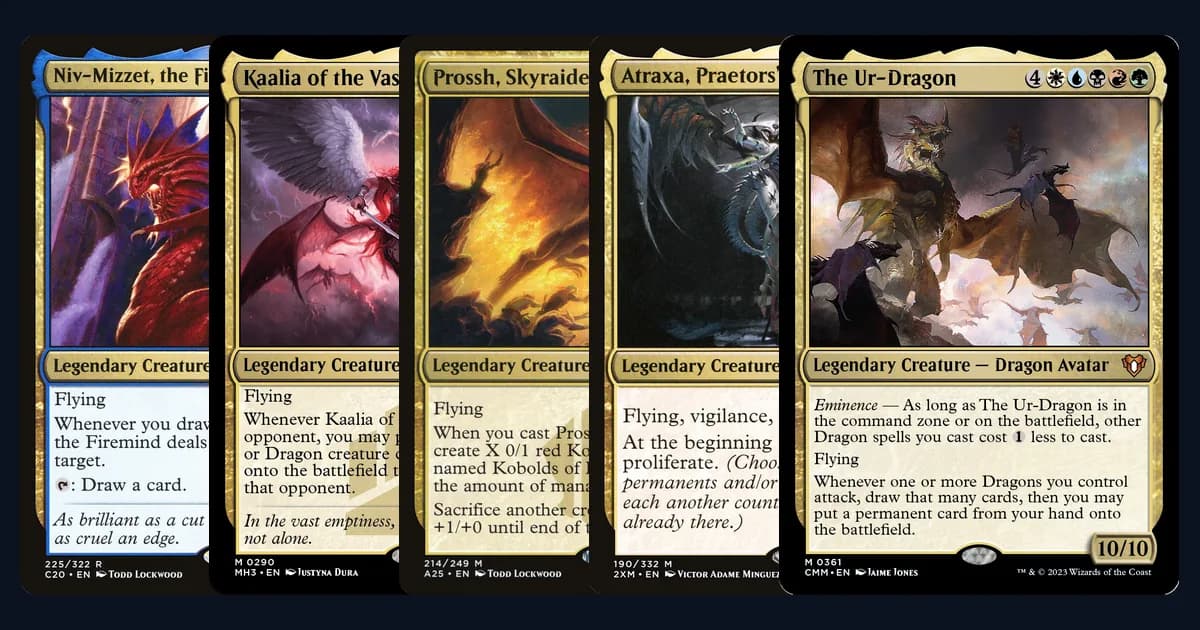
MTG color combinations have names because nobody wants to say "white-blue-black" fifty times a game. There are 26 of them: ten two-color guilds from Ravnica, five shards from Alara, five wedges from Tarkir, five four-color combinations with two rival sets of nicknames, and WUBRG for all five. The first twenty are settled, and decklist sites use them as standard labels. The four-color ones aren't, and that's fine.
Picking colors for a deck? Start with a guild. One color is simpler still, but a second color covers its blind spots while the mana still works without expensive lands. Add a third color when your pair is missing a tool you need, not because a three-color commander looks cool.
How MTG color combinations get their names
Everything starts from the color wheel on the back of every card: white at the top, then blue, black, red and green clockwise. That's where "WUBRG order" comes from (U is blue). Colors next to each other are allies. Colors across the wheel are enemies.
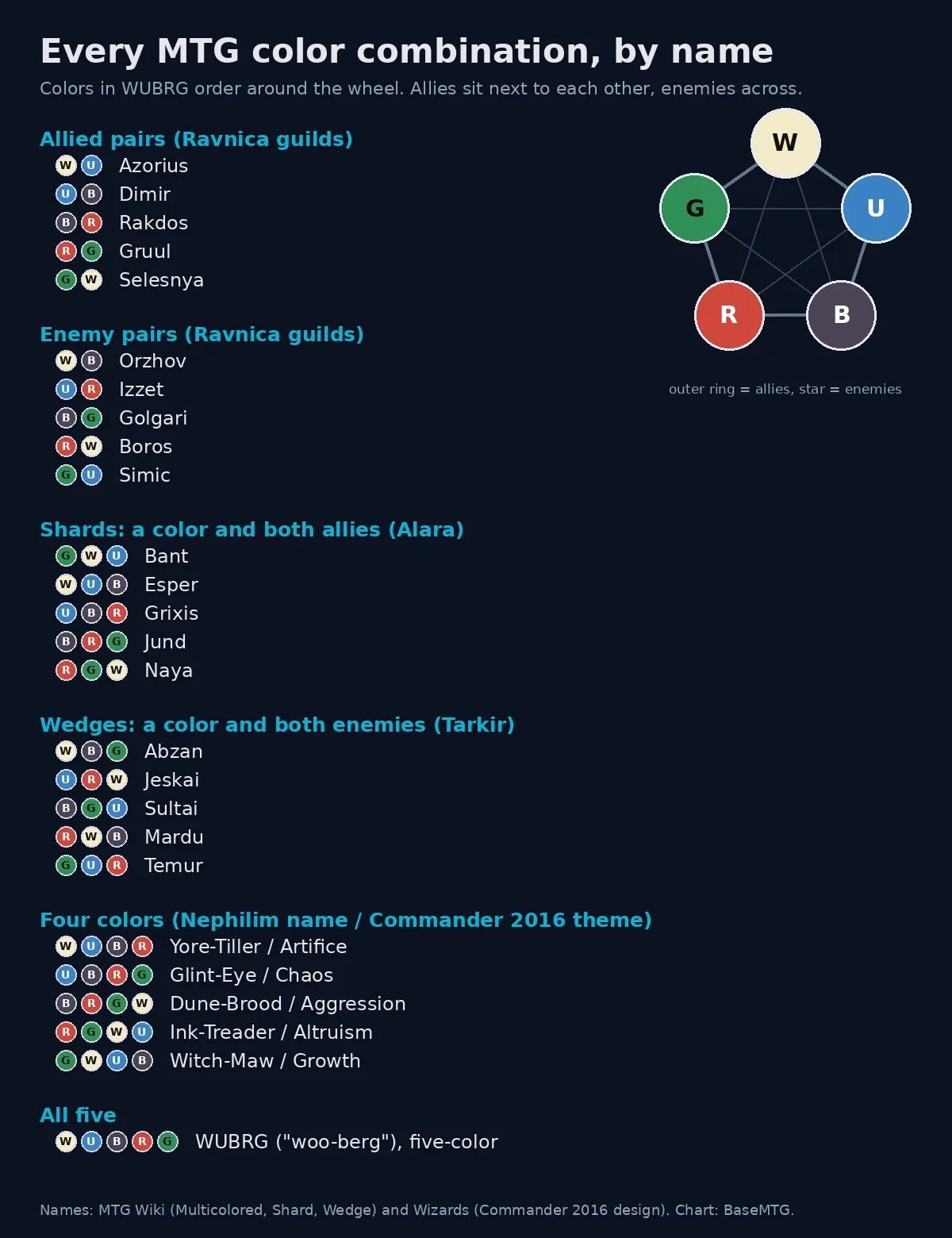 Save this one. Names from MTG Wiki and Wizards' Commander 2016 design notes. Image: BaseMTG chart.
The names come from whichever set first turned a combination into a faction. Gold cards have been around since Legends in 1994, but the pairs only got official names when Ravnica: City of Guilds built a city of ten guilds, one per pair. Shards of Alara did the same for three-color "arcs" in 2008, and Khans of Tarkir named the other five three-color groups, the wedges, in 2014. Nobody has done it for four colors, which is why that section below has two names per row.
If you'd rather watch than read, DiceTry runs through every color and pair in one video:
Two-color MTG color combinations: the ten guilds
Five guilds are allied pairs (Azorius, Dimir, Rakdos, Gruul, Selesnya) and five are enemy pairs (Orzhov, Izzet, Golgari, Boros, Simic). The "plays like" column is the classic archetype from Wizards' own breakdown of the pairs, so read it as the default, not a law: any given set can push a pair somewhere else.
| Guild | Colors | Plays like | Legal commanders | EDHREC decks |
|---|---|---|---|---|
| Azorius | White-blue | Flyers in the air, big-butt blockers and tempo on the ground | 135 | 326,697 |
| Dimir | Blue-black | Control: black removal, blue card draw, milling on the side | 125 | 403,683 |
| Rakdos | Black-red | The first truly aggressive pair: cheap threats and burn | 140 | 437,412 |
| Gruul | Red-green | Big creatures that attack, plus fight and ramp | 113 | 363,770 |
| Selesnya | Green-white | Fair creatures at every cost, tokens, life gain | 131 | 296,376 |
| Orzhov | White-black | Top-end removal, lifelink, bringing creatures back | 110 | 380,562 |
| Izzet | Blue-red | Quick tempo, cheap spells, instants and sorceries matter | 117 | 419,167 |
| Golgari | Black-green | Grindy midrange: small edges, recursion, the long game | 112 | 475,771 |
| Boros | Red-white | Aggro built on two- and three-drops, tokens, going wide | 147 | 376,559 |
| Simic | Green-blue | Big creatures, card draw, +1/+1 counters, almost no removal | 118 | 382,745 |
Legal commanders: Scryfall, cards that can lead a deck in exactly those colors. EDHREC decks: every deck EDHREC has logged in that color identity. Both pulled October 20, 2026.
Two things jump out of that table. Golgari is the guild Commander players build most, which fits a format that rewards the long game. And Selesnya, the pair Wizards calls "a popular choice for newer players since its game plan is so straightforward," is the least-built guild on EDHREC. Straightforward wins Limited games; Commander players apparently want a gimmick.
If you play Standard, two of these are live right now: our Izzet Spellementals deck guide and the Golgari midrange list are what those guild descriptions look like in an actual 60-card deck.
Three colors: the shards and the wedges
A shard is a color plus both of its allies, so it looks like an arc on the wheel. A wedge is a color plus both of its enemies, the pointy triangle. That's the whole difference, and it matters in play: shards share a lot of philosophy and tend to be smoother, wedges glue together colors that disagree.
The five shards (Shards of Alara)
| Shard | Colors | Alara mechanic | Plays like | Legal commanders | EDHREC decks |
|---|---|---|---|---|---|
| Bant | Green-white-blue | Exalted | One big attacker, protection, an orderly board | 47 | 326,690 |
| Esper | White-blue-black | Colored artifacts | Control and artifacts, the "system" deck | 52 | 448,548 |
| Grixis | Blue-black-red | Unearth | Selfish spells: removal, card draw, reanimation | 58 | 478,089 |
| Jund | Black-red-green | Devour | Sacrifice and midrange creatures | 39 | 290,879 |
| Naya | Red-green-white | 5-power matters | The creature trio: big bodies, tokens, combat | 55 | 418,232 |
MTG Wiki calls Naya "the most creature-centric color trio" and Grixis "the most self-centered three-color combination," and both descriptions hold up in deckbuilding: Naya decks are mostly creatures, Grixis decks are mostly answers. Streets of New Capenna tried new names for these five (Brokers, Obscura, Maestros, Riveteers, Cabaretti), and players kept saying Bant, Esper, Grixis, Jund and Naya anyway.
The five wedges (Khans of Tarkir)
| Wedge | Colors | Khans mechanic | Plays like | Legal commanders | EDHREC decks |
|---|---|---|---|---|---|
| Abzan | White-black-green | Outlast | Durable creatures, counters, attrition | 24 | 249,804 |
| Jeskai | Blue-red-white | Prowess | Spells-matter, noncreature spells fueling a few threats | 51 | 361,918 |
| Sultai | Black-green-blue | Delve | Graveyard value, self-mill, recursion | 35 | 366,471 |
| Mardu | Red-white-black | Raid | Attacking: tokens, sacrifice, pressure every turn | 37 | 404,097 |
| Temur | Green-blue-red | Ferocious | Big creatures backed by blue tricks and red burn | 33 | 333,431 |
Before Khans, wedges went by Dega, Ceta, Necra, Raka and Ana, from an Apocalypse card cycle, but those were never the official names. Older nicknames survive in deck names: Abzan used to be "Junk," Temur is still "RUG" and Sultai is "BUG."
Grixis is the most-built three-color identity on EDHREC, second only to five-color decks overall. Abzan sits at the bottom of the three-color list and has the fewest commanders of any of them, which is a shame for anyone who likes +1/+1 counters and grinding.
Four colors: two naming systems, no winner
Here's where it gets messy. MTG Wiki puts it flatly: "There are no given names for four color combinations yet." The Nephilim from Guildpact were the first four-color cards, so their names stuck. Then Wizards' Commander 2016 team gave each four-color group a theme, built around the color it leaves out, and those became the second set of nicknames.
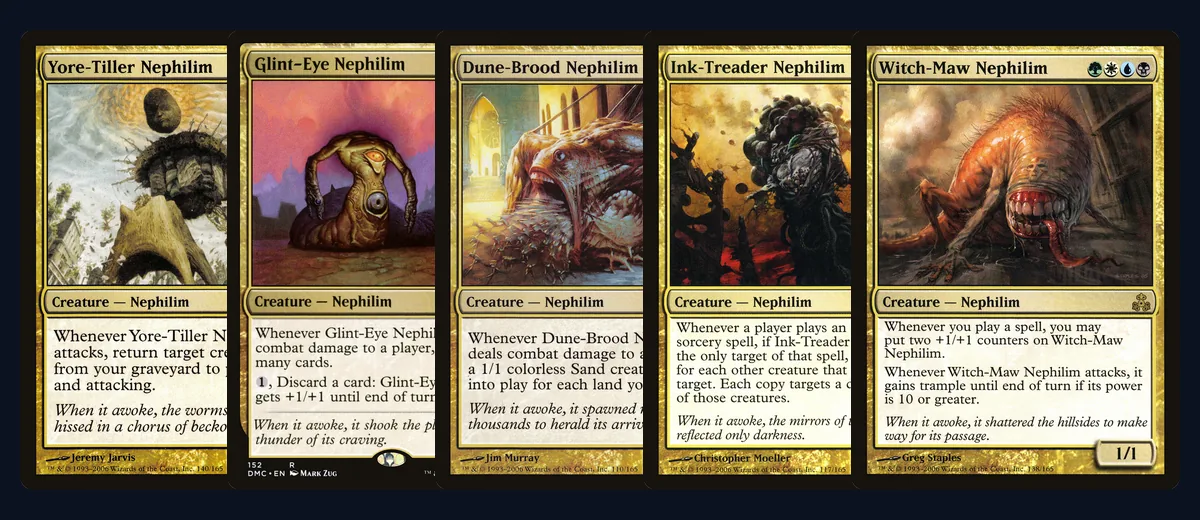 The five Nephilim, the cards behind the four-color nicknames. Card images: Scryfall, © Wizards of the Coast.
| Missing | Colors | Nephilim name | Commander 2016 theme | What the theme means | Legal commanders | EDHREC decks |
|---|---|---|---|---|---|---|
| Green | WUBR | Yore-Tiller | Artifice | Artifacts: build a machine, win over time | 3 | 59,858 |
| White | UBRG | Glint-Eye | Chaos | Variance: coin flips, cards cast blind | 1 | 18,687 |
| Blue | BRGW | Dune-Brood | Aggression | Kill the table as fast as possible | 1 | 16,005 |
| Black | RGWU | Ink-Treader | Altruism | Help every player, make yourself awkward to attack | 11 | 78,387 |
| Red | GWUB | Witch-Maw | Growth | Build up slowly with counters | 2 | 80,624 |
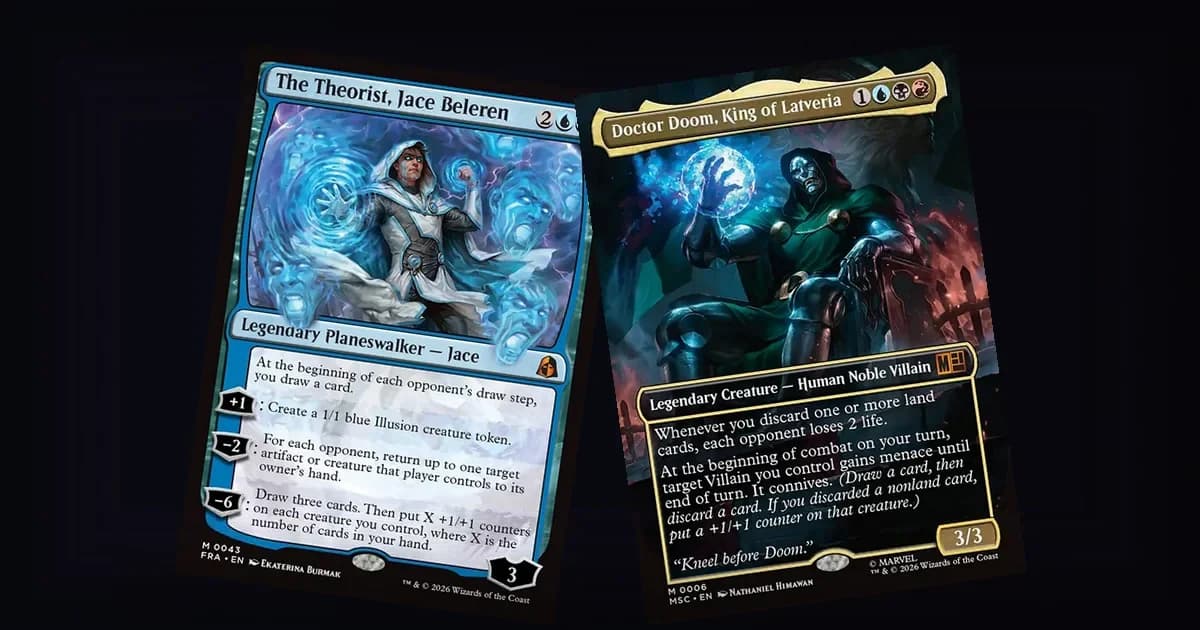
The commander column is the problem. Glint-Eye has exactly one card that can lead it alone (Yidris, Maelstrom Wielder), Dune-Brood has one (Saskia the Unyielding), and Witch-Maw's two are both Atraxa. Ink-Treader has the deepest bench thanks to Kynaios and Tiro of Meletis, Omnath, Locus of Creation and a pile of recent Universes Beyond cards such as The Fantastic Four. Yore-Tiller just tripled its options: Reality Fracture Commander added two planeswalkers,  frc-1
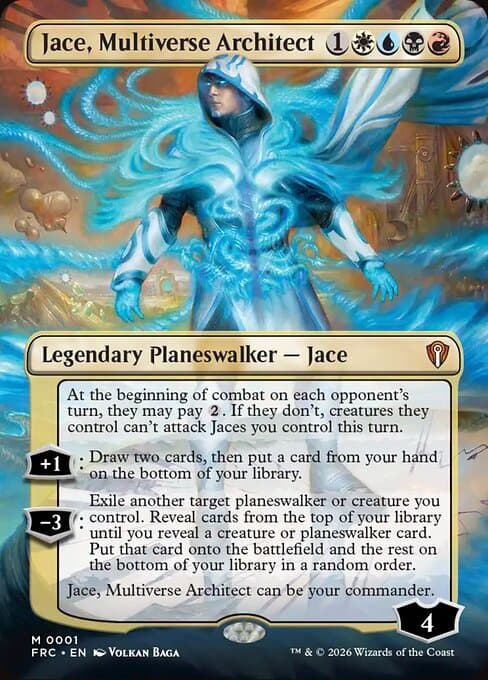 frc-1Shop on TCGplayer Jace, Multiverse Architect and
 frc-2
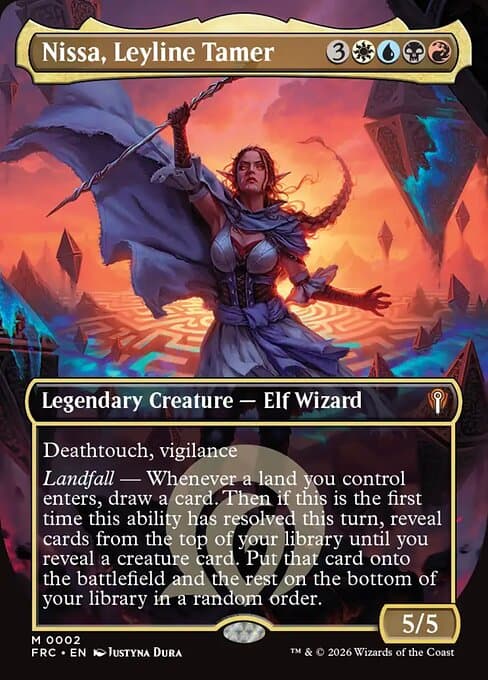 frc-2Shop on TCGplayer Nissa, Leyline Tamer, next to Breya, Etherium Shaper.
The Commander 2016 team saw this coming. Its design notes describe the pitch that became partner: "What if you could have two two-color commanders who could team up to lead a four-color deck?" If you want four colors and none of those single commanders appeals, two partners is the way in.
Players haven't settled the names either. In an r/magicTCG thread on why the Nephilim names stuck, u/slvstrChung pointed out the Nephilim simply came first: "That's a long time to assert dominance" (comment). Further down, u/th3saurus offered the version most people actually use at the table: "Imo the best way to think of 4c is as a three color combo splashing a fourth color, for example, jund splashing blue is Damp Jund" (comment). Which earned the reply "And Abzan splashing blue is moist junk" (u/SamTheHexagon).
Our advice: when you need to be understood, say the missing color. "Non-white" or "everything but blue" never confuses anyone, and you can drop Glint-Eye once the table nods.
Five colors: WUBRG
All five colors together is WUBRG, said "woo-berg." It's the outlier in every way. Five-color is the most-built identity on EDHREC, ahead of every guild, shard, wedge and mono color, and it has more legal commanders than any three-color group.
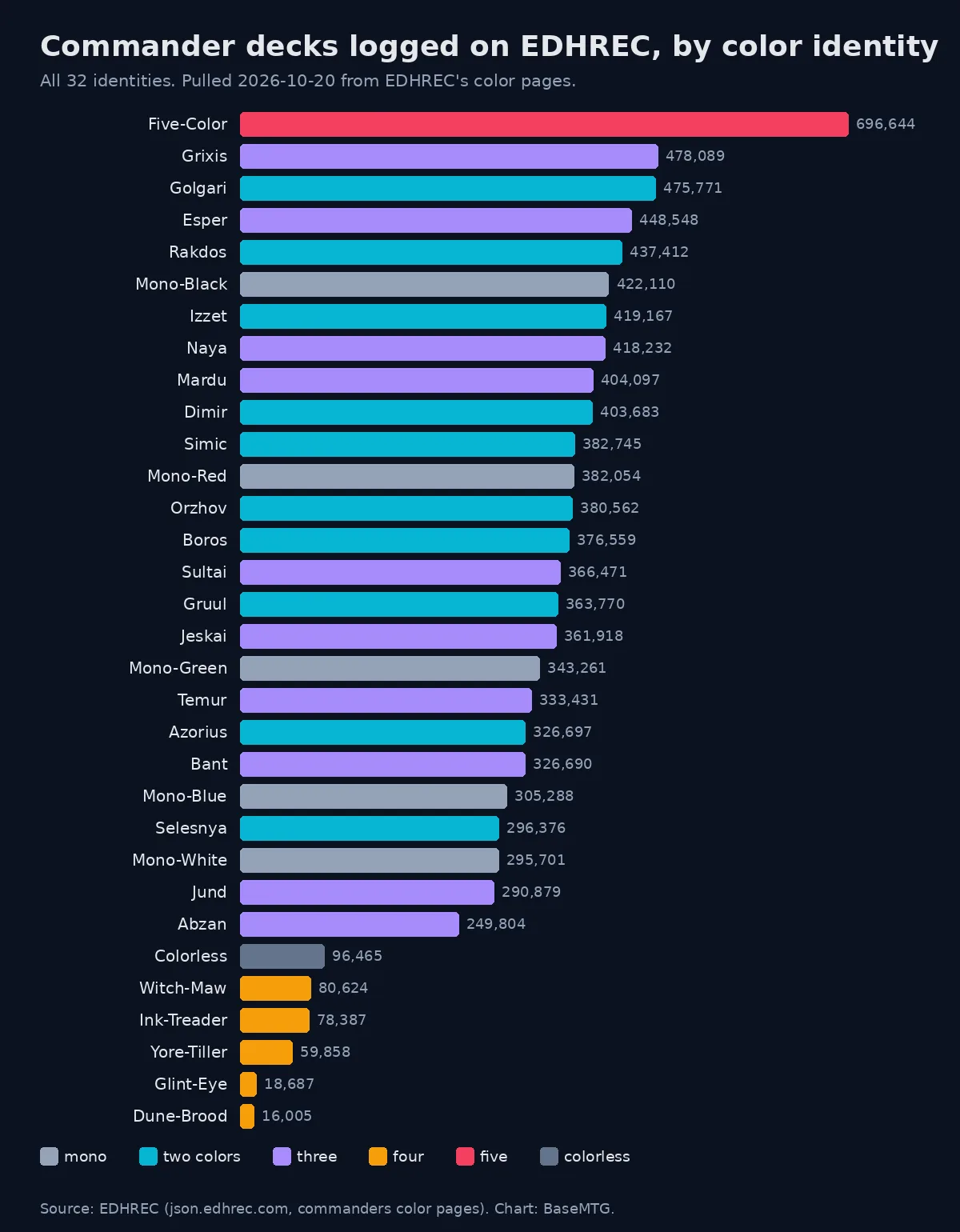 Commander decks per color identity on EDHREC, pulled October 20, 2026. Image: BaseMTG chart from EDHREC data.
The chart shows the real split in Commander: one, two, three and five colors all draw a crowd, four colors barely registers, and colorless trails everything except the four-color groups. Five-color decks pay for that popularity in the mana base, which is the next point.
How to pick your colors
1. Start with what you want to happen in a game. Each color has a one-line philosophy that predicts how it plays: white is peace through structure, blue is perfection through knowledge, black is power through opportunity, red is freedom through action, green is growth through acceptance. Pick the one or two that sound like your idea of fun, then read the "plays like" lines above for the pairs that contain them.
2. Build your first deck in two colors. The color pie pulls you toward more colors and the mana pulls you back; as MTG Wiki puts it, "The color pie therefore encourages playing as many colors as possible, while the mana system encourages playing as few as possible." Mono-color decks have the deepest commander pools of all, around three hundred per color, and the simplest mana, but every color is defined by what it can't do as much as by what it can. A second color is the cheapest fix. Two colors is where that balances best for a first deck, and Wizards builds most Limited sets around two-color decks for the same reason. Our mana base guide covers how many lands and sources each color needs.
3. Add a third color for a specific hole. Every pair has a weakness. Simic is the clearest example: Wizards' archetype breakdown says it "doesn't really have any actual removal." Add black and you're Sultai, add red and you're Temur, and now you can kill things. If you can't name the card the third color gets you, stay in two.
4. In Commander, the commander sets the colors. Your commander's color identity is the limit for every other card in the deck. Hybrid symbols count as both colors, reminder text is ignored, and our color identity rules guide covers the edge cases with real cards.
5. Check the commander pool before you fall for a combination. Guilds give you over a hundred choices each. Shards and wedges give you a few dozen. Two of the four-color groups give you one. If a specific commander is the reason you're building, this step is moot; if it's the colors you love, start where the pool is deep.
For the bigger picture on building and budgeting the deck once the colors are settled, start with the MTG Commander deck guide.
References
- MTG Wiki: Color
- MTG Wiki: Multicolored (pairs, triples, four colors, WUBRG)
- MTG Wiki: Shard and Wedge
- Wizards of the Coast: As Good as Gold (Mark Rosewater)
- Wizards of the Coast: Color Pair Building Blocks
- Wizards of the Coast: Designing Commander (2016 Edition)
- Scryfall: four-color commanders, for example the one Glint-Eye commander
- EDHREC: Commanders by color identity
- r/magicTCG: Why are the 4 color combinations known more for the Nephilim?
- DiceTry: Every Magic: the Gathering Color and Combination Explained (YouTube)
- Card images in the header and the Nephilim strip: Scryfall, © Wizards of the Coast
Was this guide helpful?
About the author

Commander & Budget Desk
Pen name for the BaseMTG Commander desk: budget builds, precons, upgrades and deck-building. Lists are priced from Scryfall on the publish date and every card pick comes with a reason.
- Commander builds, budget lists and precon upgrades
- Prices checked on Scryfall, dated in the article
- A sources table behind every card and number
Keep reading
MTG Mulligan Rules Explained: London Mulligan Step by Step
Guides · 7 min
Bury MTG Meaning: What the Old Destroy Wording Did
Guides · 13 min
Board Wipe in MTG: The 5 Kinds and Which Decks Play Them
Guides · 9 min
MTG Keyword Abilities Explained: Combat and Protection
Guides · 7 min
MTG Format Legality Explained: Standard vs Commander
Guides · 11 min
MTG Mana Base Guide: The Land Count Formula Explained
Guides · 15 min
MTG Color Identity: Hybrid, Phyrexian and Reminder Text
Guides · 15 min
How to Play Magic: The Gathering: Rules and Basics
Guides · 8 min
Disclaimer
This article is published for informational and entertainment purposes. It does not constitute professional financial, legal, or technical advice. Game performance, online services, patch schedules, and store listings change. Verify critical details (pricing, system requirements, regional availability) with publishers and storefronts before you buy. Affiliate links, where present, help support our editorial work and are labelled in our affiliate disclosure.