

BaseMTG · Guides
Bury MTG Meaning, Plus Extort and Discover Explained
Reviewing
Magic: The Gathering
The bury MTG meaning confuses anyone who finds a twenty-year-old card, and Extort and Discover cause their own trouble: players wonder why a Discover 3 ability did not behave like Cascade. Bury is retired terminology, Extort is a named life-drain trigger, and Discover is a newer library-exile action. This guide explains what each word means today and how to resolve a Discover trigger without skipping a step.
TL;DR: Bury meant "destroy it, and it can't be regenerated," but old cards now have Oracle text. Extort triggers once for each Extort permanent whenever you cast any spell, and its
{W/B}payment can use white or black mana. Discover N exiles cards until it finds a nonland card with mana value N or less, then lets you cast that card for free or put it into your hand before the leftovers go to the bottom of your library in a random order.
What Is the Bury MTG Meaning, and What Do Extort and Discover Do? (quick answer)
Bury is discontinued shorthand for destroying a permanent so it cannot be regenerated. Extort triggers whenever you cast any spell, lets you pay {W/B}, and drains each opponent for 1 life while you gain that much life. Discover N exiles cards until it finds a qualifying nonland card, then gives you the choice to cast it without paying its mana cost or put it into your hand.
Key Takeaways
- Treat Bury as historical card wording, not as a third modern removal category. Check the card's current Oracle text before playing it.
- Extort triggers for every spell, including instants, sorceries, and other noncreature spells. Each Extort permanent you control creates its own trigger.
- Paying
{W/B}for Extort means paying one white or one black mana for that trigger, not both. - In Commander, the hybrid payment symbol in Extort does NOT add to a card's color identity, because it appears inside the ability's italicized reminder text, and reminder text is ignored for color identity (rule 903.4b).
- Discover exiles cards as part of resolving the ability. You cannot stop early, and the discovered card is not automatically put onto the battlefield.
- If you cast the discovered card, you are casting a spell. It uses the stack, can be countered, and still requires non-mana additional costs.
Overview: Why These Three Terms Cause Confusion
These terms look like one vocabulary list, but they do different jobs. Bury is a retired word from an older templating era. Extort is a keyword ability that triggers whenever you cast a spell. Discover is a keyword action describing a library search, exile, and a possible free cast.
The safest habit is to separate the printed card from current rules text. Old cards can retain wording that no longer appears on new cards, while reminder text can compress a complete sequence into one parenthesis. When wording matters, use current Oracle text from Scryfall or Gatherer. Printed text is useful history, but it is not always the text that governs the card now.
Bury MTG Meaning: An Old Way to Say Destroy
The exact historical meaning of bury X was destroy X. It can't be regenerated. In other words, bury was a destruction effect with an added instruction that prevented a regeneration effect from saving the permanent. It did not mean exile, and it did not normally mean sacrifice.
Bury appeared in early Magic templating and was introduced in Revised in 1994. Wizards removed it from card templating beginning with Tempest and Sixth Edition around 1997 because the term caused rules confusion, especially around indestructible permanents and regeneration.
All old cards that used bury have received Oracle errata. Most now say some version of destroy [X]. It can't be regenerated. Some cards instead say sacrifice [X], because that wording preserves the intended interaction for that particular card better than a direct destroy effect does. That exception is why you should not translate every printed instance yourself during a game.
If a pre-1997 card says bury, look up its current Oracle text before you cast or resolve it. The practical lesson is simple: bury is not a distinct modern removal category. Start with its historical translation, then follow the actual current wording for that specific card.
GODEEPER: Bury is historical wording, while modern keywords are reusable rules shorthand. Use MTG Keyword Abilities Explained: Combat and Protection → for a broader guide to how defined abilities such as flying, deathtouch, trample, hexproof, and ward work.
Extort: What the Keyword Does
Extort first appeared in the Return to Ravnica block in 2012. Its reminder text is:
Extort (Whenever you cast a spell, you may pay
{W/B}. If you do, each opponent loses 1 life and you gain that much life.)
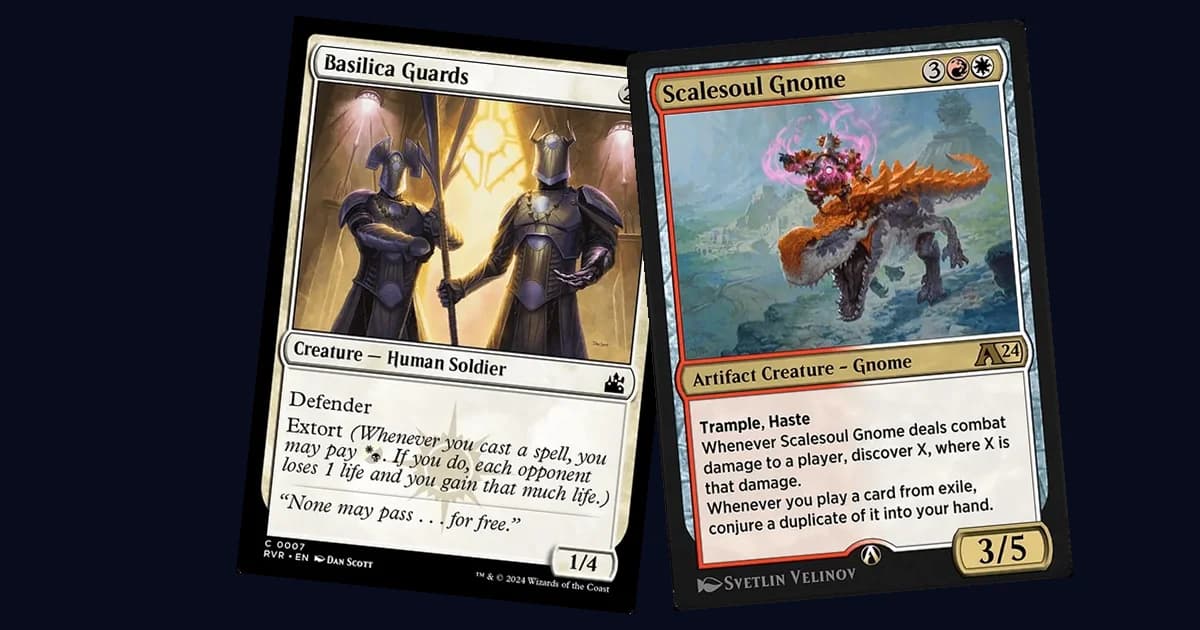
The first important word is any. Extort does not care whether the spell is a creature or a noncreature spell. Casting an instant, sorcery, artifact, or enchantment still creates the trigger. On a card such as Basilica Guards, the trigger waits on the stack after you cast your spell, and you decide whether to pay when it resolves.
The second important point is that Extort is counted per permanent. If you control two Extort permanents and cast one spell, you get two separate triggers. You can pay for neither, one, or both. Each payment makes each opponent lose 1 life, and you gain life equal to the total life lost from that trigger.
The {W/B} symbol is hybrid mana. For each Extort trigger, one white mana or one black mana pays the cost. You do not pay two mana, and you do not need one mana of each color. If you pay for two Extort triggers, you pay the hybrid cost twice.
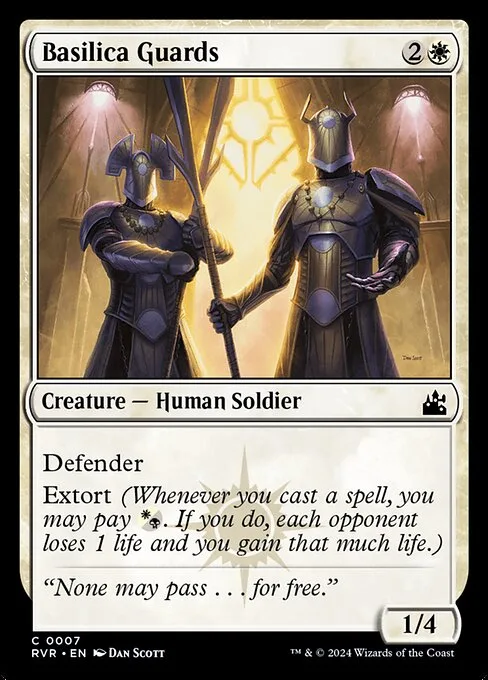 Basilica Guards' Extort reminder text shows the {W/B} hybrid payment printed directly in the card's own box.
There is also a Commander deckbuilding wrinkle, and it runs the opposite direction from what many players assume. The {W/B} in Extort's reminder text is a genuine mana symbol, but rule 903.4b tells you to ignore reminder text entirely when calculating color identity. A mono-black creature with Extort, such as Basilica Screecher, stays purely black in color identity even though its ability lets you pay white or black mana. Only mana symbols in the card's actual mana cost or in non-reminder rules text count.
GODEEPER: Reminder text is exactly the trap this rule sets for new Commander players. MTG Color Identity Explained: What Actually Counts → covers the full rule, including cards where a similar-looking symbol does count because it's printed outside reminder text.
Discover N: The Modern Keyword Action
Discover was introduced in The Lost Caverns of Ixalan in November 2023. The rules text is:
Discover N: Exile cards from the top of your library until you exile a nonland card with mana value N or less. You may cast it without paying its mana cost if the resulting spell's mana value is less than or equal to N. If you don't, put it into your hand. Put the remaining exiled cards on the bottom of your library in a random order.
The number matters. Discover 3 means you keep exiling from the top until you find a nonland card with mana value 3 or less. It does not mean you look at the top three cards, and it does not let you choose any card from a fixed group. Lands and nonland cards above the threshold are exiled along the way and remain part of the cleanup at the end.
Exiling is mandatory. The only choice comes after the ability finds a qualifying nonland card: cast it without paying its mana cost, or put it into your hand. If you choose to cast it, it is a spell on the stack. It is not being put onto the battlefield directly from exile. That means it can be countered, and effects that trigger whenever a player casts a spell can see it being cast.
Free does not mean costless in every sense. Discover removes the need to pay the card's mana cost, but non-mana additional costs still have to be paid. If the spell asks you to sacrifice a permanent or exile another card as an additional cost, you must still satisfy that cost. Normal casting permissions still matter.
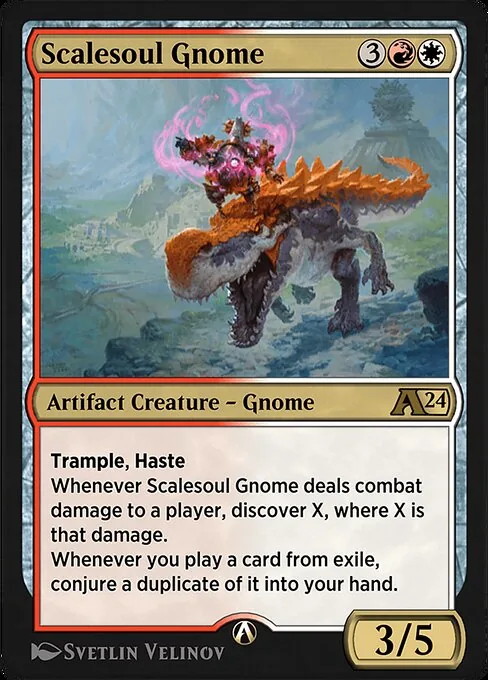 Scalesoul Gnome's own rules text uses "discover X" directly, tying the ability's size to the combat damage it deals.
Step-by-Step: How to Resolve a Discover Trigger
1. Read the value of N. Identify the number after Discover. It is the mana-value limit for the nonland card you seek and the resulting spell you may cast.
2. Exile cards from the top of your library. Exile the top card, then continue one card at a time. This part is mandatory. Do not stop because you see a card you like, and do not stop on a land.
3. Stop at the first qualifying nonland card. The search ends when you exile a nonland card with mana value N or less. A land or a nonland card above the limit does not qualify, so keep it exiled and continue looking.
4. Choose whether to cast it or put it into your hand. You may cast the qualifying card without paying its mana cost, subject to normal casting rules and any non-mana additional costs. If you do not cast it, put that card into your hand instead.
5. Finish the library cleanup. Put every other card exiled during the search on the bottom of your library in a random order. If you cast the discovered card, it is already a spell on the stack while Discover finishes resolving, so cast triggers can exist and an opponent can respond afterward.
Discover and Cascade: Similar Search, Different Rules
Discover and Cascade both exile cards from the top of your library until they find a nonland card under a mana-value threshold. That shared pattern makes them look interchangeable. They are similar, but not identical, so check the exact text before applying a Cascade shortcut to Discover.
The important Discover distinction is that you may cast a spell with a higher mana cost than N as long as the resulting spell's mana value is less than or equal to N. That bookkeeping can matter with alternative costs or cost reductions. Cascade uses its own flat comparison against the triggering spell's mana value. Read the keyword being used instead of relying on memory.
Tips for Reading These Terms on Real Cards
Check Oracle text for old cards. If a printed card says bury, do not make a table ruling from the word alone. Look up the current wording, especially because some cards received sacrifice errata instead of a destroy effect.
Count Extort triggers, not just spells. One spell creates one Extort trigger per Extort permanent you control. Put the triggers on the stack separately and decide on each payment as it resolves.
Separate casting from resolving. Discover can cast a card during the ability's resolution, but the card still becomes a spell. It can trigger cast-related abilities and can be countered after the Discover ability finishes.
Keep the exiled cards visible. Lands and over-threshold cards are not lost or shuffled immediately. Keep them separate until the Discover ability finishes, then put the remaining cards on the bottom in a random order.
Do not reduce Discover to its number. Discover 3 is not three cards and not three mana. It is an open-ended search for the first nonland card that satisfies the stated mana-value condition.
Frequently Asked Questions
What does bury mean in MTG?
Bury was old Magic wording for destroying a permanent and preventing it from being regenerated. It did not automatically mean exile or sacrifice. Because the term was retired, a modern player should check the card's Oracle text. Most cards now use destroy with a no-regeneration instruction, while some specific cards use sacrifice instead.
Is bury the same as sacrifice or exile?
Historically, bury was closest to destroy, not exile or sacrifice. Current Oracle text controls, however, and some cards that once used bury now say sacrifice because that preserves their intended behavior. Exile moves a permanent to a different zone without destroying it, so do not substitute exile when interpreting the old term.
Does Extort trigger on noncreature spells?
Yes. Extort triggers whenever you cast any spell, not only a creature spell. An instant, sorcery, artifact, enchantment, or planeswalker spell can all create the trigger. If you control multiple permanents with Extort, each one triggers separately for the same spell, giving you a separate payment decision for each trigger.
Do you need both white and black mana to pay Extort?
No. The {W/B} symbol is one hybrid mana, so one white mana or one black mana pays one Extort trigger. You cannot pay half with each color, and one payment does not cover multiple triggers. If several Extort triggers are waiting, decide and pay separately as each trigger resolves.
What does Discover 3 mean in MTG?
Discover 3 means exile cards from the top of your library until you exile a nonland card with mana value 3 or less. You then choose to cast that card without paying its mana cost or put it into your hand. It is not a choice among only the top three cards.
Can a discovered spell be countered?
Yes. If you choose to cast the discovered card, it becomes a spell on the stack rather than entering the battlefield automatically. It can trigger abilities that watch for spells being cast, and an opponent can counter it after the Discover ability finishes resolving. Any required non-mana additional costs still apply when you cast it.
What happens to the other cards exiled by Discover?
Every card exiled before the qualifying card remains exiled during the search. After you cast the qualifying card or put it into your hand, put the other exiled cards on the bottom of your library in a random order. Lands and nonland cards above the mana-value limit follow this same cleanup rule.
Related Reading
- How to Play Magic: The Gathering: Rules and Basics: a foundation for the game terms that surround these mechanics.
- MTG Board Wipes Explained: How They Work and When to Cast: compare destroy effects with exile, sacrifice, and other ways to answer permanents.
- MTG Commander Deck Guide: Building, Budget, and cEDH: the wider Commander rules context for color identity and deck construction.
- MTG Mana Base Guide: The Land Count Formula Explained: plan the mana that pays colored and hybrid costs consistently.
References
Was this guide helpful?
About the author

Commander & Standard Deck Analyst
Commander and cEDH grinder covering deckbuilding, precons, and the Standard/Commander metagame. Plays out of a local game store scene, reads spoilers the day they drop.
- Weekly Commander night regular, 6+ years
- Tracks EDHREC/MTGGoldfish data for every article
- Covers every Standard-legal set + Commander precon on release
Keep reading
MTG Board Wipes Explained: How They Work and When to Cast
Guides · 10 min
MTG Keyword Abilities Explained: Combat and Protection
Guides · 11 min
MTG Format Legality Explained: Standard vs Commander
Guides · 10 min
MTG Mana Base Guide: The Land Count Formula Explained
Guides · 13 min
MTG Color Identity Explained: What Actually Counts
Guides · 13 min
How to Play Magic: The Gathering: Rules and Basics
Guides · 5 min
cEDH Meaning in MTG: What Competitive Commander Actually Is
Guides · 11 min
MTG Commander Brackets Explained: The 5-Bracket System
Guides · 12 min
Disclaimer
This article is published for informational and entertainment purposes. It does not constitute professional financial, legal, or technical advice. Game performance, online services, patch schedules, and store listings change. Verify critical details (pricing, system requirements, regional availability) with publishers and storefronts before you buy. Affiliate links, where present, help support our editorial work and are labelled in our affiliate disclosure.