

BaseMTG · Guides
MTG Board Wipes Explained: How They Work and When to Cast
Reviewing
Magic: The Gathering
A board wipe is one of Magic: The Gathering's clearest answers to a crowded battlefield. If you have searched for "boardwipe mtg" or wondered what a board wipe actually does, the short version is simple: it removes many permanents at once, usually creatures. The important part is learning how the wording changes what survives, who gets hit, and when casting the spell helps you instead of your opponents.
TL;DR: A board wipe removes all permanents of a certain type at once, usually every creature on the battlefield. Most are symmetric, so your own board goes away too, while a card such as Cyclonic Rift can become a one-sided wipe. Check whether the effect destroys, exiles, or gives creatures -X/-X, then cast it when the board-state exchange and your next turn both favor you.
Key Takeaways
- A board wipe, also called a board sweep, removes many permanents of one type at the same time.
- "Wrath" is the narrower name for symmetric destruction of most or all creatures by one spell or ability.
- Most board wipes hit every player's board, so count what you lose as carefully as what opponents lose.
- Destroy, exile, and -X/-X use different rules, so indestructible or regeneration does not answer all three in the same way.
- The best timing usually comes from comparing board disparity, likely responses, and what you can rebuild afterward.
What Is a Board Wipe? (quick answer)
A board wipe is an instant or sorcery that destroys, exiles, or otherwise removes all permanents of a certain type at once, typically all creatures. It is also called a board sweep, and the term describes the mass-removal effect rather than one specific color, cost, or card. MTG Wiki's board sweep entry uses this broad definition.
One-Sided vs Symmetric Board Wipes
The default board wipe is symmetric. It affects every player's permanents that match the instruction, not only the creatures or other permanents controlled by your opponents. That is why a spell that says "destroy all creatures" can be a good play when you are behind, but a painful play when you have built the strongest board at the table. Before casting one, count both sides of the exchange.
Symmetry does not mean every player loses the same amount. If an opponent controls several creatures and you control none, the same effect may remove much more of their battlefield than yours. If you have developed a wide board of your own, the spell may reset the game while also giving up the advantage you worked to create. The right question is not simply whether a wipe is powerful. Ask who benefits from the battlefield after it resolves.
One-sided effects change that calculation. Cyclonic Rift is the clearest example in this guide: when overloaded for {6}{U}, it returns all permanents you do not control to their owners' hands. Your own permanents stay on the battlefield, so the effect functions as a one-sided wipe even though it does not destroy or exile anything. The card is also on Wizards' official Commander Brackets "Game Changers" list, which is a useful signal of how much its asymmetry matters in Commander.
The word "wrath" is more specific than "board wipe." It describes the symmetric destruction of most or all creatures in play by one spell or ability, a nickname that comes from the classic card Wrath of God. Every wrath is a type of board wipe, but the broader term also includes effects that exile, reduce toughness, return permanents to hands, or affect a different permanent type. The history of board wipes in Magic explains that distinction and the origin of the nickname.
Board wipes are most common in white, although black, red, and other colors have their own versions. Color changes the way a wipe works, so "board wipe" does not tell you whether the spell destroys, deals damage, exiles, or uses another instruction. Read the whole effect before assuming what will happen.
Destroy vs Exile vs -X/-X: Why the Wording Matters
"Destroy all creatures" is not the same as "exile all creatures" or "all creatures get -X/-X." Those phrases describe different ways of removing a battlefield. The distinction is especially important when a permanent has protection that answers only one kind of effect.
Destroy effects attempt to destroy the matching permanents. Indestructible can stop that destruction, and regeneration can also be relevant to a destroy effect. That is why Wrath of God and Damnation both include "They can't be regenerated" in their printed effect. Even with that wording, a creature with indestructible is not destroyed by a normal destroy instruction. You must check whether the permanent has a relevant ability or whether an opponent can provide one before the effect resolves.
Exile effects move the matching permanents out of the battlefield instead of destroying them. Indestructible does not stop exile, and regeneration does not turn an exile effect into a destroy effect. If the goal is to remove a creature that is difficult to destroy, exile wording can matter more than the general label "board wipe."
An -X/-X effect works through toughness rather than destruction. If the effect makes a creature's toughness zero or less, indestructible does not save it, because the creature is removed for having no toughness rather than being destroyed by the word "destroy." This is why a scalable -X/-X wipe can answer indestructible creatures that a flat destroy effect cannot. It also means the value of X must match the toughness you need to overcome.
These differences give you a quick reading test. First, identify the verb: destroy, exile, return, or reduce. Next, look at the board for the protection that matters against that verb. Finally, consider whether the wipe is symmetric. A spell can be excellent against an opponent's indestructible board and still be a poor play if it removes your own important creatures at the same time.
Step-by-Step: How to Time a Board Wipe Well
1. Count the board-state disparity. Compare what each player controls before you cast the spell. Count the permanents that will be affected, then ask which side loses more useful material. A wipe is usually easier to justify when an opponent has a much wider or more threatening board than you do, especially when your own affected permanents are replaceable or already absent.
2. Check the exact wording and protection. Confirm whether the spell destroys, exiles, returns, deals damage, or gives -X/-X before you commit. Then inspect the battlefield for indestructible, regeneration, and other effects that could change the result. Do not assume hexproof protects a permanent from a non-targeted board wipe, and do not assume a destroy effect handles indestructible creatures.
3. Hold priority and inspect responses. After casting the wipe, hold priority long enough to think through the responses opponents may have. Watch for an opponent protecting a key permanent, changing the board, or answering the spell before it resolves. If the wipe is your only way to catch up, make sure the effect is still useful after those possible responses rather than treating the cast as an automatic reset.
4. Plan what you rebuild into. Before casting, consider what your next board looks like after the effect resolves. A wipe is not automatically a winning play if every player is left with the same empty battlefield and an opponent can rebuild more effectively. Keep enough mana, cards, or a clear follow-up plan to make the new board favor you, not just to make the current board disappear.
Notable Board Wipes to Know
These five cards show why the label covers several different jobs. Their effects are more useful to remember as categories than as one generic "destroy everything" template.
-
Wrath of God. This is the classic white example: it costs {2}{W}{W}, is a sorcery, and says, "Destroy all creatures. They can't be regenerated." It is the card behind the "wrath" nickname, and it illustrates a symmetric destroy effect in its most recognizable form.
-
Damnation. This is the black counterpart to Wrath of God. It costs {2}{B}{B}, is a sorcery, and has the same effect: "Destroy all creatures. They can't be regenerated." The color changes, but the core destroy wording and the symmetric result remain the same.
-
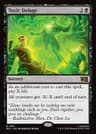
Toxic Deluge
 msc-161
 msc-161Shop on TCGplayer. This sorcery costs {2}{B} and asks you to pay X life as an additional cost. All creatures get -X/-X until end of turn. You choose how large X is, so the effect scales with the board, and the -X/-X wording gets around indestructible unlike a flat "destroy all creatures" effect.
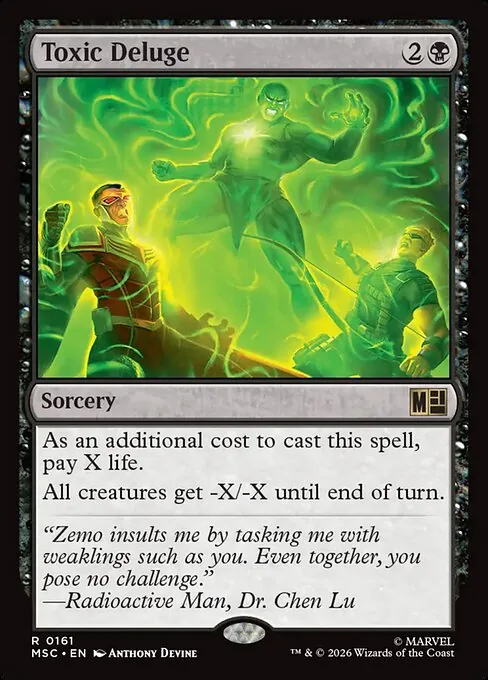 Toxic Deluge's -X/-X wording gets around indestructible, a genuinely different answer than a flat destroy effect.
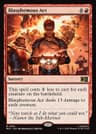
- Blasphemous Act
 msc-163
 msc-163Shop on TCGplayer. This spell costs {1} less for each creature on the battlefield, so it can cost as little as {R} against a wide board. It deals 13 damage to each creature. That makes it notable against a go-wide or token strategy, where the number of creatures both reduces its cost and gives the damage effect more targets.
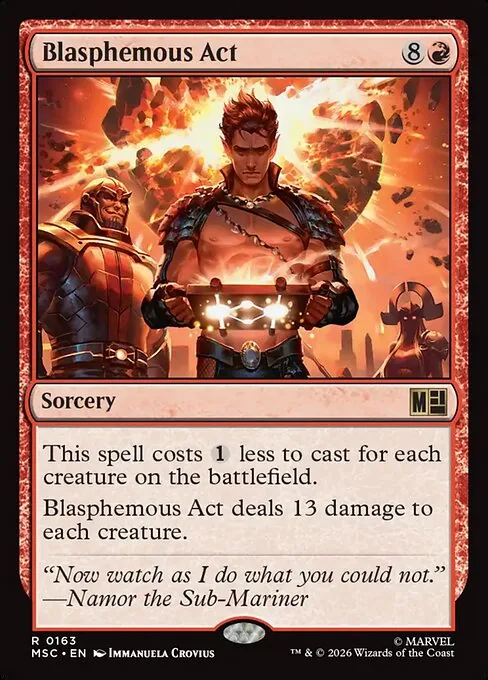 Blasphemous Act gets cheaper as the board gets wider, the opposite incentive of most removal spells.
- Cyclonic Rift. This blue instant can be overloaded for {6}{U} to return all permanents you do not control to their owners' hands. It is a one-sided wipe rather than a symmetric destroy effect, so it preserves your battlefield while clearing opponents' permanents from the board. Its place on the official Commander Brackets "Game Changers" list reflects that unusually strong asymmetry.
GODEEPER: Cyclonic Rift's Game Changers status connects board wipes to the way Commander groups discuss power. See MTG Commander Brackets Explained → for the broader bracket framework.
GODEEPER: Board wipes are also a useful example of why exact rules words matter. Use MTG Keyword Abilities Explained → as a wider reference for Magic abilities and their interactions.
Tips for Playing Around Board Wipes
These tips are for the player who expects someone else to cast the wipe.
- Do not commit every creature to the battlefield just because you can. Keep one or two threats back when the opponent's board is already under control and a wipe would otherwise erase your entire plan.
- Watch for open mana in colors where board wipes are common, especially white, black, or red. It is useful information when deciding whether to add another permanent.
- Separate your threats by importance. If an opponent casts a symmetric wipe, losing a small creature and your best threat at the same time may be much worse than keeping the best threat in reserve.
- Check the wording of the likely answer. Indestructible can matter against destroy, but it does not stop exile or an -X/-X effect that reduces toughness to zero or less. Hexproof also does not automatically protect a permanent from a non-targeted wipe.
- Rebuild with the next board state in mind. If you keep a threat or a way to re-establish pressure, the player who cast the wipe may not get to enjoy the reset for long.
Frequently Asked Questions
What is a board wipe in MTG?
A board wipe is an instant or sorcery that removes all permanents of a certain type at once, usually all creatures. "Board sweep" is another name for the same broad category.
Is a board wipe the same as a Wrath?
Not exactly. A Wrath is the narrower term for symmetric destruction of most or all creatures by one spell or ability, while a board wipe can also exile, return permanents, reduce toughness, or affect another permanent type.
Do board wipes destroy my own creatures?
Most do, because board wipes are symmetric by default and affect every player's matching permanents. Read the spell carefully: an effect such as Cyclonic Rift's overload returns only permanents you do not control, so it is one-sided.
Does indestructible stop every board wipe?
No. Indestructible can stop a destroy effect, but it does not stop exile or an -X/-X effect that makes a creature's toughness zero or less. Regeneration is also relevant to destroy wording, which is why some classic destroy wipes specify that creatures cannot be regenerated.
Is Cyclonic Rift a board wipe?
It functions as a one-sided board wipe when overloaded for {6}{U}. It returns all permanents you do not control to their owners' hands and leaves your own permanents in place, so it clears opponents' boards without using destroy or exile wording.
When should I cast a board wipe?
Cast one when the board-state exchange is favorable and you have considered the responses that can change the result. The strongest timing often comes when opponents control much more of the affected board than you do and you have a plan for what to do after the battlefield is reset.
Related Reading
- MTG Basics Complete Guide: Build the wider rules and gameplay foundation that makes mass-removal decisions easier to evaluate.
- MTG Format Legality Explained: Check how format rules shape the cards and strategies available to you.
- MTG Mana Base Guide: The Land Count Formula Explained: Plan the mana needed to cast a wipe and still develop your next board.
References
Was this guide helpful?
About the author

Commander & Standard Deck Analyst
Commander and cEDH grinder covering deckbuilding, precons, and the Standard/Commander metagame. Plays out of a local game store scene, reads spoilers the day they drop.
- Weekly Commander night regular, 6+ years
- Tracks EDHREC/MTGGoldfish data for every article
- Covers every Standard-legal set + Commander precon on release
Keep reading
Bury MTG Meaning, Plus Extort and Discover Explained
Guides · 11 min
MTG Keyword Abilities Explained: Combat and Protection
Guides · 11 min
MTG Format Legality Explained: Standard vs Commander
Guides · 10 min

MTG Mana Base Guide: The Land Count Formula Explained
Guides · 13 min
MTG Color Identity Explained: What Actually Counts
Guides · 13 min

How to Play Magic: The Gathering: Rules and Basics
Guides · 5 min
cEDH Meaning in MTG: What Competitive Commander Actually Is
Guides · 11 min
MTG Commander Brackets Explained: The 5-Bracket System
Guides · 12 min
Disclaimer
This article is published for informational and entertainment purposes. It does not constitute professional financial, legal, or technical advice. Game performance, online services, patch schedules, and store listings change. Verify critical details (pricing, system requirements, regional availability) with publishers and storefronts before you buy. Affiliate links, where present, help support our editorial work and are labelled in our affiliate disclosure.