BaseMTG · Guides
MTG Mulligan Rules Explained: London Mulligan Step by Step
MTG mulligan rules cover what happens when your first seven cards do not work as an opening hand. The current procedure gives you a fresh hand, then asks you to put cards on the bottom of your library.
The details that matter are the declaration order, the simultaneous mulligan action, the free first mulligan in multiplayer and Brawl, and the point where further mulligans stop. Commander needs one extra check, since a two-player game is not multiplayer under the Comprehensive Rules glossary.
TL;DR: A mulligan gives you a new hand of seven cards. After drawing it, put cards on the bottom of your library equal to the number of mulligans you have taken. In a multiplayer game, your first mulligan is free because it does not count toward the bottomed cards.
How Does a Mulligan Work in MTG? (quick answer)
Under the MTG mulligan rules, you shuffle your hand into your library, draw a new hand equal to your starting hand size, normally seven cards, and put a number of those cards on the bottom equal to the number of mulligans you have taken. If you keep that hand, the remaining cards become your opening hand and you cannot take another mulligan. In a multiplayer game and in any Brawl game, the first mulligan does not count toward either the bottomed cards or the number of mulligans you may take.
Key Takeaways
- Start with a hand of seven cards in the normal case.
- Declare mulligans in order, starting with the starting player.
- All declared mulligans happen at the same time.
- Bottom cards only after drawing the replacement hand.
- The first mulligan is free in multiplayer games and Brawl games.
Overview: The London Mulligan in the Comprehensive Rules
The current text is rule 103.5 in the Magic: The Gathering Comprehensive Rules effective as of September 25, 2026. It begins with each player drawing cards equal to their starting hand size, which is normally seven. A dissatisfied player may take a mulligan. The declaration order is not simultaneous: "First, the starting player declares whether they will take a mulligan." Each other player then does the same in turn order. Once all declarations are made, all players who chose a mulligan take it at the same time.
The action itself has two parts. First, shuffle the cards in your hand back into your library. Then draw a new hand equal to your starting hand size and put a number of those cards on the bottom of your library equal to the number of mulligans you have taken. You choose the cards to bottom in any order. If you choose not to mulligan, the hand remaining in front of you becomes your opening hand and you may not mulligan again. The rule lets a player take mulligans until their opening hand would be zero cards, after which they may not take further mulligans.
Wizards calls this procedure the London mulligan. It was adopted with Core Set 2020 in 2019. Wizards said it wanted one unified mulligan rule for all of Magic rather than a format-by-format rule.
GODEEPER: If the mulligan decision starts with your mana base, use the land-count formula. MTG Mana Base Guide: The Land Count Formula Explained →
Step-by-Step: How to Take a Mulligan
1. Look at the opening hand. Look at the cards you drew for your starting hand, normally seven cards. Decide whether that hand can become your opening hand or whether you are dissatisfied and want another look.
2. Declare in turn order. The starting player declares first, saying whether they will take a mulligan. Each other player then declares in turn order. No one performs the mulligan immediately after speaking; all players who declared one wait until every declaration is complete.
3. Shuffle and draw a new seven. If you declared a mulligan, shuffle all the cards in your hand back into your library, then draw a new hand equal to your starting hand size. In the normal case, that means drawing seven new cards, even though your final opening hand will be smaller after you bottom cards. Everyone who declared a mulligan performs this action together.
4. Bottom as many cards as mulligans taken. After the new hand is drawn, put a number of those cards on the bottom of your library equal to the number of mulligans you have taken. In a normal game, a first mulligan means bottoming one card; in multiplayer or Brawl, the first mulligan means bottoming none. For example, after two mulligans in a normal game, you draw seven cards on the second attempt, put two on the bottom, and keep five.
5. Keep or repeat. If you are satisfied, keep the cards left in hand; they are your opening hand and no more mulligans are allowed. If not, declare another mulligan when the process returns to you, then repeat the shuffle, draw, and bottom sequence. The rule lets players take mulligans until an opening hand would be zero cards, after which no further mulligans are allowed.
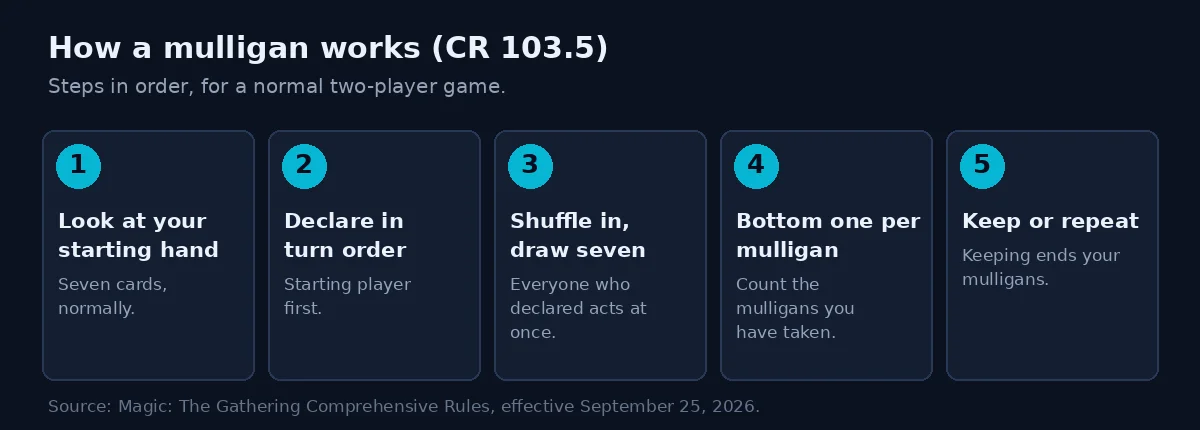 The mulligan procedure from rule 103.5, in the order the rules apply it.
Mulligan Rules for Commander and Multiplayer Games
In a multiplayer game, and in any Brawl game, the first mulligan does not count toward the number of cards bottomed or the number of mulligans you may take. The CR glossary defines a multiplayer game as one that begins with more than two players. A two-player Commander game is not multiplayer under the CR glossary, so its first mulligan is not guaranteed to be free by rule 103.5c.
Commander also has a starting-life rule: each player's starting life total is 40. That life total is separate from the opening-hand calculation. The table uses a starting hand size of seven and applies the rule directly: every attempt draws seven, while the bottoming count equals mulligans taken, except that the first multiplayer or Brawl mulligan is not counted.
| Mulligans taken | Normal game opening hand | Multiplayer or Brawl opening hand |
|---|---|---|
| 0 | 7 | 7 |
| 1 | 6 | 7 |
| 2 | 5 | 6 |
| 3 | 4 | 5 |
| 4 | 3 | 4 |
| 5 | 2 | 3 |
| 6 | 1 | 2 |
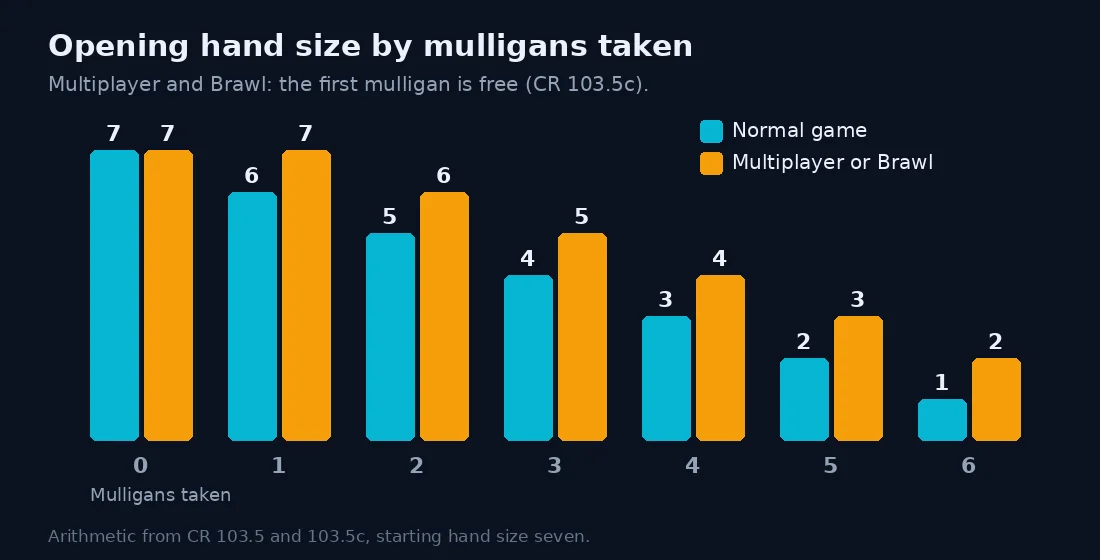 The same numbers as the table above. The free first mulligan keeps the multiplayer hand one card larger from the first mulligan on.
The table stops at six mulligans. In a normal game, a seventh mulligan would bring the opening hand to zero cards, which is where rule 103.5 applies its limit. In multiplayer or Brawl, the free first mulligan moves that point back by one mulligan. The table is arithmetic from rules 103.5 and 103.5c.
The number of players decides the first-mulligan treatment under the glossary definition, and Brawl has its own exception in the rule.
GODEEPER: Use this Commander deck-building guide when you want to connect opening-hand decisions to the deck itself. How to Build Your First Commander Deck: A Beginner Guide →
What Happens After Mulligans: Opening-Hand Actions
After the starting player has been determined, each player shuffles their deck so the cards are in a random order. Each player may then shuffle or cut an opponent's deck. This deck procedure happens before the opening-hand action window.
Some cards allow a player to take actions with them from their opening hand. Once the mulligan process is complete, the starting player may take any such actions in any order. Each other player may then do the same in turn order.
Tips for Deciding When to Mulligan
- You choose the cards to bottom only after seeing the new seven. General guidance: evaluate those seven as the actual choice set, because the rules do not make you name bottomed cards before drawing.
- The starting player declares first, and later players hear earlier declarations. That order is information available during the decision.
- In multiplayer or Brawl, the first mulligan costs no cards from the final hand. The first replacement hand remains seven cards before you keep it.
- Every additional counted mulligan reduces the final opening hand by one card. That change follows directly from the bottoming count in rule 103.5.
Frequently Asked Questions
How many cards do you draw for a mulligan in MTG? You draw a new hand equal to your starting hand size, normally seven cards. After drawing, you put a number of those cards on the bottom of your library equal to the number of mulligans you have taken. In a normal game, one mulligan leaves six cards in your opening hand.
What is the London mulligan? The London mulligan is the current mulligan procedure described in the Comprehensive Rules: each mulliganing player shuffles their hand into their library, draws a new hand of the starting size, then puts one card on the bottom for each mulligan taken. Wizards adopted it with Core Set 2020 in 2019 as one unified mulligan rule for Magic.
Do you get a free mulligan in Commander? You get a free first mulligan in a multiplayer Commander game, but not automatically in every Commander game. The CR glossary defines multiplayer as a game that begins with more than two players. A two-player Commander game is not multiplayer under the CR glossary, so its first mulligan is not guaranteed by the Comprehensive Rules.
Can you mulligan down to zero cards? Rule 103.5 says a player can take mulligans until their opening hand would be zero cards, after which they may not take further mulligans. In a normal game that limit arrives at a seventh mulligan, since each mulligan removes one card from a seven-card hand. In multiplayer or Brawl, the free first mulligan moves it back by one.
Who decides to mulligan first? The starting player declares first. After that, each other player declares in turn order. Players do not immediately perform their mulligans after speaking; once every player has declared, all players who chose to mulligan do so at the same time. This order lets later players hear earlier declarations.
Where do the cards you put back go? They go on the bottom of your library, in any order you choose. You first shuffle your current hand into your library, draw a new hand equal to your starting hand size, and then bottom the required number of cards. The cards remain part of your library after the mulligan.
Related Reading
- How to Play Magic: The Gathering: Rules and Basics: Use this rules primer for the larger sequence of starting a game.
- MTG Commander Deck Guide: Building, Budget, and cEDH: Continue with the deck-building decisions that shape future opening hands.
- MTG Format Legality Explained: Standard vs Commander: Compare the format rules that determine where different decks can be played.
References
Was this guide helpful?
About the author

Commander & Standard Deck Analyst
Commander and cEDH grinder covering deckbuilding, precons, and the Standard/Commander metagame. Plays out of a local game store scene, reads spoilers the day they drop.
- Weekly Commander night regular, 6+ years
- Tracks EDHREC/MTGGoldfish data for every article
- Covers every Standard-legal set + Commander precon on release
Keep reading
Bury MTG Meaning, Plus Extort and Discover Explained
Guides · 14 min
Board Wipe in MTG: Destroy vs Exile vs -X/-X Explained
Guides · 10 min
MTG Keyword Abilities Explained: Combat and Protection
Guides · 11 min
MTG Format Legality Explained: Standard vs Commander
Guides · 12 min
MTG Mana Base Guide: The Land Count Formula Explained
Guides · 15 min
MTG Color Identity: Hybrid, Phyrexian and Reminder Text
Guides · 18 min
How to Play Magic: The Gathering: Rules and Basics
Guides · 7 min
cEDH Meaning in MTG: What Competitive Commander Actually Is
Guides · 11 min
Disclaimer
This article is published for informational and entertainment purposes. It does not constitute professional financial, legal, or technical advice. Game performance, online services, patch schedules, and store listings change. Verify critical details (pricing, system requirements, regional availability) with publishers and storefronts before you buy. Affiliate links, where present, help support our editorial work and are labelled in our affiliate disclosure.