MTG Standard Rotation 2027: Which 6 Sets Leave and When
Six sets leave Standard after the Nauctis Prerelease, and 2026 has no rotation at all. Here's what goes, what stays, and how much of each Standard deck it takes with it, checked against Magic Spotlight Hartford.
Verdict
Start with your lands: more than a quarter of the nonbasic cards in mid-October's Challenge decks and at Magic Spotlight: Fracture rotate, and dual lands lead the list. Mono-Green Landfall loses the least, Dimir Midrange about half its deck.
MTG Standard rotation 2027 happens after the Prerelease of Nauctis: The Sunken Realm, the first premier set of 2027, which releases February 5, 2027. There's no rotation in 2026. The six oldest entries on Wizards' Standard list leave together, and the only published day so far is February 2, 2027, for MTG Arena. Wizards still hasn't given a paper rotation day or the paper Prerelease dates; we rechecked its Standard and Nauctis pages on October 26, 2026.
That leaves two questions worth your time: which sets go, and how much of a current deck goes with them. We answered the second twice: with every card in the October 8 to 15 Magic Online Standard Challenge decks, and again with the 777 decklists from Magic Spotlight: Fracture in Hartford, which finished on October 25.
Why There Is No Standard Rotation in 2026
There is no Standard rotation in 2026 because Wizards announced in October 2024 that rotation would move to coincide with the first set of the calendar year starting in 2027. Standard would continue to cover three years of sets, while 2026 became the transition year with no rotation.
Under that model, sets released in 2025, 2026, and 2027 are legal in Standard as of the first release of 2027. Wizards also said that Bloomburrow and Duskmourn: House of Horror would remain legal for slightly less time than first expected. That shorter window follows from moving the rotation point.
Wizards' Standard page still listed 20 entries on October 16, 2026. That total treats The Big Score as part of Outlaws of Thunder Junction and includes Through the Omenpaths, which the page marks as digital only. For a primer on how format legality works across formats, see MTG Format Legality Explained. For the broader Standard rules and set context, use Standard Format Complete Guide 2026.
MTG Standard Rotation 2027: The Six Sets That Leave
Applying Wizards' six-oldest rule to the Standard list checked October 16, 2026 gives the following six entries, ordered by release date.
| Set | Release date |
|---|---|
| Wilds of Eldraine | September 8, 2023 |
| The Lost Caverns of Ixalan | November 17, 2023 |
| Murders at Karlov Manor | February 9, 2024 |
| Outlaws of Thunder Junction, including The Big Score | April 19, 2024 |
| Bloomburrow | August 2, 2024 |
| Duskmourn: House of Horror | September 27, 2024 |
This is a six-entry result, even though some lists describe it as seven sets. Wizards' format page lists The Big Score inside Outlaws of Thunder Junction, while a source that counts The Big Score separately reaches seven named products. Either way, Outlaws of Thunder Junction and The Big Score leave together. Wizards hasn't published an announcement naming each departing set; the table applies its rule to its list.
Standard Rotation Schedule: 2027 Set, 2028 Projected
Wizards' rule fits in one sentence: "Once per year, after the first premier set Prerelease of the year, the six oldest sets in Standard rotate out." It publishes no multi-year calendar, so the 2028 row below is our reading of that rule, not an announcement.
| Rotation | When | Sets that leave | Status |
|---|---|---|---|
| 2027 | After the Nauctis: The Sunken Realm Prerelease; Arena on February 2, 2027 | Wilds of Eldraine, The Lost Caverns of Ixalan, Murders at Karlov Manor, Outlaws of Thunder Junction with The Big Score, Bloomburrow, Duskmourn | Rule applied to Wizards' current list |
| 2028 | After the first premier set Prerelease of 2028 (no 2028 set announced yet) | Aetherdrift, Tarkir: Dragonstorm, FINAL FANTASY, Edge of Eternities, Through the Omenpaths, Marvel's Spider-Man | Projected: the next six oldest, skipping Foundations |
| Foundations | Not before 2029 | Foundations | Wizards: legal in Standard "at least until 2029" |
The 2028 row only holds if Wizards keeps the six-oldest rule and keeps Foundations out of the count. If either changes, the list changes with it, so recheck it once the 2028 sets are announced.
How Much of Today's Standard Rotates
More than you'd guess from six set symbols. We took the 296 decklists from the ten Magic Online Standard Challenges between October 8 and 15 and checked every nonbasic card in their main decks against Scryfall. A card counts as rotating only when none of its printings is in a set that stays, so Foundations reprints are safe. Of 15,938 nonbasic main-deck cards, 4,427 rotate: about 28 percent. Not one of the 296 decks gets through untouched.
The cards most decks lose are lands. Four of the five most-played rotating cards are lands:
| Rotating card | Set it leaves with | Challenge decks playing it (of 296) |
|---|---|---|
| Gloomlake Verge | Duskmourn | 80 |
| Bitter Triumph | The Lost Caverns of Ixalan | 73 |
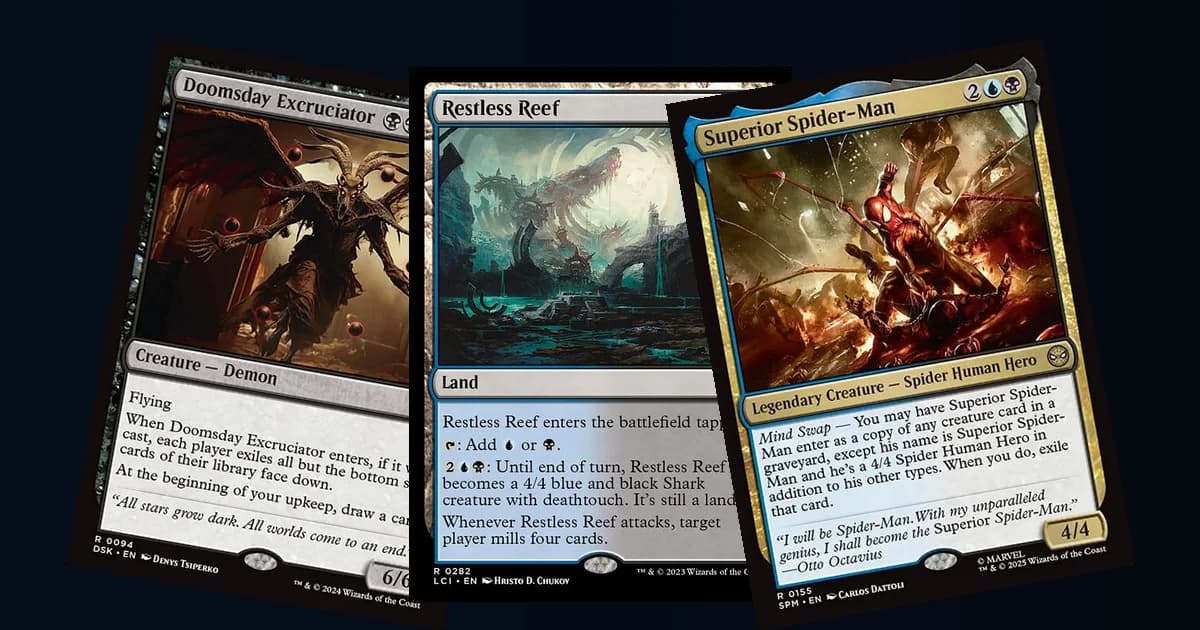
| Restless Reef | The Lost Caverns of Ixalan | 65 |
| Cavern of Souls | The Lost Caverns of Ixalan | 60 |
| Spirebluff Canal | Outlaws of Thunder Junction | 57 |
| Sleight of Hand | Wilds of Eldraine | 52 |
Two more Verges, Floodfarm and Blazemire, are in another 45 and 33 decks. Sleight of Hand is a useful example of step four below: it has been printed many times, but its only printing in today's Standard is Wilds of Eldraine, so it goes.
Which Standard Decks Survive the 2027 Rotation
Magic Spotlight: Fracture in Hartford gave us a paper field to run the same check on: all 777 decklists melee.gg published for the event, sorted into decks with the archetype rules from our Hartford meta report. The overall share barely moved from the Challenges: 11,697 of 41,462 nonbasic main-deck cards rotate, and only three of the 777 lists lose nothing. By deck, the gap is wide:
| Deck | Hartford lists | Nonbasic main-deck cards that rotate |
|---|---|---|
| Dimir Midrange | 53 | 52% |
| Orzhov Life Gain | 67 | 36% |
| Izzet Prowess | 22 | 34% |
| Izzet Spellementals | 61 | 34% |
| Jeskai Artifacts | 27 | 31% |
| Blue-black control | 58 | 31% |
| Jund Sacrifice | 42 | 31% |
| Azorius Control | 61 | 31% |
| Azorius Momo | 23 | 20% |
| Boros Dragons | 33 | 14% |
| 4c Control | 34 | 13% |
| Mono-Green Landfall | 97 | 12% |
Mono-Green Landfall, the most played deck at Hartford with two players in the top 8, is the safest deck to buy into: John Norman's and Ronan Casey's lists lose their four Fabled Passage plus two Keen-Eyed Curator or one Cavern of Souls, and nothing else. Dimir Midrange is the opposite. Both Dimir lists in the top 8 lose about half their nonbasic cards, among them four copies each of Kaito, Bane of Nightmares, Enduring Curiosity, Floodpits Drowner, Spyglass Siren and Gloomlake Verge. Alexander von Stange's winning Jund Sacrifice list loses 17 of its 57 nonbasic cards, including four each of Greedy Freebooter, Lively Dirge and Blooming Marsh. The rotating cards in the most Hartford lists were Bitter Triumph (176), Cavern of Souls (164) and Gloomlake Verge (159).
What Stays Legal After Rotation
The 14 other entries on Wizards' current list stay legal through the MTG Standard rotation 2027. They are shown below from oldest to newest, with the digital-only status called out where it applies.
| Set | Release date | Note |
|---|---|---|
| Foundations | November 15, 2024 | Wizards says it remains in Standard until at least 2029 |
| Aetherdrift | February 14, 2025 | 2025 set |
| Tarkir: Dragonstorm | April 11, 2025 | 2025 set |
| FINAL FANTASY | June 13, 2025 | 2025 set |
| Edge of Eternities | August 1, 2025 | 2025 set |
| Through the Omenpaths | September 23, 2025 | Digital only on Wizards' list |
| Marvel's Spider-Man | September 26, 2025 | 2025 set |
| Avatar: The Last Airbender | November 21, 2025 | 2025 set |
| Lorwyn Eclipsed | January 23, 2026 | 2026 set |
| Teenage Mutant Ninja Turtles | March 6, 2026 | 2026 set |
| Secrets of Strixhaven | April 24, 2026 | 2026 set |
| Marvel Super Heroes | June 26, 2026 | 2026 set |
| The Hobbit | August 14, 2026 | 2026 set |
| Reality Fracture | October 2, 2026 | 2026 set |
Wizards has said Foundations will remain in Standard until at least 2029. The other entries stay because they fit the three-year window at the first release of 2027. The table follows Wizards' entry structure, so Through the Omenpaths appears as one digital-only entry.
Nauctis: The Sunken Realm joins as the first set of 2027, with a February 5, 2027 release. Star Trek is scheduled for November 13, 2026 on our release calendar, cross-checked in September, and it is not yet on Wizards' 20-entry list. The six-oldest rule removes only the oldest entries, so Star Trek is unaffected. Kamigawa: Titanbreach is scheduled for June 4, 2027, followed by Zhalfir on October 1, 2027.
Counting entries makes the size of the change concrete. Wizards' list has 20 entries today, Star Trek (November 13, 2026) makes 21, and removing the six oldest while Nauctis joins leaves 16, a drop of five entries (about 24 percent) at the moment of rotation.
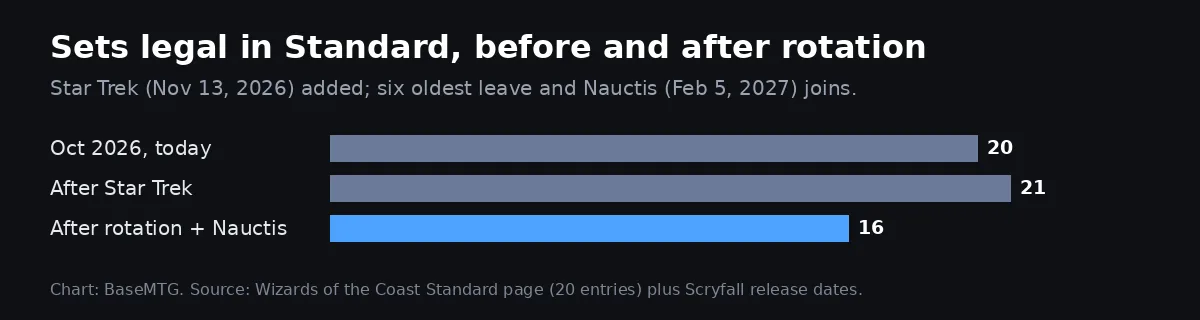 Image: BaseMTG chart. Source: Wizards of the Coast Standard page (20 entries, read October 10, 2026) and Scryfall release dates; the 21 and 16 are our arithmetic.
Players were already talking about the growth in August. In an r/magicTCG thread, u/Scott13Pippen wrote: "Currently standard has 18 sets, but by the end of the year we will have 21 sets." (r/magicTCG) Another commenter put the worry in one line: "It's like we've reintroduced the extended format." (u/Stef-fa-fa on r/magicTCG) Rotation is the release valve for that pressure, which is why the five-entry drop matters for deck planning, not just for the card pool.
For a creator walkthrough of the same change, Arstall published a rotation guide on July 28. It predates Reality Fracture, so check its card calls against the Wizards list above before relying on them.
*Video: "2027 Rotation Guide", Arstall on YouTube, published July 28, 2026.*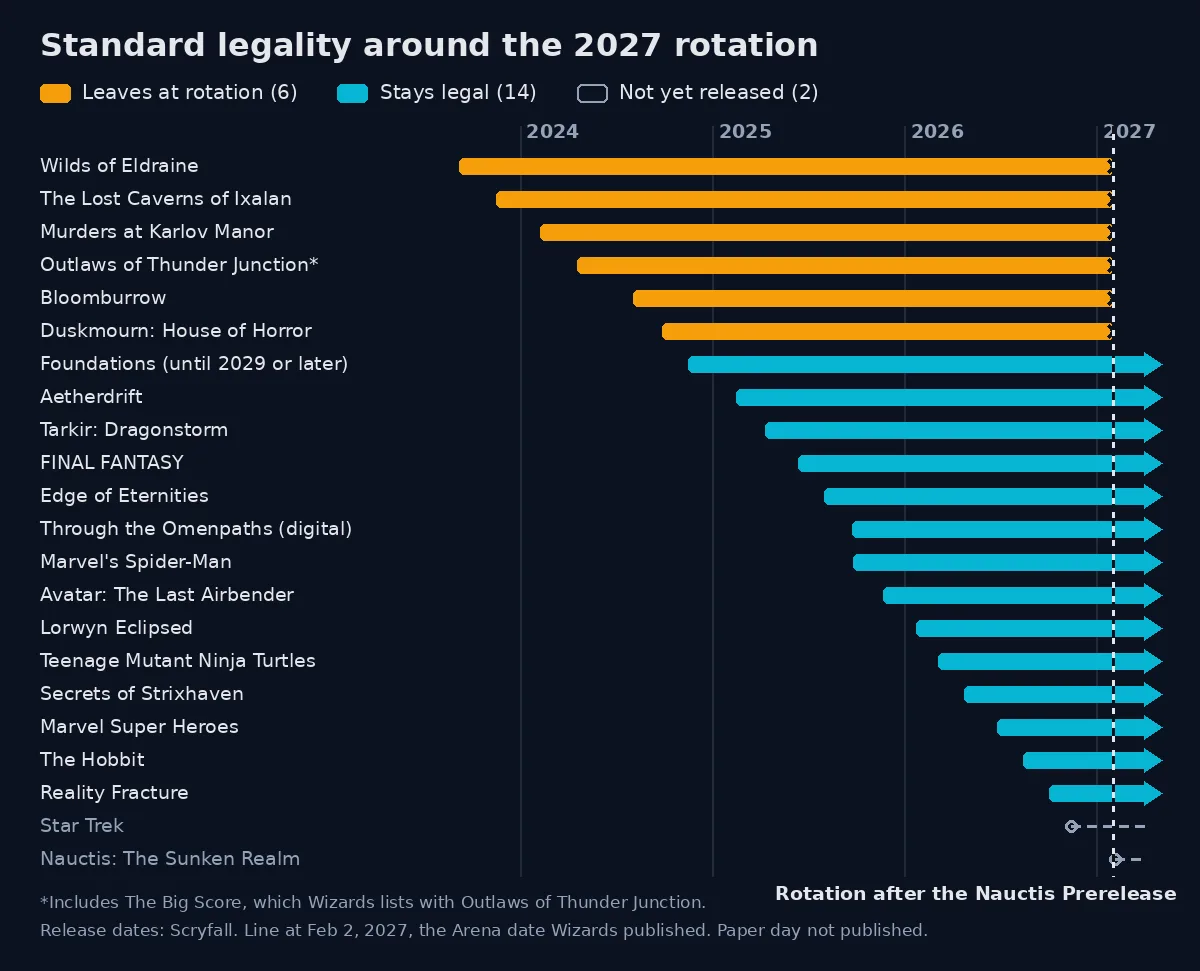 Image: BaseMTG chart. Source: Scryfall set release dates. The line marks February 2, 2027, the only rotation-related day Wizards has published, for Arena.
GODEEPER: See all seven Standard-legal 2026 releases in order, with their dates, in The 2026 MTG Standard Sets, Complete List →
MTG Standard Rotation 2027 on Arena vs Paper: Which Day Applies to You
Both the format page's rule and the Arena announcement key off the Nauctis: The Sunken Realm Prerelease, but the only published day is Arena's February 2, 2027. Wizards says Alchemy will be removed from MTG Arena on that date, with 2027's Standard rotation happening alongside the Nauctis: The Sunken Realm Prerelease events. Wizards hadn't published a paper rotation day when we checked on October 16, 2026, and the Nauctis product page still shows only the February 5 release.
Treat February 2 as a digital date. Don't assume paper uses the same day until Wizards publishes the paper schedule. The format page's wording matters here: it ties rotation to a Prerelease, not to a release date, so a checklist that only tracks release dates can miss the day the six sets actually leave.
For paper players, the planning anchor is the first Nauctis Prerelease. Fan sites fill the gap with January 29, 2027: MTG Rocks writes that it's "99% confident" rotation happens that day, the start of the Prerelease events it expects, while noting that Wizards hasn't confirmed the timing. Treat January 29 as a likely date, not an announced one. For Arena players, February 2 is the date for the Alchemy removal and the Standard change that goes with it.
Steps to Check Whether Your Deck Survives the 2027 Rotation
1. Export or write out your full 75. Include every card in the main deck and sideboard, not only the cards you expect to lose. A complete list keeps lands and sideboard answers in the audit.
2. Look up each card's printings on Scryfall. Open the card's "All prints" view and record every set that contains a printing. Scryfall's Standard legality badge tells you the card's legality today. It doesn't project the 2027 rotation, so a Legal badge won't warn you about a card whose printings all leave.
3. Mark printings from the six leaving sets. Use the set codes WOE, LCI, MKM, OTJ, BIG, BLB, and DSK. OTJ and BIG leave together because Wizards treats The Big Score as part of Outlaws of Thunder Junction for this list. Mark the set for every printing rather than stopping at the first result.
4. Keep a card if one printing is in a staying set. A card remains legal when at least one of its printings is in a set that stays, and Foundations counts for this test. Flag only cards whose every printing is in one of the leaving sets. This separates a real legality problem from an older set symbol on the copy you own.
5. Assign a role to each flagged card and start replacement work. Write down whether it supplied removal, mana fixing, a threat, or card advantage, then search the 2025 and 2026 sets for the same job. Revisit the search when Nauctis spoilers arrive, since the first 2027 premier set can add new options.
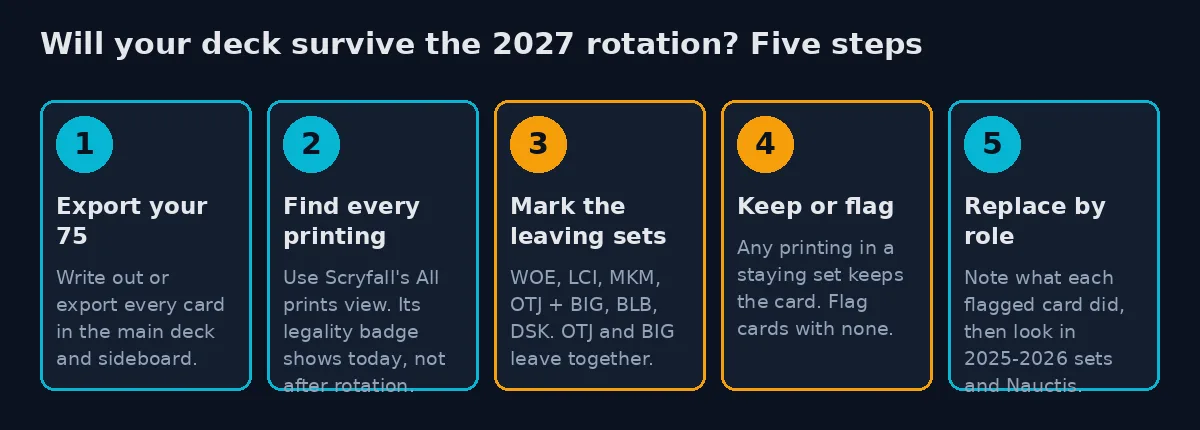 Image: BaseMTG checklist graphic, drawn from the five steps in this article.
GODEEPER: Once you know which cards you keep, compare your archetype against the current results in the MTG Standard Tier List →
Our Take: Rebuild the Mana First
Rebuild your mana first. February 2 is the date for Arena, and for paper it's whatever the first Nauctis Prerelease turns out to be, but the work doesn't depend on the date: the dual lands that hold today's two-color decks together are the biggest single loss, and the replacement pool from the 2025 and 2026 sets is already fully known. If you're choosing a deck now, Mono-Green Landfall carries almost all of itself past the rotation and Dimir Midrange keeps about half. Run the five-step audit now, starting with the land count, and leave the spells until Nauctis spoilers show what the first 2027 set adds.
Tips for Planning Around Rotation
- Audit legality before changing the strategy. A deck may lose fewer functional pieces than its oldest set symbols suggest, because another printing can keep a card legal.
- Start with mana and sideboard roles. A missing threat is easy to notice, but losing a color source or a narrow answer can quietly change how the deck is built.
- Keep two lists: cards that are definitely affected by the six oldest entries, and cards that are merely candidates for replacement. The second list is a testing decision, not a rotation rule.
- Recheck Wizards' Standard list after each Prerelease and release. The replacement pool changes whenever a new set is added, and rotation itself keys off a Prerelease.
- Run the five steps on Izzet Spellementals, Dimir Midrange, and Mono-Green Landfall rather than assuming which cards leave from the deck names alone. Our Golgari Standard deck guide has already run them on both Golgari builds.
Once each flagged card has a job written down, testing replacements is a comparison against the deck's curve, mana, and sideboard plan.
Related Reading
- Reality Fracture Standard Preview: What Reality Fracture adds to Standard, one of the 14 sets that stay after rotation.
- MTG Set Reviews Complete Guide: Set-by-set coverage for the sets that stay legal.
- Most Expensive Standard Cards in MTG: Buy, Hold or Skip: which expensive cards rotate in early 2027 and which to skip because of it.
- The 12 Best Cards in Reality Fracture, Ranked: Our ranking of the strongest cards in a set that stays legal through 2027.
- MTG Card Market Complete Guide: Background on how MTG card prices work, useful before you buy into or out of a set.
- Dimir Excruciator Standard Deck Guide and 60-Card List: which of this deck's cards leave Standard at the early 2027 rotation.
- Mono-Black Aggro Standard Deck Guide and 60-Card List: which of this deck's cards leave Standard at the early 2027 rotation.
- MTG Standard Banned List: All 14 Entries (October 2026): Every banned card with cost and set, plus what Wizards said on August 10.
- MTG World Championship 2026: Schedule, Format and Prize: World Championship 32 runs November 13-15, with Standard decklists due November 11.
References
- Wizards of the Coast: Aligning the Universes: Making All Our Sets Legal in All Our Formats
- Wizards of the Coast: Standard format page
- Wizards of the Coast: Everything Announced for the Magic Multiverse in 2027
- Wizards of the Coast: MTG Arena State of the Formats 2026
- Wizards of the Coast: Announcing Magic: The Gathering Foundations
- 21 sets in standard is a massive problem, r/magicTCG
- 2027 Rotation Guide, Arstall on YouTube
- Scryfall sets API
- Magic Spotlight: Fracture, Hartford standings and decklists (melee.gg)
- MTG 2027 Rotation: Everything You Need to Know, MTG Rocks
Was this guide helpful?
About the author

Standard & Metagame Desk
Pen name for the BaseMTG Standard desk: deck guides, metagame reports and tournament results. Each piece starts from published tournament lists and dated metagame data, with a sources table behind every number.
- Standard decks, metagame and tournament results
- A sources table behind every number
- Mana and opening-hand odds computed by script, run count stated
Keep reading
Azorius Momo Standard Deck Guide: Decklist and Matchups
Guides · 12 min
MTG Standard Meta After Reality Fracture: Decks to Play Now
Guides · 23 min
Boros Dragons Standard Deck Guide: Smaug and Sarkhan
Guides · 14 min
Jund Standard Deck Guide: Sackville-Bagginses Sacrifice
Guides · 9 min
Rakdos Standard Deck Guide: Lizards After Reality Fracture
Guides · 12 min
Dimir Midrange Standard Deck Guide: Decklist and Sideboard
Guides · 16 min
Dimir Excruciator Standard Deck Guide and 60-Card List
Guides · 11 min
Orzhov Lifegain Standard Deck Guide: Decklist and Tips
Guides · 13 min
Disclaimer
This article is published for informational and entertainment purposes. It does not constitute professional financial, legal, or technical advice. Game performance, online services, patch schedules, and store listings change. Verify critical details (pricing, system requirements, regional availability) with publishers and storefronts before you buy. Affiliate links, where present, help support our editorial work and are labelled in our affiliate disclosure.