MTG Stack Explained: How Priority and Responses Work
Picture the stack as a pile where the newest card resolves first, and most of the 'wait, can I do that?' arguments at the table settle themselves.
Verdict
Spells and abilities go on the stack one at a time and the last one added resolves first. Nothing resolves until every player passes in a row, so anyone can answer anything before it happens.
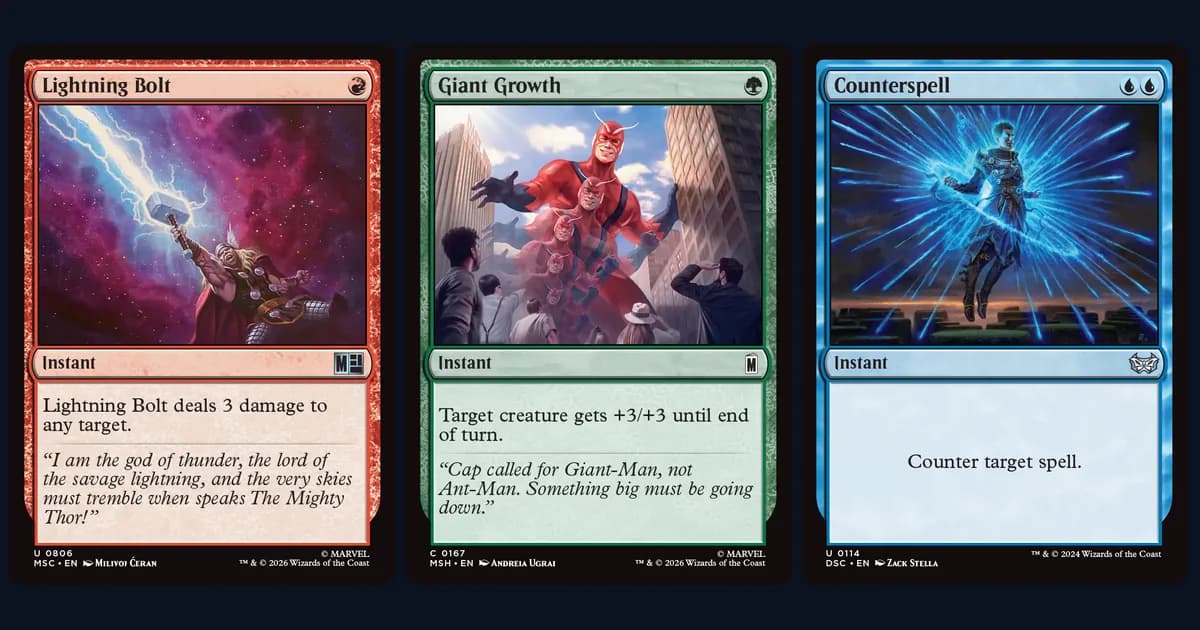
The MTG stack is where spells and abilities wait before they happen, and it has one rule that does most of the work: the last thing added resolves first. You cast something, it sits on the stack, every player gets a chance to answer it, and only when everyone passes in a row does the top item resolve.
That's the whole system. The rest of this guide is how priority moves around the table, what skips the stack completely, and the handful of edge cases that decide real games.
How the MTG stack works, step by step
The Comprehensive Rules put it in two sentences. Each new spell or ability "is put on top of all objects already there", and "when all players pass in succession, the top (last-added) spell or ability on the stack resolves." Here's how that plays out in order:
- You cast a spell. The card goes onto the stack. Activated and triggered abilities go there too, just without a card.
- You get priority back. Casting doesn't hand the turn to anyone. You can add another spell on top of your own before anyone else acts. Players call this holding priority.
- You pass. Priority goes to the next player in turn order, then the next, around the table.
- Someone responds. If any player casts an instant or activates an ability, it goes on top. That's what "in response" means: the new thing resolves first. Priority then goes around again.
- Everyone passes in a row. The top item resolves. Only that one.
- The active player gets priority again, and the loop restarts with whatever is left on the stack. When the stack is empty and everyone passes, the step or phase ends.
Two timing rules sit on top of this. Instants can be cast any time you have priority. Everything else (creatures, sorceries, artifacts, planeswalkers) needs your own main phase and an empty stack. That second condition is why you can't flash a sorcery out in response to anything.
A worked example: Bolt, Giant Growth, Counterspell
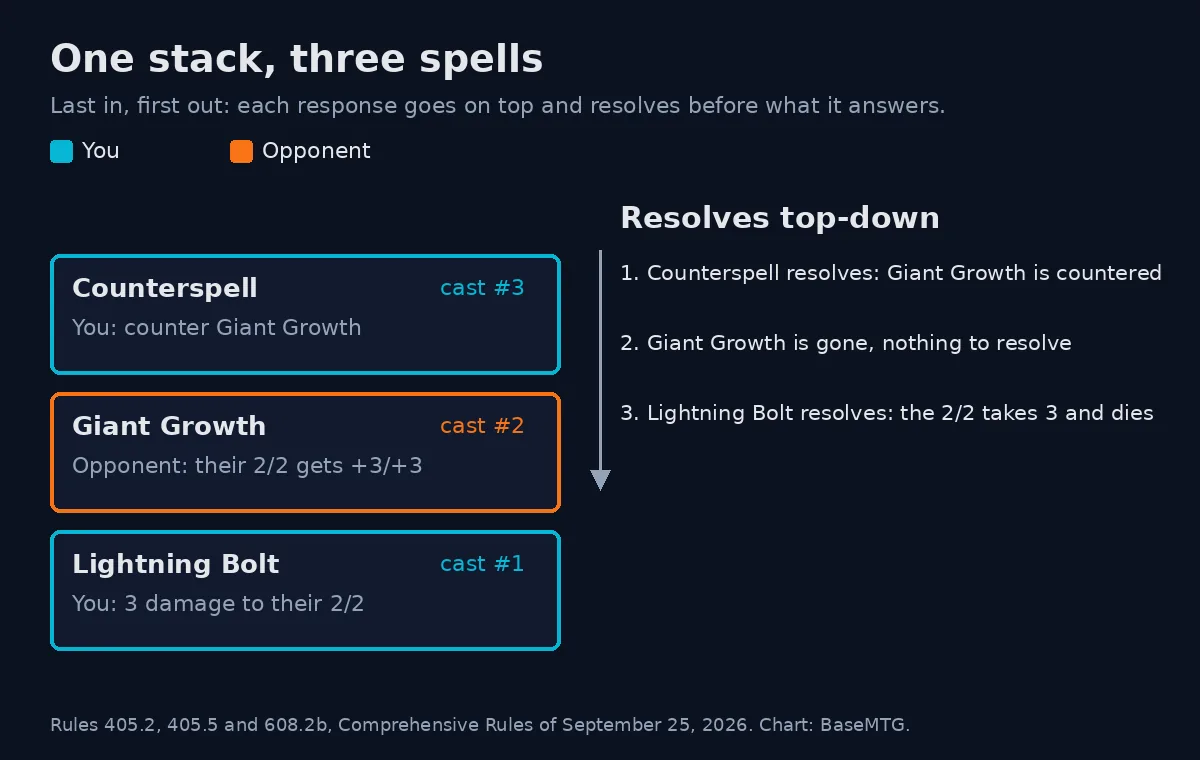 The example below, drawn as a stack. Image: BaseMTG chart from rules 405.2, 405.5 and 608.2b.
Your opponent has a 2/2. You cast Lightning Bolt at it: "Lightning Bolt deals 3 damage to any target." Bolt is on the stack, nothing has happened yet.
Your opponent responds with Giant Growth on the 2/2 ("Target creature gets +3/+3 until end of turn"). Giant Growth is now on top. If everyone passes here, Giant Growth resolves first, the creature becomes a 5/5, then Bolt resolves and deals 3 to a creature that survives it. The response won.
But you hold up two blue mana and cast Counterspell targeting Giant Growth. Now the stack, from the top, is Counterspell, Giant Growth, Bolt. Counterspell resolves and counters Giant Growth. Bolt resolves last and the 2/2 dies. Three spells, and the one cast first did its job last.
One more twist on the same board. Say the opponent had sacrificed the 2/2 in response instead. When Bolt tries to resolve, its only target is gone, and the rules say a spell whose targets are all illegal "doesn't resolve" and goes to the graveyard. Players call that fizzling. Bolt doesn't hit anything else, because the target was chosen when you cast it.
What doesn't use the stack
Some things skip the MTG stack entirely, with no chance to respond, and knowing the list saves a lot of table arguments:
- Mana abilities. Tapping Sol Ring for two colorless mana resolves at once. The rules say a mana ability "can't be targeted, countered, or otherwise responded to." Same for a Llanowar Elves tapping for green.
- Playing a land. It's a special action, not a spell. Nobody can respond to your land drop, so nobody can counter it either. Sorry, Counterspell.
- Combat damage. It's dealt the moment it's assigned. The rules say no player gets a window "between the time combat damage is assigned and the time it's dealt." Your tricks go in before damage, during the declare blockers step.
- State-based actions. A creature with lethal damage dies, a player at 0 life loses. These are checked every time a player would get priority, with no stack involved.
- Static abilities. "Creatures you control get +1/+1" just applies. There's nothing to respond to.
Keyword abilities like flying or deathtouch are static too; our keyword abilities guide covers how they work in combat.
Triggered abilities on the MTG stack
A triggered ability ("whenever", "when", "at the beginning of") doesn't go on the stack the instant it triggers. The rules say "nothing actually happens at the time an ability triggers." It waits until the next time a player would get priority, then goes on the stack like anything else, and players can respond to it.
When several abilities trigger at once, the active player puts all of theirs on the stack first, in any order they like, then the next player in turn order does the same. Since the stack resolves from the top, the active player's triggers resolve last. In a four-player Commander game that ordering matters every time a board wipe sends a dozen creatures to the graveyard at once.
Targets get locked in when the trigger goes on the stack, not when it resolves. "As soon as a triggered ability goes on the stack, if it requires a target, you must name the target before any other abilities resolve," wrote @ethanboyd2981 under The Command Zone's priority episode. So you can't order two triggers so that the first one puts a creature onto the battlefield and the second one targets it. The creature wasn't there when the second trigger needed a target.
The edge cases that decide games
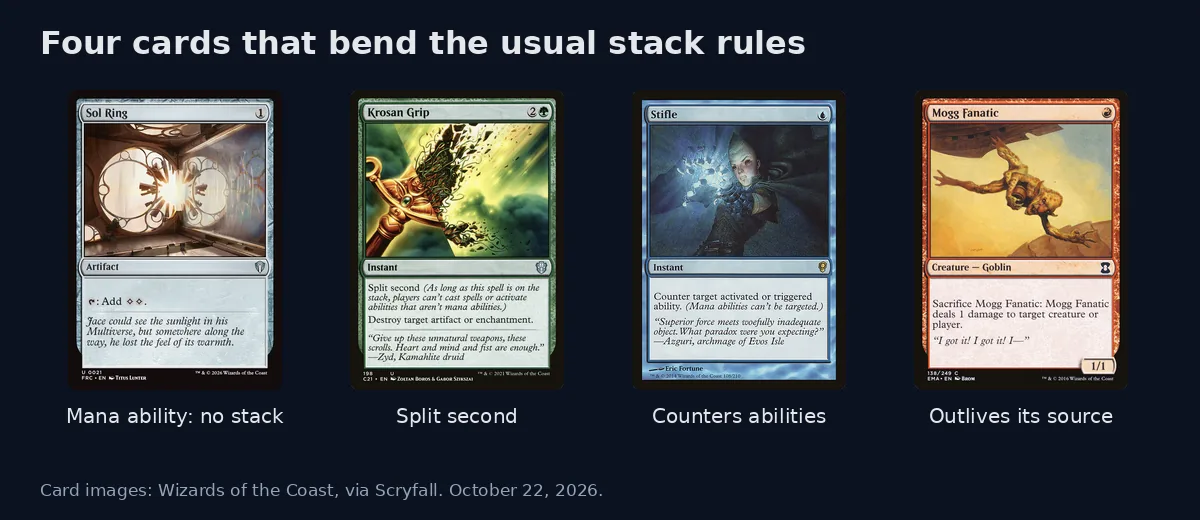 Card images: Wizards of the Coast, via Scryfall. Mogg Fanatic's printed wording is older; its current Oracle text reads "any target".
An ability outlives its source. Once an ability is on the stack it "exists on the stack independently of its source." Classic case: your opponent Bolts your Mogg Fanatic ("Sacrifice this creature: It deals 1 damage to any target"). In response, you sacrifice it. The Fanatic is gone, but its ability still resolves and deals its 1 damage. Then Bolt has no target and fizzles. You turned a removal spell into a free ping.
Abilities can be countered too, by the right card. Counterspell only hits spells. Stifle reads "Counter target activated or triggered ability," which is how you stop a fetch land search or an enters-the-battlefield trigger. Mana abilities are out of reach even for Stifle.
Split second shuts the window. While a split second spell like Krosan Grip is on the stack, players "can't cast other spells or activate abilities that aren't mana abilities." Triggered abilities still trigger and go on the stack as normal, but nobody can answer the Grip with a spell. If your plan to protect an artifact is "I'll respond", split second is the card that says no.
Who gets priority after something resolves. It's always the active player, never the player whose spell just resolved. On your own turn that means after an opponent's instant resolves in your main phase, the stack is empty and you're first to act again, so you can still cast a sorcery or a creature before moving to combat.
The basics of a Magic turn and older wording that still shows up on reprints, like bury, are worth a read once the stack clicks.
How players teach it
Priority is the part new players miss, and veterans know it. "Sometimes it feels like you have to explain priority more than actually playing the game at your LGS," wrote @peeporiot9948 in one of the most-liked comments on that episode.
The best fix we found in those comments came from someone who taught kids at a summer camp. "What i used to teach priority is have a dealer chip. So when I pass priority to a player I would give the chip to that player. I told the kids only the person with the chip can cast a spell or use an ability," wrote @sagibear2506. It's a slow way to play one game and a quick way to make the stack visible, which is the point.
The full episode runs well over an hour and walks through priority, the stack and triggers with real Commander boards:
References
Was this guide helpful?
About the author

Spoilers & New Sets Desk
Pen name for the BaseMTG new-sets desk: spoiler season, set reviews, Universes Beyond crossovers and rules news. Cards are read from the official text, and what is confirmed is kept apart from our own reading of it.
- Spoilers, set reviews and Universes Beyond
- Card text read from official sources
- Confirmed facts marked apart from our reading
Keep reading
MTG Color Combinations: Names, Playstyles and How to Pick
Guides · 10 min
MTG Mulligan Rules Explained: London Mulligan Step by Step
Guides · 7 min
Bury MTG Meaning: What the Old Destroy Wording Did
Guides · 13 min
Board Wipe in MTG: The 5 Kinds and Which Decks Play Them
Guides · 9 min
MTG Keyword Abilities Explained: Combat and Protection
Guides · 7 min
MTG Format Legality Explained: Standard vs Commander
Guides · 11 min
MTG Mana Base Guide: The Land Count Formula Explained
Guides · 15 min
MTG Color Identity: Hybrid, Phyrexian and Reminder Text
Guides · 15 min
Disclaimer
This article is published for informational and entertainment purposes. It does not constitute professional financial, legal, or technical advice. Game performance, online services, patch schedules, and store listings change. Verify critical details (pricing, system requirements, regional availability) with publishers and storefronts before you buy. Affiliate links, where present, help support our editorial work and are labelled in our affiliate disclosure.