MTG Zones Explained: Every Zone and Your Board Layout
Most rules arguments at a kitchen table are really zone arguments: where a card went, who can see it, and whether it's the same card when it comes back.
Verdict
Magic has seven zones: library, hand, battlefield, graveyard, stack, exile and command. Library and hand are hidden, the rest are public, and a card that moves between zones becomes a brand-new object with no memory of where it was.
MTG zones are the places a card can be during a game, and there are seven of them: library, hand, battlefield, graveyard, stack, exile and the command zone. Rule 400.1 of the Comprehensive Rules lists them and adds one split that matters: "Each player has their own library, hand, and graveyard. The other zones are shared by all players."
Add which zones your opponent is allowed to see and one rule about cards that move, and you can settle almost any zone question that comes up at a table.
The seven MTG zones at a glance
| Zone | Whose | Hidden or public | What's there |
|---|---|---|---|
| Library | yours | hidden | your deck, one face-down pile |
| Hand | yours | hidden | cards you've drawn |
| Battlefield | shared | public | lands, creatures and every other permanent |
| Graveyard | yours | public | countered, discarded, destroyed and sacrificed cards, and resolved instants and sorceries |
| Stack | shared | public | spells and abilities waiting to resolve |
| Exile | shared | public | exiled cards, face up unless a card says otherwise |
| Command | shared | public | commanders, emblems and other special objects |
Rule 400.2 draws the hidden line: "Library and hand are hidden zones, even if all the cards in one such zone happen to be revealed." Everything else is public. The old ante zone still exists in the rules for a few early cards, and the Magic Tournament Rules ban playing for ante outright.
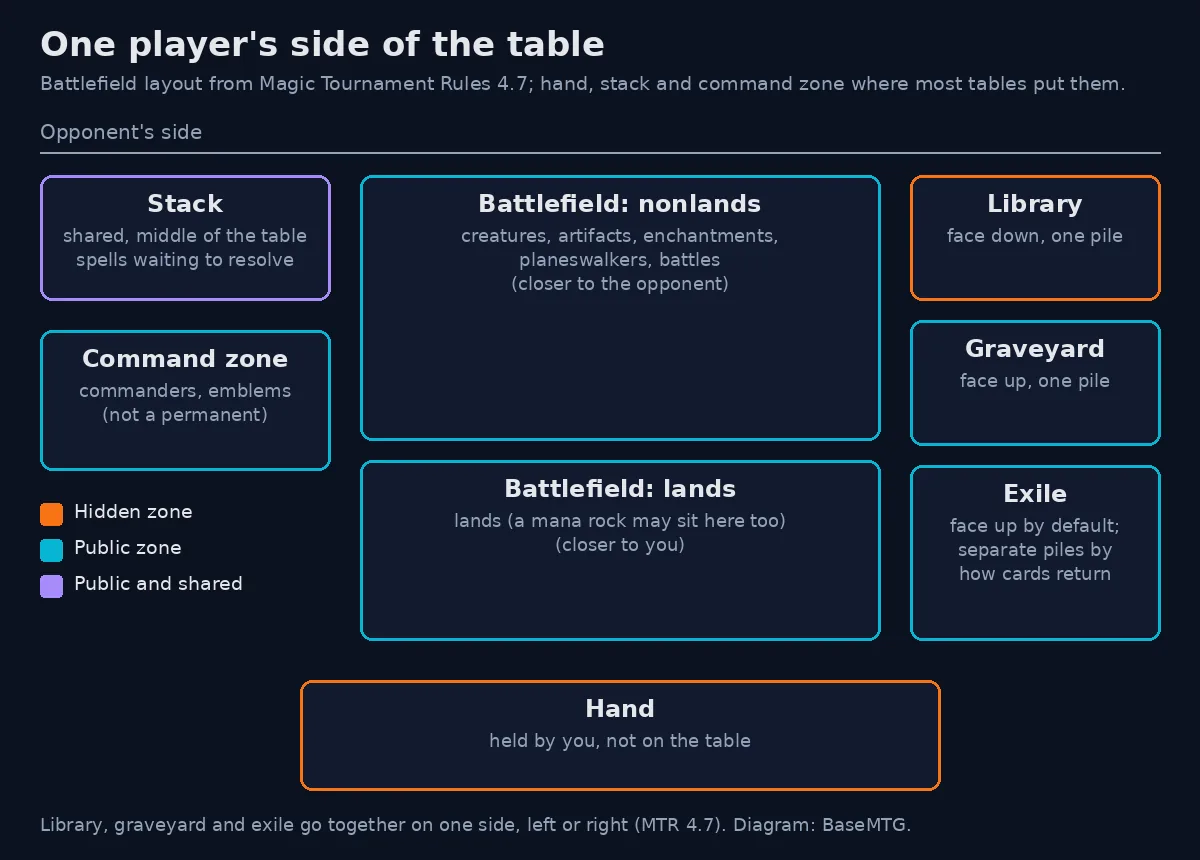 Where each zone sits. The battlefield, library, graveyard and exile follow Magic Tournament Rules 4.7; the rules don't place the hand, stack or command zone, so we drew them in common spots. Image: BaseMTG diagram.
Which MTG zones you can see and count
You can't look at an opponent's hand, but rule 402.3 says a player "may count those cards at any time." The same goes for libraries: "Any player may count the number of cards remaining in any player's library at any time" (rule 401.3).
Rule 404.2 lets any player "examine the cards in any graveyard at any time," and exiled cards are "by default, kept face up and may be examined by any player at any time" (rule 406.3). The exception is a card exiled face down, which nobody can look at unless the card that exiled it allows it.
MTG board setup: how to lay out your side of the table
The Comprehensive Rules barely place anything. Rule 403.1 says "Most of the area between the players represents the battlefield," and the library and graveyard each have to be a single pile. The real layout rules live in the Magic Tournament Rules, section 4.7, and they're binding at Competitive and Professional events:
- Lands closest to you. Nonland cards go nearer the opponent, and no nonland card sits between your lands and your edge of the table. A creature land that's currently a creature moves to the nonland area.
- Library, graveyard and exile on one side. All three go "to the left of the battlefield or all to the right," next to each other, and "distinct at all times."
- Exiled cards stay clearly linked to what exiled them. If a permanent can do something more with a card it exiled, the link between the two must be clear; keeping them together is recommended, not required.
- Untapped permanents face you. Tapped ones turn about 90 degrees (section 3.14).
Casual games don't have to follow any of this, but it's a good default because it's what tournament players are used to reading. In a long r/magicTCG thread on board layout, u/BlackShadowWolf13 described a typical home setup: "I keep my lands to the left, deck and grave to the right, and my board state in the centre. If my Commander isn't on the board, they're off the mat."
A card that changes zones is a new card
Rule 400.7 is the one to remember: "An object that moves from one zone to another becomes a new object with no memory of, or relation to, its previous existence." Apart from a short list of exceptions in the same rule, nothing that applied to the old object carries over.
 eoe-34
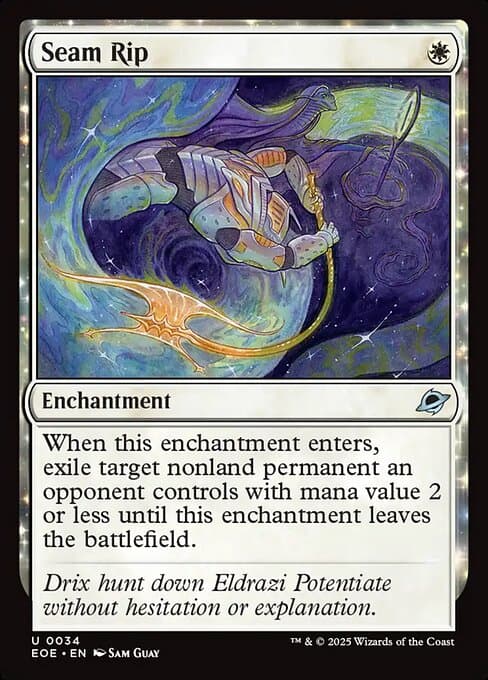 eoe-34Shop on TCGplayer Seam Rip shows it in Standard. It exiles a cheap nonland permanent until Seam Rip leaves the battlefield, and Scryfall's ruling spells out what happens to the exiled card: "Any counters on the exiled permanent will cease to exist. When the card returns to the battlefield, it will be a new object with no connection to the card that was exiled." Auras on it go to the graveyard, the same ruling adds.
Tokens get a harsher version. Rule 111.7 says "A token that's in a zone other than the battlefield ceases to exist," so a token exiled by Seam Rip never comes back. Enduring Curiosity shows the same rule from the other side: when it dies as a creature it returns to the battlefield, but as the card itself says, "It's an enchantment. (It's not a creature.)"
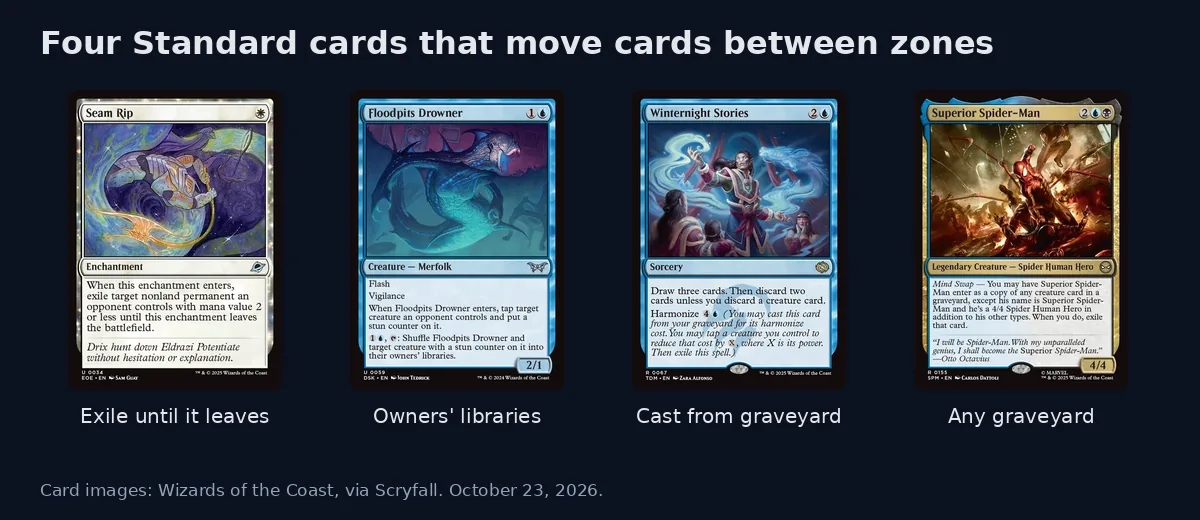 Card images: Wizards of the Coast, via Scryfall.
Cards always go home to their owner
Rule 400.3: "If an object would go to any library, graveyard, or hand other than its owner's, it goes to its owner's corresponding zone." If you steal a creature and it dies, it goes to your opponent's graveyard, not yours. Floodpits Drowner's ability is worded with this in mind: it shuffles itself and a stunned creature "into their owners' libraries."
Two more quick ones: instants and sorceries can never be on the battlefield (rule 400.4a keeps them where they were), and cards in your sideboard aren't in any zone at all. Rule 400.11 says "Outside the game is not a zone," and rule 400.11a puts sideboards there.
The graveyard: order and who uses it
The Comprehensive Rules say a graveyard is "a single face-up pile" whose order players "normally can't change", then leave room for tournament rules. The Magic Tournament Rules use that room in section 3.15: in formats with only cards from Urza's Saga and later, "players may change the order of their graveyard at any time." You still can't touch an opponent's.
We searched Scryfall again on October 29: 699 of the 5,164 Standard-legal cards name a graveyard in their rules text, more than name any other zone. Library (511) edges out exile (503) for fourth.
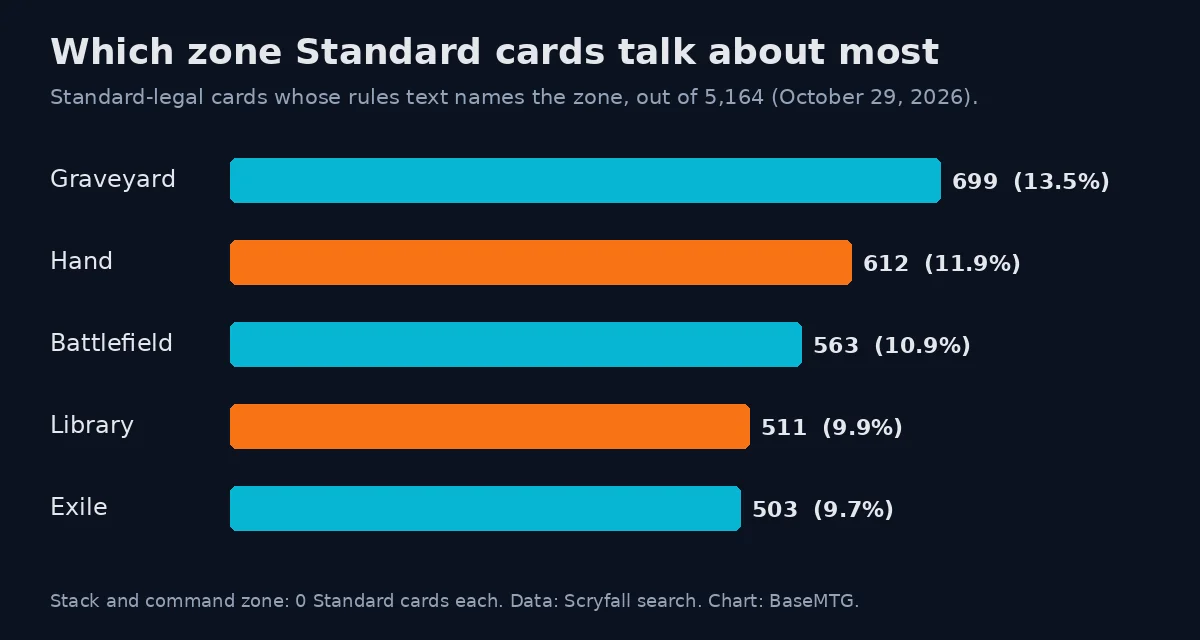 Standard-legal cards whose rules text names each zone, out of 5,164. Data: Scryfall search, October 29, 2026. Image: BaseMTG chart.
That's why your graveyard is a resource for both players.  spm-155
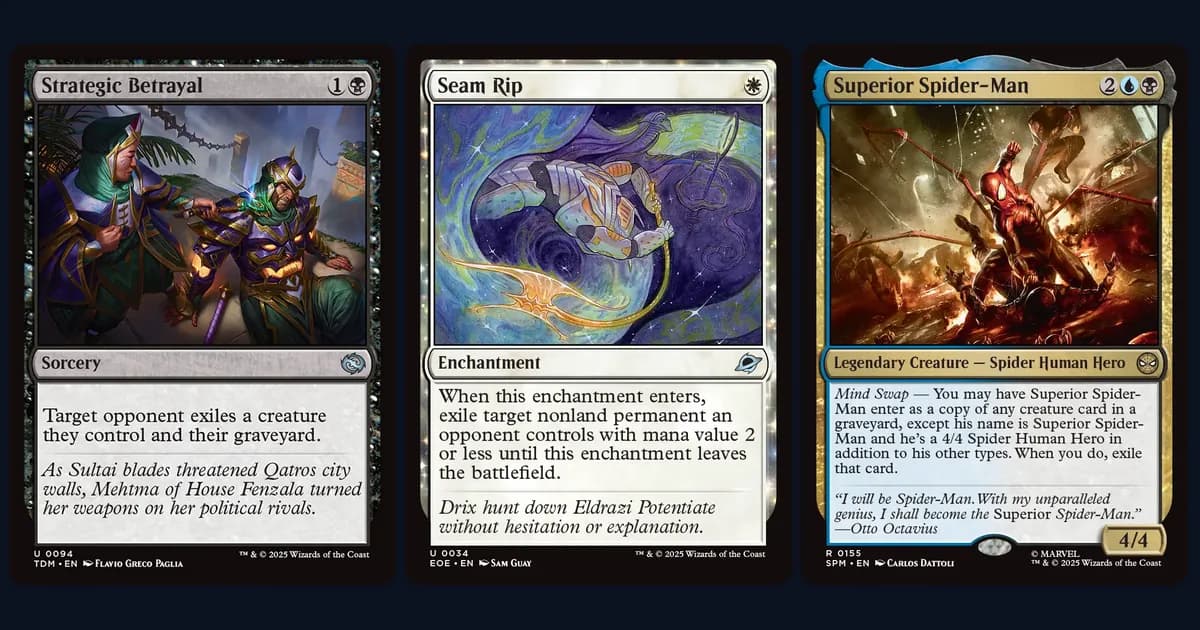
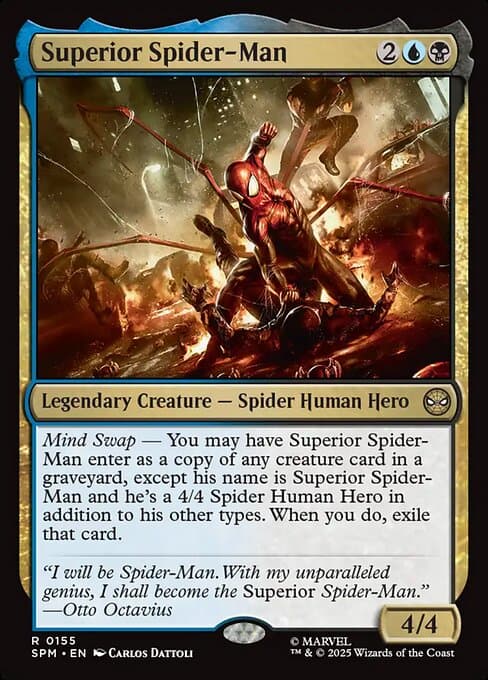 spm-155Shop on TCGplayer Superior Spider-Man can enter as a copy of "any creature card in a graveyard", yours or your opponent's, and exiles that card. Winternight Stories can be cast again from your graveyard with harmonize, after which it's exiled; Scryfall's ruling says a harmonize spell "will always be exiled afterward, whether it resolves, is countered, or leaves the stack in some other way." And
 tdm-94
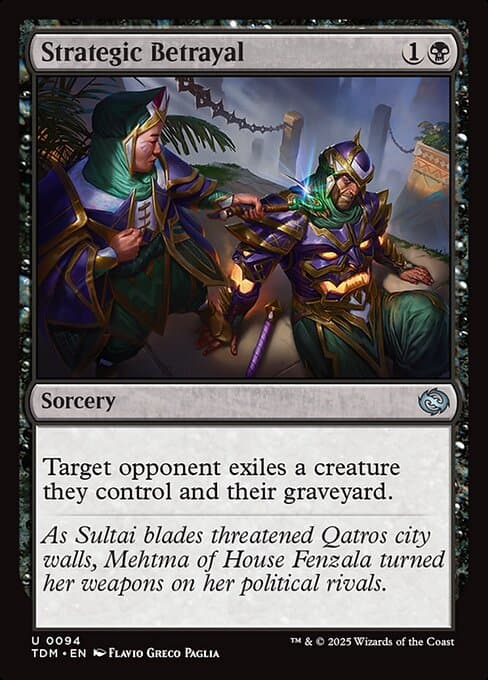 tdm-94Shop on TCGplayer Strategic Betrayal answers both at once: the opponent "exiles a creature they control and their graveyard."
The stack, exile and the command zone
The stack holds spells and abilities on their way to resolving. When you cast a spell, rule 405.1 says "the physical card is put on the stack"; an activated or triggered ability goes there "without any card associated with it." The last thing added resolves first. Our guide to the stack walks through responses and priority.
Exile used to be called the "removed-from-the-game zone" (rule 406.8), and old cards that say "remove from the game" mean exile. It's not always permanent: rule 406.1 notes that some cards exile "only temporarily," which is what Seam Rip does. Keep those cards in separate piles by how they'll come back (rule 406.5).
The command zone holds objects that affect the game but aren't permanents and "cannot be destroyed" (rule 408.1). In Standard that means emblems. Kaito, Bane of Nightmares, the planeswalker in Dimir Midrange, has "+1: You get an emblem with 'Ninjas you control get +1/+1.'" Rule 114.4 says "Abilities of emblems function in the command zone," so the bonus stays for the rest of the game even after Kaito is gone. Our search found no Standard-legal card that names the command zone in its text, against 48 Commander-legal ones.
In Commander, your commander starts there. Wizards' Commander page says "each player puts their commander face up into the command zone," and rule 903.9 handles the trip back, in two different ways:
- Graveyard or exile: you may move it to the command zone as a state-based action (rule 903.9a). It does reach the graveyard first, so in our reading "dies" triggers still see it.
- Hand or library: you may put it in the command zone instead (rule 903.9b), a replacement, so it never arrives in your hand or library at all.
Each cast from the command zone costs more; the commander tax rules cover the details.
Blood Artist's 10-minute walkthrough (September 2025) has a chapter for each of six zones, from the library at 1:00 to exile at 7:08. There's no chapter on the command zone.
Zone questions that come up at the table
What happens if I can't draw? You lose. Rule 121.4: a player who tries to draw from an empty library "loses the game the next time a player would receive priority." It's a state-based action, so the loss waits until the spell or ability that made you draw has finished.
How many cards can I keep in hand? Any number during the turn. Rule 402.2 sets the maximum hand size at seven and only enforces it in your cleanup step, where you discard down to seven.
Is milling the same as discarding? No. Rule 701.17a: to mill, a player "puts that many cards from the top of their library into their graveyard." The cards go straight from library to graveyard and never pass through your hand, so it isn't a discard.
How we checked this
On October 23, 2026 we read rules 400 to 408, plus 111.7, 114, 121.4, 402.2, 701.17a and 903.9, in the September 25, 2026 Comprehensive Rules file, and sections 3.14, 3.15 and 4.7 of the February 27, 2026 Magic Tournament Rules. Card text and rulings come from Scryfall's API. The zone counts are Scryfall searches of Standard-legal cards (f:standard plus a whole-word match on each zone's name or its plural, such as \bexiles?\b), re-run on October 29 after a reviewer caught that our first exile count also took "exiled". Scryfall's o: search skips reminder text (its fo: search is the one that includes it), and a card that names two zones is counted under both.
Our take
If you remember one thing about MTG zones, make it rule 400.7: a card that leaves and comes back is a new card, and whatever was on it is gone. It explains why blinking resets a creature, why tokens vanish and why your stolen creature goes back to its owner's graveyard. Second, lay your side of the table out the tournament way even at home. It costs nothing, and every opponent can read your graveyard and exile at a glance, which heads off a lot of "wait, where did that go?" moments.
For the rest of the basics, see how to play Magic: The Gathering, keyword abilities explained and mulligan rules. New to Commander? The Commander guide starts with the command zone.
References
- Wizards of the Coast: Comprehensive Rules, September 25, 2026 (text file)
- Wizards of the Coast: Magic Tournament Rules, February 27, 2026 (PDF)
- Wizards of the Coast: Commander format page
- Scryfall: Seam Rip rulings
- Scryfall: Winternight Stories rulings
- Scryfall: Standard-legal cards that name a graveyard
- r/magicTCG: Board Layout Etiquette?
- YouTube: The Zones of Magic (Blood Artist)
Was this guide helpful?
About the author

Spoilers & New Sets Desk
Pen name for the BaseMTG new-sets desk: spoiler season, set reviews, Universes Beyond crossovers and rules news. Cards are read from the official text, and what is confirmed is kept apart from our own reading of it.
- Spoilers, set reviews and Universes Beyond
- Card text read from official sources
- Confirmed facts marked apart from our reading
Keep reading
MTG Stack Explained: How Priority and Responses Work
Guides · 8 min
MTG Color Combinations: Names, Playstyles and How to Pick
Guides · 10 min
MTG Mulligan Rules Explained: London Mulligan Step by Step
Guides · 7 min
Bury MTG Meaning: What the Old Destroy Wording Did
Guides · 13 min
Board Wipe in MTG: The 5 Kinds and Which Decks Play Them
Guides · 9 min
MTG Keyword Abilities Explained: Combat and Protection
Guides · 7 min
MTG Format Legality Explained: Standard vs Commander
Guides · 11 min
MTG Mana Base Guide: The Land Count Formula Explained
Guides · 10 min
Disclaimer
This article is published for informational and entertainment purposes. It does not constitute professional financial, legal, or technical advice. Game performance, online services, patch schedules, and store listings change. Verify critical details (pricing, system requirements, regional availability) with publishers and storefronts before you buy. Affiliate links, where present, help support our editorial work and are labelled in our affiliate disclosure.