Commander Tax in MTG: How It Works, Partners and Reducers
Commander tax is the one cost every Commander deck pays, and most of the table arguments come from not knowing what counts as a cast.
Verdict
Each time you cast your commander from the command zone it costs {2} more than the time before. Casting it from your hand, or putting it onto the battlefield without casting it, skips the tax and doesn't add to it.
Commander tax is simple once you see the rule: every time you cast your commander from the command zone, it costs two more generic mana than the time before. The first cast is free of tax, the second costs {2} extra, the third {4} extra, and it keeps climbing for the rest of the game.
What causes arguments isn't the number. It's the word "cast", and the words "from the command zone". The edge cases below come down to one of those two.
The rule, word for word
Rule 903.8 of the Comprehensive Rules says a commander cast from the command zone "costs an additional {2} for each previous time the player casting it has cast it from the command zone that game." The same rule names it: "This additional cost is informally known as the 'commander tax.'"
Wizards' own Commander page puts it in plainer words: a commander "can be cast from the command zone for its normal costs, plus an additional two mana for each previous time it's been cast from the command zone this game."
Three things follow from that wording:
- It counts casts, not deaths. The tax goes up when you cast the commander from the command zone. Dying, being exiled or going back to the command zone doesn't add anything by itself. Cast it once, lose it to removal, leave it in the command zone for ten turns, and the next cast still costs only {2} extra.
- It only counts casts from the command zone. Casting it from anywhere else neither pays nor raises the tax.
- The extra is generic mana. The rule says {2}, so any colour of mana pays it.
Your commander gets back to the command zone through rule 903.9: if it goes to a graveyard or exile, or would go to your hand or library, you may put it into the command zone instead. That choice is yours every time, and it's where the tax decision really starts.
What a commander really costs over a game
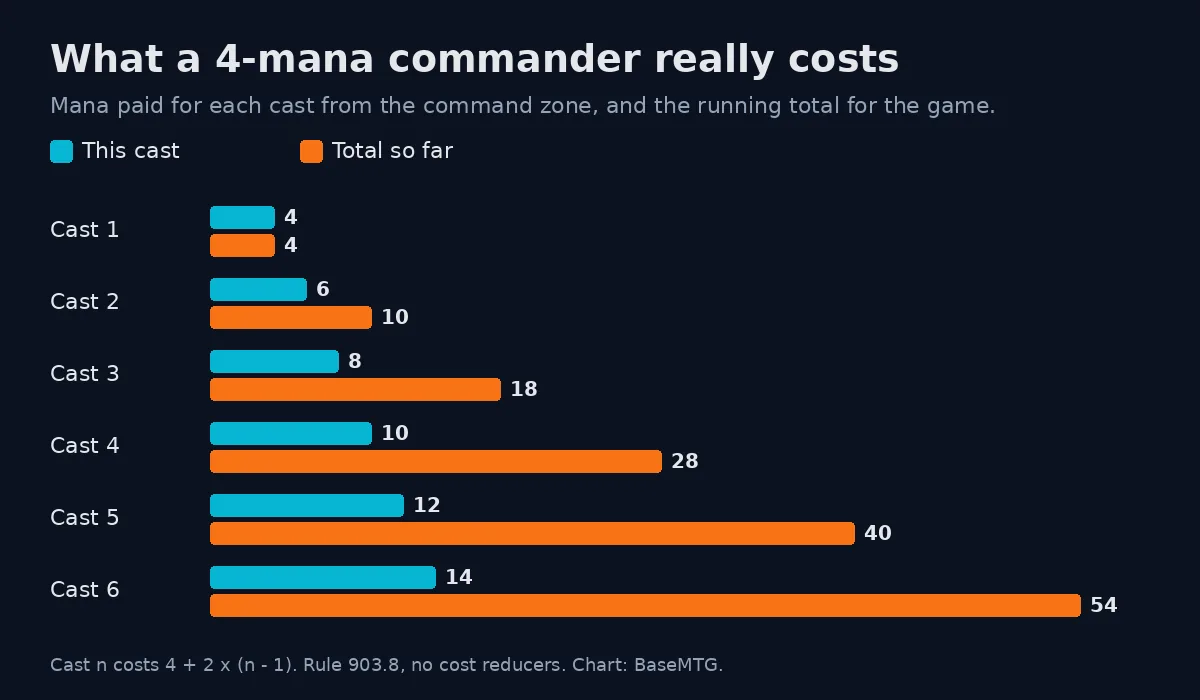 Mana per cast and running total for a commander with mana value 4. Image: BaseMTG chart, arithmetic on rule 903.8.
The tax looks small one cast at a time. Added up, it isn't. We worked it out for a commander with mana value 4, cast six times from the command zone in one game with no cost reducers:
| Cast | Tax | Mana for this cast | Total mana so far |
|---|---|---|---|
| 1st | 0 | 4 | 4 |
| 2nd | 2 | 6 | 10 |
| 3rd | 4 | 8 | 18 |
| 4th | 6 | 10 | 28 |
| 5th | 8 | 12 | 40 |
| 6th | 10 | 14 | 54 |
By the fourth cast the tax alone is bigger than the card. That's the real reason a commander that dies a lot stops coming back: not a rule against it, just a price nobody wants to pay on turn twelve.
Commander tax and mana value
The tax never changes your commander's mana value. Rule 202.3 defines mana value as "the total amount of mana in its mana cost", and the tax is an additional cost, not part of the mana cost. Rule 601.2f keeps them apart too: the total cost you pay is the mana cost "plus all additional costs and cost increases, and minus all cost reductions."
So a 4-mana commander cast for 8 is still a 4-mana-value spell for anything that checks, like a counterspell that cares about mana value.
Commander tax with partners
Two partner commanders are taxed separately. Rule 702.124d says "When casting a commander with partner, ignore how many times your other commander has been cast." Scryfall's rulings on Kraum, Ludevic's Opus and Tymna the Weaver say the same thing in plainer words: "If you cast one, you won't have to pay an additional {2} the first time you cast the other."
That's one of the quiet strengths of a partner deck. Losing one of them to removal raises the price of that one only. Which cards can pair up at all is its own set of rules: see partner commanders explained.
Cost reducers and commander tax reduction
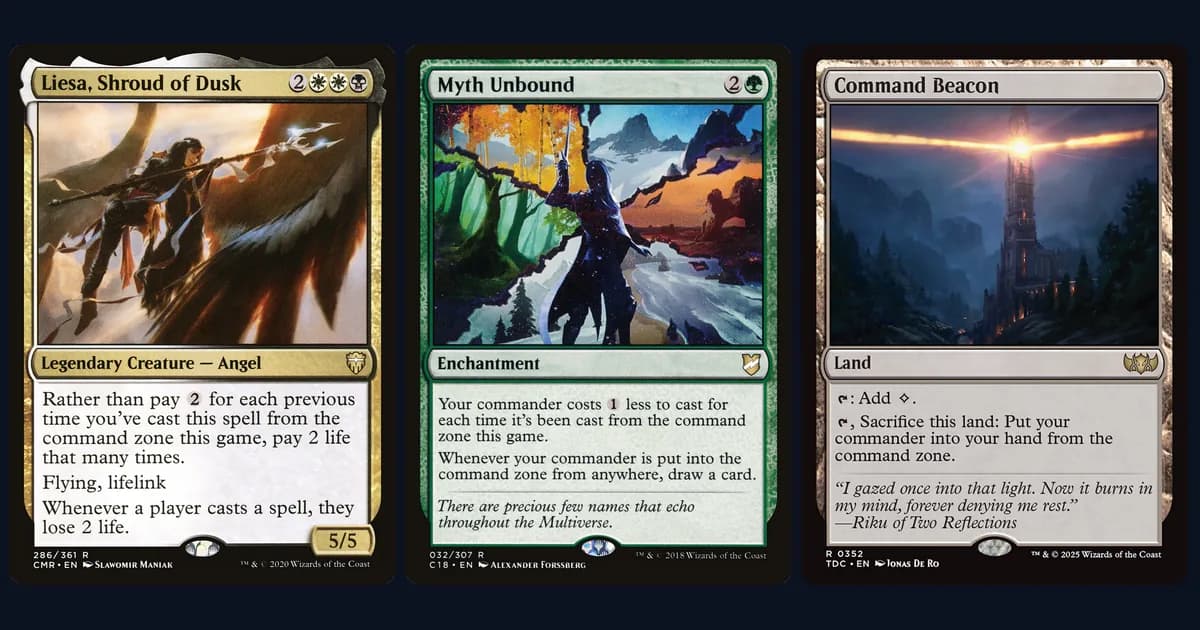
Cost reductions apply after the tax is added. That's rule 601.2f again, and Scryfall's ruling on Myth Unbound spells it out: its reduction "applies after you apply the commander tax. In effect, this reduces the commander tax to {1}." Myth Unbound reads "Your commander costs {1} less to cast for each time it's been cast from the command zone this game," so with it out, the third cast of a 4-mana commander costs 6 instead of 8.
Two other cards change the tax in their own way:
- Liesa, Shroud of Dusk swaps mana for life: "Rather than pay {2} for each previous time you've cast this spell from the command zone this game, pay 2 life that many times." It's not optional. Scryfall's ruling says "You can't choose to pay mana to cover the 'commander tax,' even if you have that mana available."
- Opal Palace turns the tax count into +1/+1 counters. Mana from its second ability makes your commander enter with counters equal to the times it's been cast from the command zone, and the ruling notes that this "includes the most recent time."
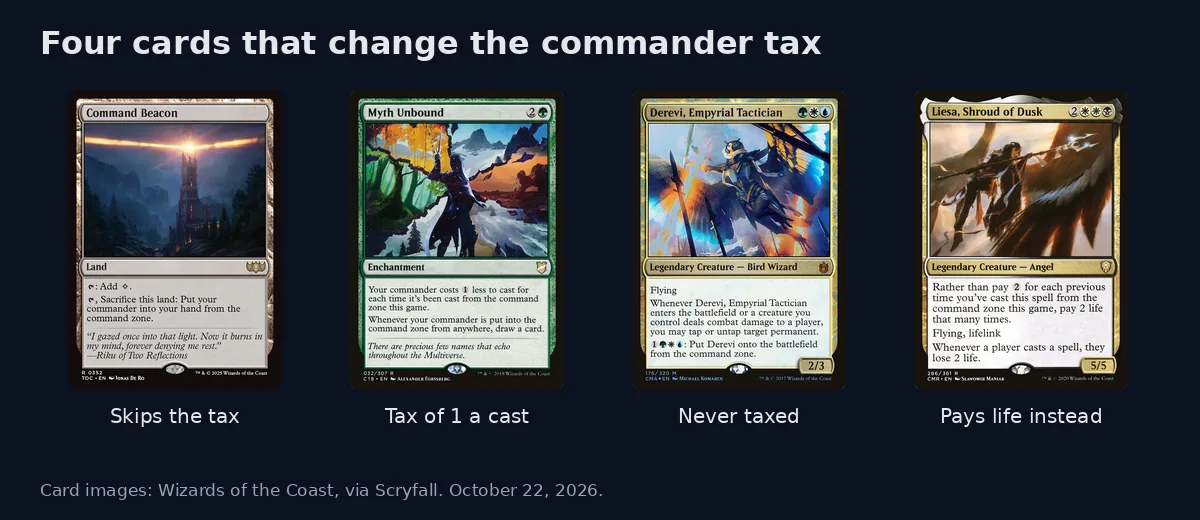 Card images: Wizards of the Coast, via Scryfall.
Ways around the tax
Cast it from your hand
Command Beacon's whole job is this: "{T}, Sacrifice this land: Put your commander into your hand from the command zone." Scryfall's ruling on it is the cleanest statement of the hand rule we found: "If you cast a commander from your hand, the commander tax doesn't apply. Additionally, that casting won't add to commander tax if you later cast the commander from the command zone."
The same goes for any other way your commander ends up in your hand, as long as you choose to leave it there instead of sending it to the command zone.
Don't cast it at all
Putting a commander onto the battlefield isn't casting it. Derevi, Empyrial Tactician has "{1}{G}{W}{U}: Put Derevi onto the battlefield from the command zone," and its ruling says that ability "isn't subject to the commander tax, nor does it increase the tax if you cast Derevi from the command zone later in the game." It also can't be countered by something that only counters spells.
Alternative costs still pay the tax
Dash, mutate and "without paying its mana cost" don't dodge the tax when you cast from the command zone. Rule 118.9d says that when you pay an alternative cost, "any additional costs, cost increases, and cost reductions that affect that spell are applied to that alternative cost."
The useful twist is dash. Kolaghan, the Storm's Fury has dash {3}{B}{R}, and dash returns it to your hand at the end step. On r/mtgrules, u/T0rgle laid out what that means: "If you cast your Commander for its dash cost from the command zone, the commander tax increases for the next time you cast it from the command zone. However, since Dash returns the creature to hand, you don't have to pay any commander tax when you cast it from you hand."
So a dash commander pays the tax once, then lives in your hand for as long as you keep it there.
Questions that come up at the table
Does a countered commander still count? In our reading, yes. Rule 903.8 counts each time the commander has been cast, and a countered spell was still cast. Put it back in the command zone and the next cast costs {2} more.
What if an opponent casts my commander? Rule 903.8 counts the previous casts of "the player casting it", so in our reading an opponent who casts your commander pays tax on their own casts, not yours. Scryfall's ruling on Myth Unbound covers the odd case where another player "is somehow able to cast your commander": the reduction applies to that player's spell.
Do I have to put it back in the command zone? No. The rule says you "may". Leaving a commander in the graveyard can be right if your deck recurs creatures from there, since casting from the graveyard isn't a cast from the command zone.
How we checked this
On October 22, 2026 we read rules 903.8, 903.9, 202.3, 601.2f, 118.9d and 702.124d in the September 25, 2026 Comprehensive Rules file, and pulled the Oracle text and rulings for every card above from Scryfall's API. The cost table is our own arithmetic on rule 903.8 (a script in our repo), not a measured game.
Our take
Treat the tax as a budget, not a punishment. In our view the first removal spell on your commander is usually worth answering by recasting it, and the second one is where we'd stop and ask whether {4} extra is better spent on the cards in hand. If your deck can't function without the commander, a Command Beacon or a partner pair buys you more than another ramp spell does. And if your table keeps arguing about the edge cases, settle them in the Rule Zero talk before the first game.
For the rest of the format's rules, see our Commander guide, commander damage rules and how the stack works. Building a deck around a commander you'll recast a lot? Start with how to build your first Commander deck.
References
- Wizards of the Coast: Comprehensive Rules, September 25, 2026 (text file)
- Wizards of the Coast: Commander format page
- Scryfall: Command Beacon rulings
- Scryfall: Myth Unbound rulings
- Scryfall: Derevi, Empyrial Tactician rulings
- Scryfall: Liesa, Shroud of Dusk rulings
- r/mtgrules: Mutate vs Dash and commander tax
Was this guide helpful?
About the author

Spoilers & New Sets Desk
Pen name for the BaseMTG new-sets desk: spoiler season, set reviews, Universes Beyond crossovers and rules news. Cards are read from the official text, and what is confirmed is kept apart from our own reading of it.
- Spoilers, set reviews and Universes Beyond
- Card text read from official sources
- Confirmed facts marked apart from our reading
Keep reading
Best Mana Rocks in Commander: Tier List for Every Bracket
Guides · 9 min
Commander Damage Rules in MTG: What Counts and What Doesn't
Guides · 8 min
MTG Tutors: The Best Tutor in Every Color for Commander
Guides · 10 min
Saltiest Cards in Commander: EDHREC's 2026 Salt Score List
Guides · 10 min
Rule Zero in MTG Commander: What It Means and What to Say
Guides · 9 min
Mystery Booster Commander Edition: 60 New Cards and Dates
News · 10 min
Calling All Angels Precon Upgrades: Best Swaps for Giada
Guides · 12 min
Tramplesaurus Rex Precon Upgrade Guide: 10 Budget Swaps
Guides · 15 min
Disclaimer
This article is published for informational and entertainment purposes. It does not constitute professional financial, legal, or technical advice. Game performance, online services, patch schedules, and store listings change. Verify critical details (pricing, system requirements, regional availability) with publishers and storefronts before you buy. Affiliate links, where present, help support our editorial work and are labelled in our affiliate disclosure.