Wakanda Forever Precon Upgrade Guide: Marvel Commander
T'Challa's deck is already an artifact deck with a Monarch habit. Ten cards for about $30 fix the gaps, and the T'Challa players on EDHREC cut the same Monarch cards we would.
Verdict
Build the Vibranium artifact engine first: add the two white removal spells, Heroic Intervention and cheap artifact payoffs, and cut Palace Jailer, Queen Mother Ramonda and M'Baku.
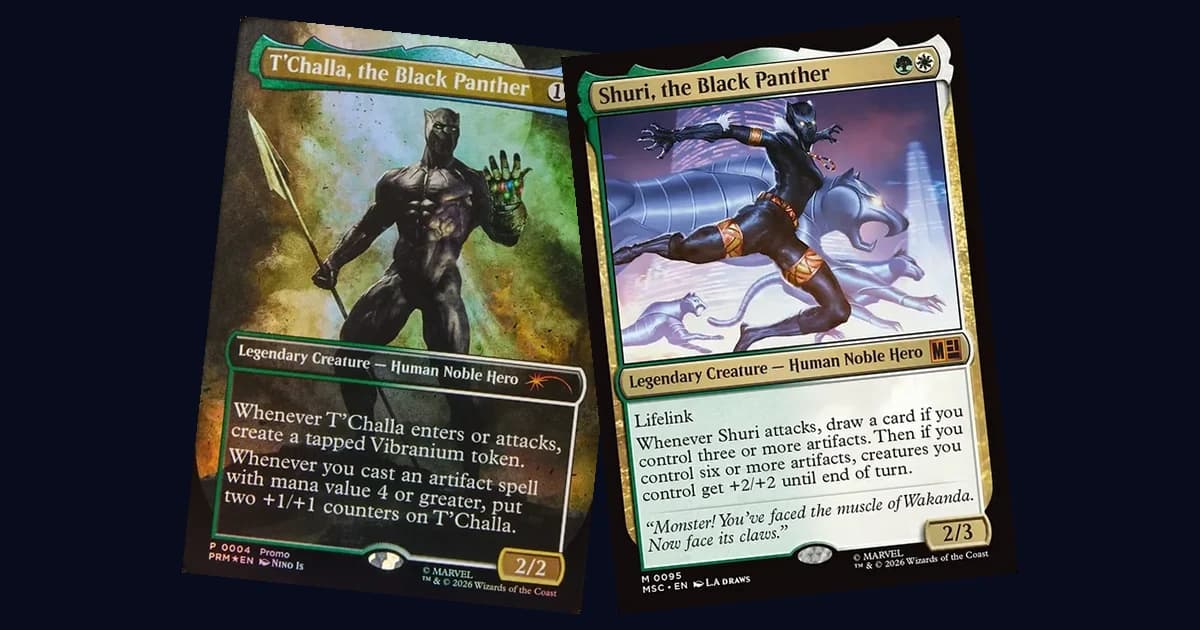
This Wakanda Forever precon upgrade guide starts from what the deck already is: a green-white artifact deck with 28 artifacts, led by a T'Challa who makes indestructible mana for them, plus a Monarch package that pulls in a different direction. Wizards released it on June 26, 2026, as one of four Marvel Super Heroes Commander decks, and it sells for about $38 on TCGplayer as of October 20. Ten upgrades for roughly $30 more push it toward the artifact plan, and the 4,618 T'Challa decks on EDHREC on October 20, 2026 show players cutting the Monarch cards first, the same call we make below.
T'Challa and the Vibranium Engine
T'Challa, the Black Panther costs {1}{G}{W} and is the deck's clearest statement of intent. Whenever T'Challa enters or attacks, create a tapped Vibranium token. That token is an artifact with indestructible and "{T}: Add {C}. This mana can't be spent to cast a nonartifact spell." Whenever you cast an artifact spell with mana value 4 or more, T'Challa gets two +1/+1 counters.
The first ability is more than a small mana boost. It gives the deck a resource that is difficult to remove. A normal mana creature can disappear in a board wipe, while an indestructible Vibranium token generally remains. T'Challa can make another one when he attacks, so pressure also develops the artifact engine. The tokens enter tapped, so they are future mana rather than an emergency answer, but that delay is reasonable when the resource survives most mass removal.
The restriction on that mana is the part new pilots need to internalize. Vibranium is not general-purpose ramp. It does not pay for a creature, removal spell, board wipe, or other nonartifact effect. It is colorless mana reserved for artifact spells, which makes the restriction a deckbuilding filter. Add more artifacts with useful effects and the tokens become closer to reliable ramp. Add too many nonartifact payoffs and the tokens sit there while your hand lacks the right colored mana.
T'Challa's second ability rewards you for following that filter. Casting an artifact with mana value 4 or more gives him two +1/+1 counters, so the deck wants enough meaningful artifacts in that cost range to trigger the ability during a normal game. Cheap artifacts still matter because they build the count and use Vibranium efficiently, but the upgrade should not replace every larger artifact with low-cost filler. You want a curve that lets the commander grow while the rest of the board develops.
The stock deck contains 28 artifacts, and 23 of them have mana value 4 or more, so T'Challa's counter trigger has plenty of fuel before you buy anything. They also support Shuri's attack condition, sit behind a go-wide board, and help you keep Monarch. The best upgrades therefore improve more than one engine. An artifact that produces value, supports combat, or helps recovery is better than a narrow payoff that only works when you are ahead.
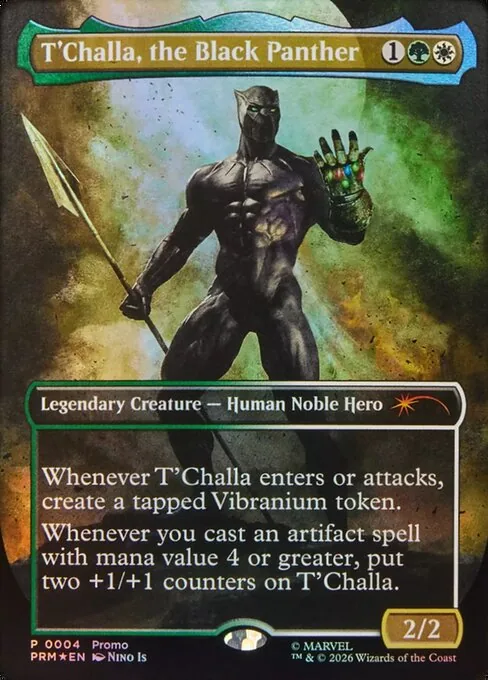 T'Challa's printed text: create a Vibranium token on entering or attacking, and grow by two +1/+1 counters whenever you cast an artifact with mana value 4 or greater. Card image: Wizards of the Coast, via Scryfall.
What Is Actually in the Wakanda Forever Box?
Wizards lists Wakanda Forever as a Green-White deck of 100 cards: one foil commander and 99 non-foil cards, 29 of which are new to Magic, plus a Vibranium // The Monarch helper token. Counted by type, the 100 cards break into 38 lands, 28 artifacts, 24 creatures, 7 sorceries, 5 instants and 2 enchantments, with the four artifact creatures counted in both groups.
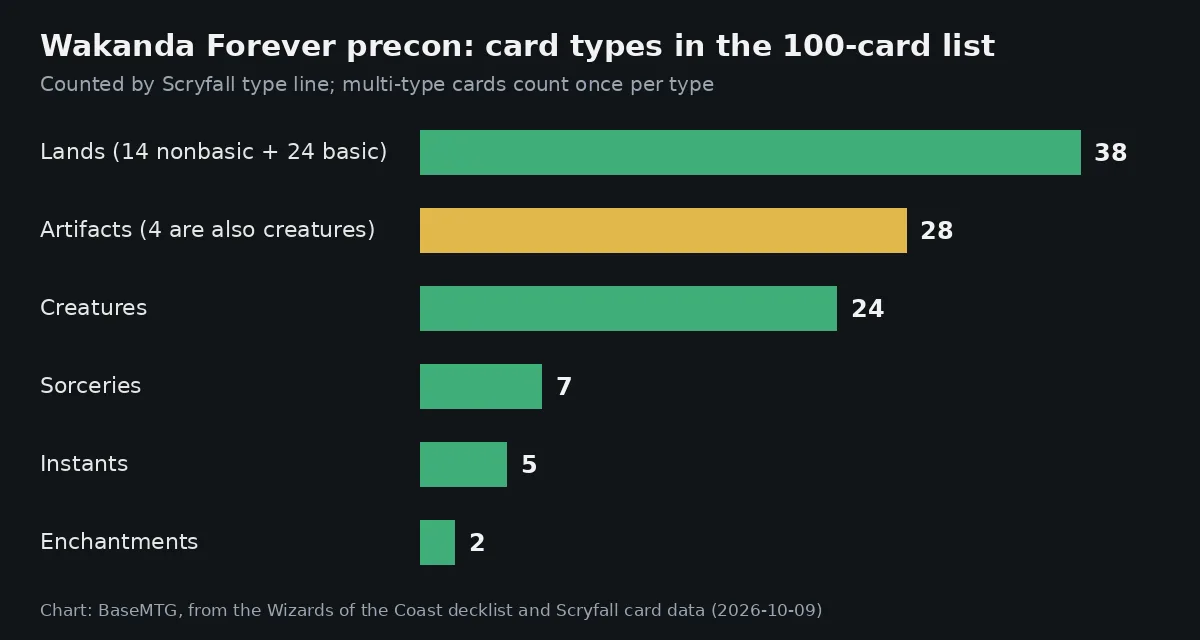 Image: BaseMTG chart. Source: Wizards of the Coast decklist and Scryfall type lines (October 9, 2026).
Two numbers matter for upgrades. First, only 5 of the 62 nonland cards are instants, so the deck answers threats mostly on its own turn. Second, 11 cards in the list mention the monarch, which explains why the stock list reads as half a Monarch deck. Three sweepers are already printed in the 99: Martial Coup destroys all other creatures when X is 5 or more, Vanquish the Horde destroys every creature and costs 1 less for each creature on the battlefield, and Scourglass destroys everything except artifacts and lands during your upkeep. That changes the advice below: the gap is cheap, targeted interaction, not another reset button.
The Three Competing Game Plans (and Which One to Cut)
The precon is trying to do three reasonable things. First, it can make a wide board of creatures and win through combat. Second, it can accumulate Vibranium and other artifacts, then turn that material into mana and a larger T'Challa. Third, it can become the Monarch and use the extra end-step card to keep up with a multiplayer table. None of these plans is bad on its own. The problem is that each one asks for different deck slots.
Go-wide tokens need a steady supply of creatures, ways to make those bodies matter, and enough protection to survive a reset. The artifact plan needs a high artifact count, a curve that includes larger artifact spells, and payoffs that care about artifacts without being dead when the board is small. Monarch wants ways to become the Monarch, ways to defend yourself from combat damage, and enough card quality that the extra draw actually converts into action. A stock precon can show you all three plans, but it cannot devote ideal space to all three at once.
GODEEPER: Vibranium isn't the only kind of restricted or specialized mana rock worth knowing. cEDH Staples Guide: Fast Mana, Tutors, and Interaction →
That is why some games feel as though the deck has pieces but no direction. You draw a token-maker without a payoff, an artifact without a useful place to spend Vibranium, or Monarch support when the table has an easy attack. The cards may be individually serviceable, yet the hand does not combine into a plan quickly enough. A budget upgrade should reduce those mismatches instead of adding a few cards to every category.
My default recommendation is to lean hardest into the Vibranium artifact engine, keep go-wide creatures as the way you turn that material into pressure, and cut down the dedicated Monarch package first. This follows T'Challa's printed abilities, makes the stock 28-artifact base more valuable, and gives your budget a clear destination. Monarch can remain a bonus when the board is stable, but it does not need to be the reason you keep a card.
Cutting Monarch does not mean ignoring the mechanic. Keep a modest number of ways to become the Monarch if they also create a board or otherwise advance your plan. What you want to avoid is paying for several narrow effects whose main job is to announce that you are Monarch, then losing the crown as soon as an opponent attacks. Extra cards are valuable, but not when the support package leaves the artifact curve thin.
There are good reasons to choose another emphasis. If your group enjoys combat and you already own several token payoffs, go-wide can be the main plan, with artifacts supplying the mana and resilience. If you prefer a more aggressive, life-total-focused game, build around Shuri and use the artifact count to turn attacks into cards and a team pump. The key is to choose deliberately. Ten small upgrades aimed at one plan will usually feel better than ten unrelated inclusions split across three plans.
Steps to Upgrade on a Budget
1. Cut the weakest do-nothing cards. Start with cards that neither advance the artifact count, create or improve a board, draw a card, nor answer an opposing permanent. A precon can afford a few low-impact cards to demonstrate its themes, but your first budget should remove cards that are poor in every game state. Make a cut list before buying, and keep the curve in view.
2. Add cheap artifact ramp that supports T'Challa. Prioritize low-cost artifacts that make mana, replace themselves, or provide a useful body. They let you spend Vibranium on legal spells while building toward the mana value 4 or more artifacts that trigger T'Challa's counters. Avoid treating every ramp effect as interchangeable. Nonartifact ramp can be good in Commander, but it does not benefit from the tokens' restricted mana and does not strengthen the artifact count.
3. Add card draw that does not rely only on Monarch. The Monarch trigger is powerful when you can protect it, but it is not a reliable draw engine by itself. Add several sources of repeatable or conditional draw tied to artifacts, creatures, attacks, or entering-the-battlefield events. The goal is redundancy, not maximum quantity. If losing Monarch leaves you unable to refill your hand, the deck is still too dependent on one table-wide incentive.
4. Add two or three cheap, targeted answers. The stock list already has three sweepers, but only 5 instants. Add effects that can answer one dangerous permanent at instant speed, so you are not forced to reset your own board to deal with a single threat. Your indestructible Vibranium tokens make recovery easier, so the sweepers you already have remain playable. Just make sure your own creature plan can rebuild afterward.
5. Test Shuri as an alternate lifegain-leaning build. Once the T'Challa version is stable, try Shuri, the Black Panther in the command zone if you want combat and lifelink to matter more. Shift some artifact slots toward attack rewards, life-total support, and ways to keep at least three artifacts, while retaining enough of the original engine to reach Shuri's larger threshold.
The First Ten Upgrades, With Prices
These are the cards T'Challa decks on EDHREC play most that aren't in the box. Inclusion is the share of those decks listing the card on October 20, 2026; price is the cheapest nonfoil printing on Scryfall that day.
| Card | What it does here | In T'Challa decks | Price |
|---|---|---|---|
| Swords to Plowshares | {W} instant, exiles a creature | 47% | $1.12 |
| Chimil, the Inner Sun | your spells can't be countered; discover 5 every end step | 47% | $7.24 |
| Bronze Guardian | double strike, power equal to your artifact count, gives other artifacts ward {2} | 44% | $0.61 |
| Heroic Intervention | {1}{G} instant, your permanents gain hexproof and indestructible | 43% | $9.51 |
| Jhoira's Familiar | flier, artifacts and legendaries cost {1} less | 41% | $1.40 |
| Path to Exile | {W} instant, exiles a creature | 40% | $1.07 |
| Mystic Forge | cast artifacts from the top of your library | 40% | $2.67 |
| Thousand Moons Smithy | Gnome token as big as your artifacts and creatures | 37% | $2.93 |
| Swiftfoot Boots | hexproof and haste for T'Challa | 30% | $1.58 |
| Foundry Inspector | artifact spells cost {1} less | 27% | $0.30 |
The ten come to about $30. Seven of them are artifacts, so Vibranium mana pays for them, and five of those seven (Chimil, Bronze Guardian, Jhoira's Familiar, Mystic Forge and Thousand Moons Smithy) cost four or more, so each one also puts two counters on T'Challa. The three instants cover step four: two one-mana removal spells and a Heroic Intervention that saves the board from the sweepers the other decks at your table are holding. Just outside our ten, Kutzil, Malamet Exemplar (34%, $1.97) and Genji Glove (33%, $7.69) are the next picks if your budget stretches.
What T'Challa Players Cut
The same EDHREC page also shows which stock cards players take out. These are the nonland cards from the box that the fewest T'Challa decks keep:
| Stock card | Kept in T'Challa decks |
|---|---|
| Fleecemane Lion | 14% |
| Divine Visitation | 17% |
| Palace Jailer | 20% |
| Queen Mother Ramonda | 27% |
| Martial Coup | 28% |
| Loyal Guardian | 28% |
| M'Baku, Jabari Chieftain | 30% |
Three of the seven are Monarch cards. Palace Jailer and Queen Mother Ramonda make you the monarch, and M'Baku hands the crown to an opponent so your creatures can attack them for a bonus. That's the package we'd demote first, and most T'Challa players already have. Divine Visitation turns tokens into 4/4 Angels, which suits a go-wide build more than an artifact one. If you also own the other Marvel boxes, Avengers Assemble and The Fantastic Four have their own upgrade guides.
Should You Build Around Shuri Instead?
Shuri, the Black Panther costs {G}{W} and has lifelink. Whenever Shuri attacks, you draw a card if you control three or more artifacts. Then, if you control six or more artifacts, creatures you control get +2/+2 until end of turn. Her plan is more combat-facing than T'Challa's. You want to attack consistently, maintain an artifact count, and turn a wide board into a meaningful swing.
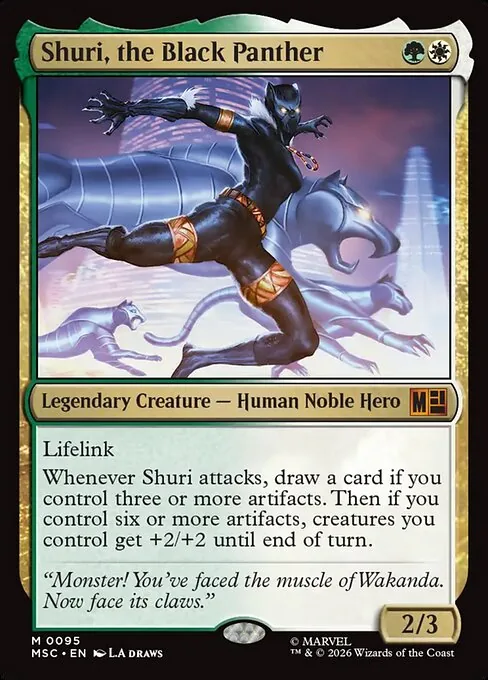 Shuri rewards a different threshold than T'Challa: 3 artifacts for a card on attack, 6 artifacts for a team-wide +2/+2. Card image: Wizards of the Coast, via Scryfall.
T'Challa is the better default when you want ramp, larger artifact spells, and a commander who grows as you cast them. Shuri is attractive when your group gives you safe attacks and you want lifelink to stabilize races. Neither choice eliminates the deck's overlapping themes. Shuri still wants artifacts, and T'Challa still appreciates creatures, but the commander tells you which resource deserves the most deck space.
Tips for Playing the Deck
Lead with production. When you have a safe chance to cast T'Challa, the first Vibranium token improves your future turns and gives later attacks a concrete payoff. Do not hold the commander forever while waiting for a perfect hand. The engine is strongest when it starts early enough to compound.
Spend Vibranium deliberately. Before tapping a token, check that the spell is an artifact. A token cannot pay for a nonartifact removal spell or a creature, and forgetting that restriction can turn a strong-looking turn into a pass. Keep colored lands available for interaction, especially if you expect an opponent to threaten a winning board.
Treat Monarch as pressure, not a promise. The monarch draws a card at the beginning of their end step, and the crown moves whenever a creature deals combat damage to the monarch. Palace Jailer shows the risk: it makes you the monarch and exiles a creature only until an opponent becomes the monarch. Take the crown when your board can defend it or when the immediate card is worth the risk. Do not distort the whole game plan just to keep a title for one turn.
Count artifacts before attacking. With Shuri, check whether you have at least three artifacts for the card and at least six for the team pump. With T'Challa, count the artifacts in your hand and the available Vibranium before committing to a larger spell. These thresholds make attacks and casts much easier to sequence correctly.
*Video: the Wakanda Forever deck reveal that Wizards of the Coast embeds on its official Marvel Super Heroes decklist page.*What Players Are Saying About T'Challa and the Artifact Plan
The community is already tuning the same engine this guide recommends. In an r/EDH thread asking for feedback on a T'Challa list, posted August 22, 2026, u/Carnafex_24 suggested leaning further into card advantage from artifacts, saying the deck could run The Ten Rings and Vibranium Strike Gauntlets "if you need more card advantage".
Vibranium Strike Gauntlets is already in the stock 99, so that advice points the same way as the artifact-first plan above: spend your budget on artifacts that draw cards or grow T'Challa, not on a fourth plan. The Ten Rings is the slower option; on October 20 it was in 28% of T'Challa decks on EDHREC and cost about $9.91, which is why it sits just outside our first ten.
Our Take: Build the Artifact Engine First
Build the artifact engine and spend the first $30 on the ten cards above. The stock deck is already built for it: 28 artifacts, 23 of them big enough to trigger T'Challa, and only five instants, which is exactly the gap Swords, Path and Heroic Intervention fill. Cut the Monarch cards before anything else; Palace Jailer's exile ends the moment an opponent takes the crown, so it's only as good as your blockers. Keep Shuri for a second build once the T'Challa list is working.
GODEEPER: Doom Prevails is another Marvel Super Heroes Commander precon released the same day, built on a completely different Grixis Connive-and-drain plan. Doom Prevails Precon Upgrade Guide: Marvel Commander →
Related Reading
- MTG Commander Deck Guide: Building, Budget, and cEDH: the full Commander deckbuilding rules this precon fits into.
- Budget Commander Decks Under $50: What Actually Fits: another budget-first approach for players who want a second cheap deck.
- MTG Color Identity Explained: What Actually Counts: confirm what actually counts toward T'Challa or Shuri's color identity before adding upgrades.
- Multiverse Reforged Precon Upgrades: 6 First Swaps (2026): Another Commander precon upgrade guide built on the printed list's counts.
References
Was this guide helpful?
About the author

Commander & Budget Desk
Pen name for the BaseMTG Commander desk: budget builds, precons, upgrades and deck-building. Lists are priced from Scryfall on the publish date and every card pick comes with a reason.
- Commander builds, budget lists and precon upgrades
- Prices checked on Scryfall, dated in the article
- A sources table behind every card and number
Keep reading
cEDH Meaning in MTG: What Competitive Commander Actually Is
Guides · 8 min
MTG Commander Brackets Explained: All 5 Brackets in 2026
Guides · 6 min
cEDH Staples Guide: Fast Mana, Tutors, and Interaction
Guides · 16 min
Budget Commander Decks Under $50: What Actually Fits
Guides · 11 min
Doom Prevails Precon Upgrade Guide: Stay in Bracket 2
Guides · 8 min
MTG Commander Deck Guide: Building, Budget, and cEDH
Guides · 9 min
How to Build Your First Commander Deck: Lands, Ramp, Removal
Guides · 7 min
Reality Fracture Precons Ranked: Which of the 6 to Buy
Guides · 19 min
Disclaimer
This article is published for informational and entertainment purposes. It does not constitute professional financial, legal, or technical advice. Game performance, online services, patch schedules, and store listings change. Verify critical details (pricing, system requirements, regional availability) with publishers and storefronts before you buy. Affiliate links, where present, help support our editorial work and are labelled in our affiliate disclosure.