

BaseMTG · Guides
MTG Commander Brackets Explained: The 5-Bracket System
Reviewing
Magic: The Gathering
Commander Brackets are Wizards' official, still-beta way to describe the intended power level of a Commander deck before a game starts. They give a playgroup a shared vocabulary for expectations, from theme decks that usually finish around turn 9 or later to cEDH decks that can win on any turn. That matters because a technically legal deck can still create a bad game if one player brings a tuned combo list and everyone else expects a slower precon-style battle. Brackets help you disclose the kind of game your deck is built to play, without pretending that Wizards enforces the choice at the table.
TL;DR: The five brackets use the earliest turn on which you would be satisfied seeing the game end as their anchor: turn 9+ for Bracket 1, turn 8+ for Bracket 2, turn 6+ for Bracket 3, turn 4+ for Bracket 4, and any turn for Bracket 5. The Game Changers list is the system's main shared restriction: Brackets 1 and 2 allow none, Bracket 3 allows up to three, and Brackets 4 and 5 have no count limit. Brackets 1 through 3 also disallow mass land denial, while intentional early two-card infinite combos are limited in the lower brackets. Treat the bracket as a pregame agreement about expectations, not as an additional rules engine.
What Are Commander Brackets? (quick answer)
Commander Brackets are a voluntary power-level framework maintained by the Commander Format Panel. Each bracket combines an expected game-ending turn with guidance about Game Changers, combos, and mass land denial, so players can describe their deck before shuffling up.
The system is currently tagged Beta. It was first introduced as Commander Brackets Beta, updated on October 21, 2025, and updated again on February 9, 2026. Wizards is giving the structure time to settle before removing that label. There is no announced date for that change.
The Five Brackets, Explained
Bracket 1: Exhibition, turn 9+. This is the home for theme decks and low-pressure lists where the theme matters more than maximum efficiency. The turn anchor means turn 9 or later is the earliest game ending you would be satisfied seeing, not a promise that the game will end on turn 9. Bracket 1 allows zero Game Changers, no intentional two-card infinite combos, and no mass land denial. A deck can still have a clear plan, strong flavor, and useful interaction. It simply does not use the format's most warping cards or a compact line designed to end the game early.
Bracket 2: Core, turn 8+. Core is the precon-level bracket. That does not mean every unmodified preconstructed deck lands here, and it does not forbid sensible upgrades. It describes a list whose games generally develop at a relaxed pace and whose cards are chosen for a broad, accessible Commander experience rather than tight optimization. Like Bracket 1, it allows zero Game Changers and no intentional two-card infinite combos. Mass land denial is also disallowed. If a precon contains a card from the Game Changers list, that card matters for the conversation even if the rest of the deck is unmodified.
Bracket 3: Upgraded, turn 6+. This is the tuned casual bracket. Expect a focused commander plan, a smoother mana base, efficient ramp and interaction, and upgrades that make the deck more consistent than a stock precon. Bracket 3 allows up to three Game Changers. It disallows mass land denial and cheap early-game two-card combos, but a combo that closes the game around turn 6 or later is acceptable under the bracket's guidance. The key distinction is not whether the deck can ever win quickly. It is whether the list is built to assemble a compact win before the table has had a reasonable chance to play.
Bracket 4: Optimized, turn 4+. Optimized is for powerful Commander decks with no real restrictions on construction beyond the normal format rules and the separate banned list. The turn anchor is turn 4 or later as the earliest satisfying ending, although a particular draw can produce a faster win. Bracket 4 has no Game Changers count limit, permits mass land denial, and allows any combo, including early two-card infinites. This is the point where a player should expect efficient tutors, fast mana, compact win conditions, and interaction that can matter immediately.
Bracket 5: cEDH, any turn. Bracket 5 is fully competitive Commander. There is no minimum turn anchor because a cEDH deck is built to win as early as its strategy and opening hand allow, while presenting enough disruption to stop opposing wins. Game Changers are unlimited, mass land denial is permitted, and there are no bracket-level combo restrictions. Bracket 5 is not simply a label for a deck with expensive staples. It describes a competitive approach to deckbuilding, mulligans, sequencing, and table politics.
GODEEPER: Your deck's turn anchor is only useful when it reflects the fastest realistic wins your list is built to produce, not an average goldfish result. Doom Prevails Precon Upgrade Guide: Marvel Commander →
The Game Changers List: The One Hard Rule
The Game Changers list is a curated list of the cards the Commander Format Panel considers especially powerful or capable of warping a game. As of the February 9, 2026 update, it contains 53 cards. The list is the system's one hard restriction across the brackets, although “hard” still means a clear pregame construction agreement rather than a deck check imposed by Wizards during a casual game.
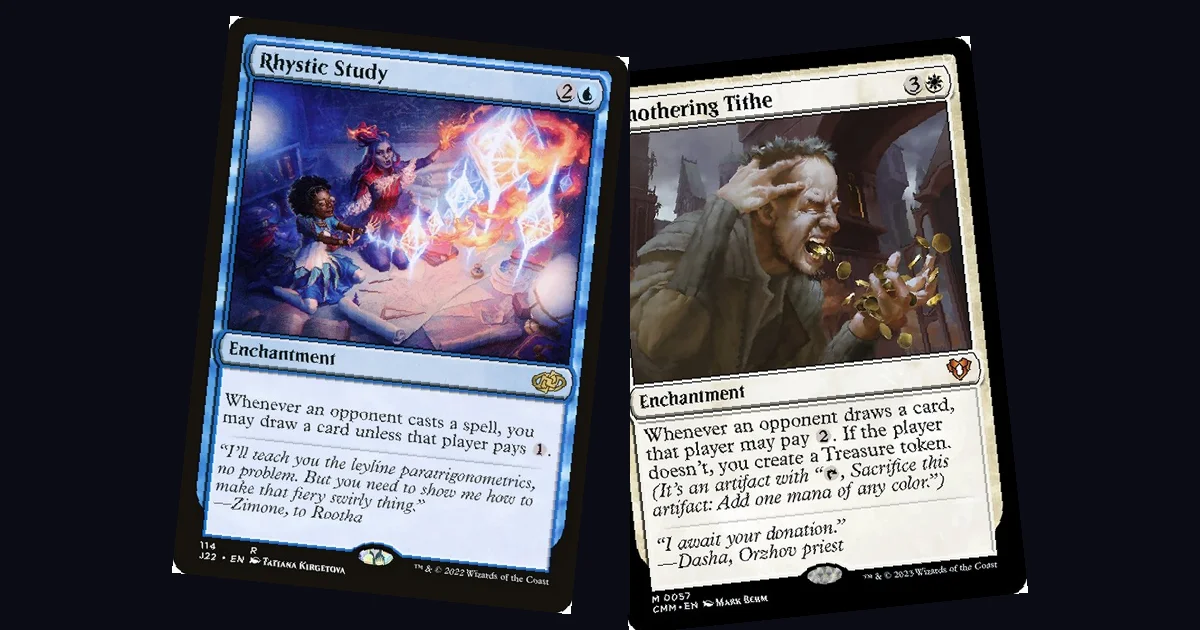
The five verified examples are Rhystic Study, Cyclonic Rift, Smothering Tithe, Thassa's Oracle, and Mana Crypt. They illustrate why the list is broader than a simple ban list. Some cards generate overwhelming advantage, some reset a developed board, some turn a winning line into a compact package, and some accelerate a deck far ahead of the table. The list is not a ranking of every powerful card in Commander, and these five examples are not the full list.
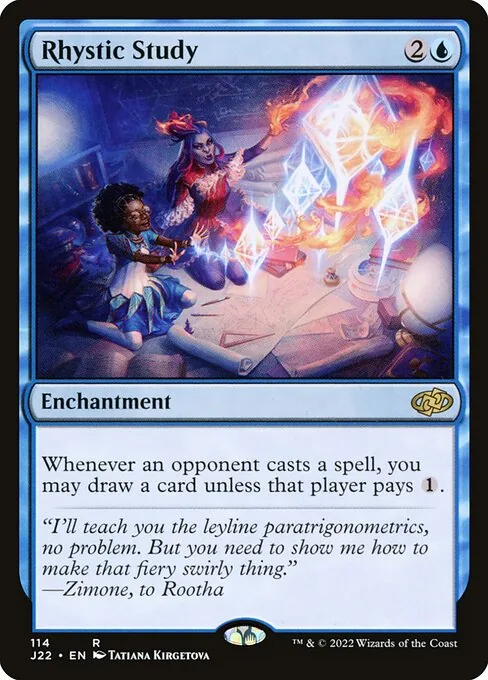 Rhystic Study is one of the 53 cards on the Game Changers list, capped at zero in Brackets 1 and 2.
The count by bracket is straightforward:
| Bracket | Game Changers allowed |
|---|---|
| 1, Exhibition | 0 |
| 2, Core | 0 |
| 3, Upgraded | Up to 3 |
| 4, Optimized | Unlimited |
| 5, cEDH | Unlimited |
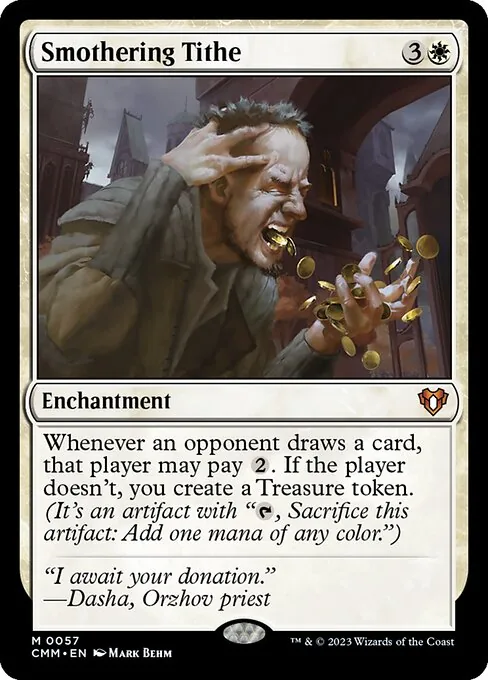 Smothering Tithe punishes card draw with Treasure tokens, another Game Changer that counts toward the Bracket 3 cap of three.
Count cards from the current list, rather than treating every strong card as a Game Changer. In Bracket 3, “up to three” is a ceiling, not a target. A deck with zero Game Changers can still be a high-end Bracket 3 list if its commander, mana, tutors, and interaction make it consistent. Conversely, a deck with three qualifying cards may still need a higher bracket if its fastest wins and other construction choices do not match the slower expectation.
Step-by-Step: How to Bracket Your Own Deck
1. Count your Game Changers. Check the current official list and count only cards that are actually in the deck, including the commander when the framework counts it as part of the deck's construction. Zero points you toward Bracket 1 or 2, up to three can fit Bracket 3, and more than three moves the list into Bracket 4 or 5.
2. Find your fastest realistic win. Look at actual opening hands, tutors, ramp, and normal sequencing. Ask when the deck can consistently threaten or complete its primary win, not when a perfect draw produces a flashy result. Compare that earliest satisfying ending with the turn anchors: 9+, 8+, 6+, 4+, or any turn.
3. Check for mass land denial. Identify cards and lines that intentionally destroy, exile, or otherwise remove multiple lands. If the deck relies on mass land denial, it does not fit Brackets 1, 2, or 3 under the current framework. That construction belongs in Bracket 4 or 5, where the strategy is permitted.
4. Check for early two-card combos. Brackets 1 and 2 do not allow intentional two-card infinite combos. Bracket 3 can include a combo that closes the game around turn 6 or later, but not a cheap early-game line designed to end the game before the table has developed. Brackets 4 and 5 have no such restriction.
5. Choose the bracket and say it before the game. Use the highest bracket required by any of these constraints, then explain unusual details in one sentence. “Bracket 3, three Game Changers, no early combo, and my fastest normal win is turn 6” gives the table something actionable. Invite questions before commanders are revealed or opening hands are kept.
The February 2026 Update: What Changed
The February 9, 2026 announcement updated the Commander Brackets framework and kept its Beta label. The same announcement bundle also changed the Commander banned list by unbanning Lutri, the Spellchaser and Biorhythm. Those are related announcements released together, not new bracket rules.
Lutri can now be used as a commander or included in the 99. Lutri can no longer be used as a Companion, and that Companion restriction is new as part of the change. Biorhythm was also unbanned. These changes do not mean every newly legal card belongs in every bracket. You still apply the current Game Changers count, combo guidance, mass land denial guidance, and turn anchor when describing a deck.
Commander Brackets also do not replace the separate Commander banned list. A card's bracket status and its format legality answer different questions: the bracket describes the social power level a group expects, while the banned list determines whether a card may be played in the format at all. Keep those conversations separate when discussing the February update.
GODEEPER: The Lutri and Biorhythm changes affect card legality, while the bracket update affects how players set expectations before a game. cEDH Staples Guide: Fast Mana, Tutors, and Interaction →
Tips for Talking About Brackets at the Table
Ask before the game starts: “What bracket are you playing, and is there anything unusual I should know?” The second half matters because a bracket number cannot communicate every commander, win condition, or house preference. A Bracket 3 deck built around a turn-6 graveyard combo may play very differently from a Bracket 3 deck that wants a long combat game.
Answer with the bracket and the relevant facts. Mention your fastest normal win, Game Changer count, mass land denial, and whether an early combo is central to the deck. If you are unsure, say so and describe the list honestly. Players can usually find a workable table when they know what the deck actually does.
Do not use brackets as a challenge or a status label. The goal is not to prove that your deck belongs in the highest category. The goal is to avoid a mismatch where one player is trying to execute a compact turn-4 win while the rest of the table brought decks that want to spend several turns setting up.
If the table's expectations do not line up, make a change before the game. Swap decks, remove a specific card, agree to delay a combo, or establish a house rule that everyone accepts. Once the game begins, silently changing the standard usually creates more frustration than the original mismatch.
Frequently Asked Questions
Are Commander Brackets official rules?
No. Wizards and the Commander Format Panel provide the framework, but players use it voluntarily as a shared vocabulary. Brackets do not enforce deck construction during a game, replace the banned list, or determine a winner after a dispute. Your playgroup still decides what it accepts, and honest pregame communication matters more than the number alone.
What does the turn number actually mean?
It is the earliest turn ending you would be satisfied seeing, based on the deck's intended performance. It is not a guaranteed goldfish turn, an average game length, or a promise that the deck cannot win earlier. Use realistic draws and normal sequencing when choosing the anchor, then explain unusual faster or slower lines to the table.
Can a Bracket 3 deck win before turn 6?
Yes, an unusual draw or an opponent's mistake can produce an earlier win. Bracket 3 guidance is about what the deck is built and tuned to do consistently. It allows a combo that closes the game around turn 6 or later, but it does not allow a cheap early-game two-card combo as a normal plan.
Do three Game Changers automatically make a deck Bracket 3?
No. Three is the maximum allowed in Bracket 3, not a complete classification test. You must also consider the turn anchor, combo plan, mass land denial, and overall construction. A deck with three Game Changers and a reliable turn-4 win belongs in a higher bracket, while a deck with none can still be a strong Bracket 3 list.
What happens if my deck has four Game Changers?
Under the current count, four exceeds Bracket 3's limit, so the deck belongs in Bracket 4 or 5 for bracket purposes. That does not tell you whether the list is competitive. Compare its speed, consistency, interaction, and pilot goals with the two higher bracket descriptions, then disclose the count before the game.
Are mass land denial and land destruction the same thing?
The bracket restriction concerns mass land denial, meaning a strategy that intentionally removes multiple lands or keeps the table from rebuilding mana. A single land answer is not automatically the same construction choice. If repeated or broad land denial is part of the plan, describe it openly and use Bracket 4 or 5, where it is permitted.
Does unbanning Lutri change my deck's bracket?
Not by itself. Lutri's legality changed, and it may now be your commander or part of the 99, but the bracket still depends on the complete deck. Count Game Changers, assess the fastest realistic win, and check combo and mass land denial guidance. Also remember that Lutri cannot be used as a Companion.
Related Reading
- Budget Commander Decks Under $50: two tribal budget builds that sit comfortably in Bracket 1 or 2.
- Wakanda Forever Precon Upgrade Guide: another precon upgrade path to compare against the bracket ladder.
- MTG Commander Deck Guide: Building, Budget, and cEDH: the full Commander format hub, from rules to high-power strategy.
References
Was this guide helpful?
About the author

Commander & Standard Deck Analyst
Commander and cEDH grinder covering deckbuilding, precons, and the Standard/Commander metagame. Plays out of a local game store scene, reads spoilers the day they drop.
- Weekly Commander night regular, 6+ years
- Tracks EDHREC/MTGGoldfish data for every article
- Covers every Standard-legal set + Commander precon on release
Disclaimer
This article is published for informational and entertainment purposes. It does not constitute professional financial, legal, or technical advice. Game performance, online services, patch schedules, and store listings change. Verify critical details (pricing, system requirements, regional availability) with publishers and storefronts before you buy. Affiliate links, where present, help support our editorial work and are labelled in our affiliate disclosure.