

BaseMTG · Guides
Mono-Green Landfall Standard Deck Guide (September 2026)
Reviewing
Magic: The Gathering
Mono-Green Landfall is a Standard deck guide for the September 2026 RCQ field, but the archetype is not one fixed list. Its cards can press early with cheap creatures or turn every land drop into a late-game growth engine. The key is identifying which plan your 75 supports and sequencing the manabase around it.
TL;DR: Mono-Green Landfall is one of the top 3 Standard archetypes for September 2026 RCQs per Wizards of the Coast's own Metagame Mentor data. It runs two overlapping plans: early aggression with cheap landfall creatures, or a grinding value plan built around payoffs like Mossborn Hydra. Fabled Passage is the archetype's key enabler since it triggers landfall twice per activation. Being mono-colored is a real structural edge in a no-rotation, 18-set-legal Standard.
Key Takeaways
- Mono-Green Landfall is one of the top 3 Standard archetypes for September 2026 RCQs according to Wizards of the Coast's Metagame Mentor article.
- Landfall triggers whenever a land enters the battlefield under your control, so fetch lands can provide more than one trigger from a single activation.
- The early-pressure plan uses cheap creatures and Llanowar Elves to establish a fast clock.
- The value plan uses payoffs such as Mossborn Hydra to keep scaling when the game goes long.
- Mono-green mana consistency matters more in a large, no-rotation Standard card pool, where the format has 18 legal sets as of writing.
What Is Mono-Green Landfall? (quick answer)
Mono-Green Landfall is a mono-green Standard archetype that turns lands entering the battlefield into creature growth and other forms of value. Wizards of the Coast's own Metagame Mentor data places it among the top 3 Standard archetypes for the September 2026 RCQ season, alongside Dimir Midrange and Izzet Spellementals. The archetype can be built toward quick attacks, long-game scaling, or a blend of both.
The Landfall Mechanic, Briefly
Landfall is a triggered ability that checks whenever a land enters the battlefield under your control. A normal land play creates one event, while an effect that puts another land onto the battlefield creates another. If two lands enter separately, landfall sees two entries and triggers twice.
That distinction is the foundation of the deck. You are counting both the lands you can play and the land entries those lands can create. A payoff can become more threatening as the game progresses, while an extra entry can convert one turn into a large attack or a burst of value.
Landfall triggers do not require you to cast a spell. The land entering is the event that matters, so you can develop your board while spending mana on creatures. It also explains why Fabled Passage is more valuable here than a basic land with the same color of mana.
Two Game Plans, One Manabase: Aggro vs. Value
This archetype has two game plans. They share lands and payoff principles, but they ask different questions of your opening hand and turn sequencing.
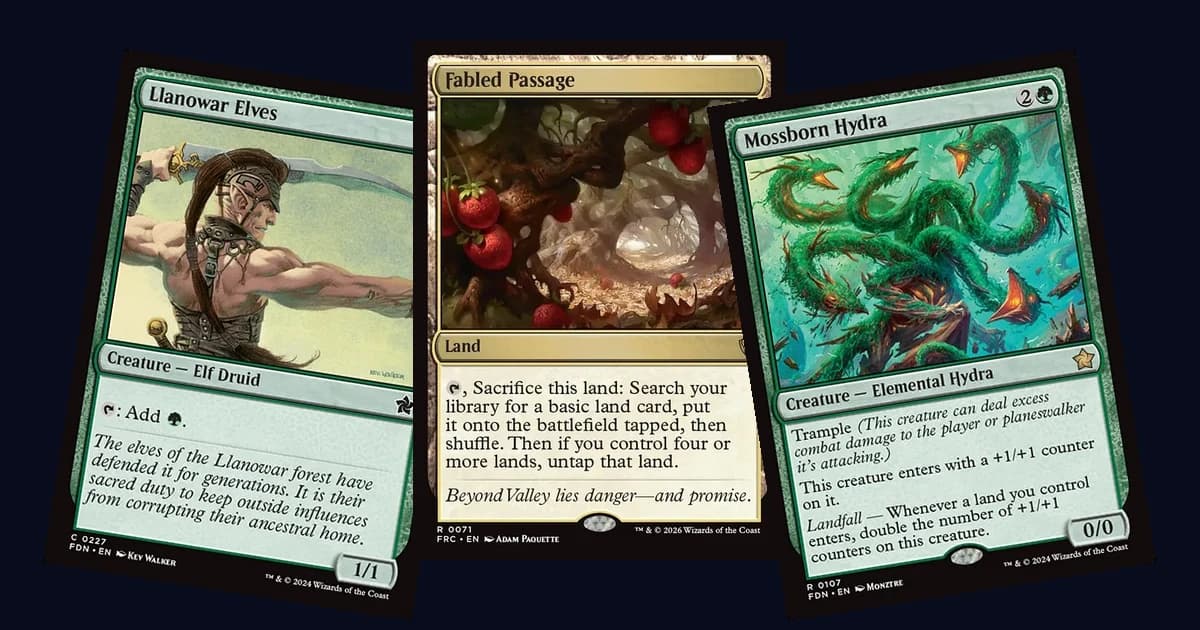
The early-aggression plan wants a cheap creature that can benefit from landfall immediately. Establish pressure before the opponent stabilizes, then use land drops and extra land entries to keep attacks relevant. Llanowar Elves is central even though it is not a landfall payoff. Its one-mana acceleration can turn a first-turn mana creature into a stronger second-turn play, bringing a larger threat or another creature onto the battlefield early.
This plan values a low, smooth curve. Icetill Explorer fits here as a landfall payoff creature, and Sazh's Chocobo is another cheap green creature for the early curve. Mightform Harmonizer is the more aggressive-leaning named payoff, giving this version another way to apply pressure after the first creature is answered. The pattern is simple: deploy early, make each land drop matter, and force answers while you keep adding to the board.
The value plan is built for games in which the first attack does not end the contest. Each land entry becomes another investment in a threat that can dominate later turns. Mossborn Hydra is the clearest example. It enters with a +1/+1 counter, and its counters double each time a land is played, so it can become enormous through several land drops. That asks the opponent to answer a growing engine rather than merely block a small attacker.
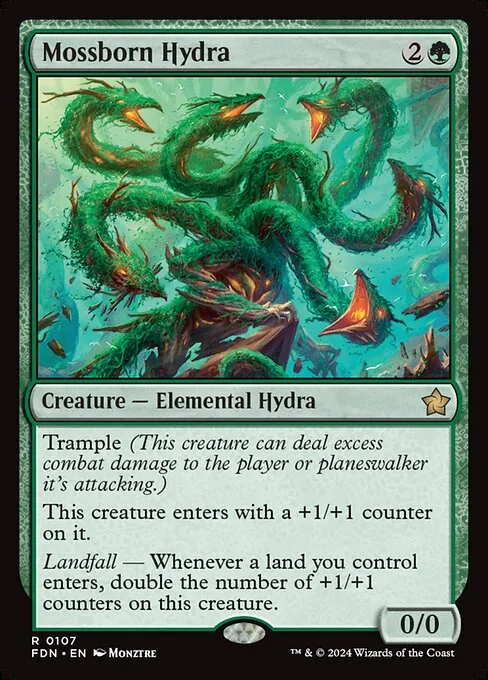 Mossborn Hydra enters with one +1/+1 counter, then doubles its counters every time a land enters, turning a slow start into an enormous threat.
The value-leaning build has more room for expensive payoffs and cards that reward later turns. Earthbender Ascension can serve as a green enchantment payoff, while Mossborn Hydra gives the deck a creature-based scaling threat. The goal is to make enough land entries that your payoffs improve after the first exchange of creatures and removal.
Most real lists blend these plans. A deck that starts with Llanowar Elves and cheap creatures still wants a threat that can win a stalled board. A deck centered on Mossborn Hydra still benefits from early pressure. Decide which plan your specific 75 leans toward: if the curve is low, play as an aggressive deck that can scale; if the list has more expensive engines, play toward value and protect your land drops.
That decision changes mulligans. An aggressive hand should have an early play and a credible land sequence, not only powerful cards that begin on turn three. A value hand can keep a slower engine if its lands function smoothly. In both cases, ask what your first three land entries accomplish. If they advance neither pressure nor scaling, the hand may be disconnected in practice.
Fabled Passage: Why One Land Card Does So Much Work
Fabled Passage is a landfall enabler because one activation can create two triggers. First, Fabled Passage itself enters the battlefield. When you use it to find a basic land, that land enters as a separate event and creates the second trigger. The events happen in sequence, so payoffs can use each one.
The timing matters. If a creature benefits from a land entering, Fabled Passage gives you one trigger and the basic it finds gives you another. One land card therefore has a larger effect than a normal land drop, especially when both triggers contribute to the same attack or growth pattern.
Fabled Passage also asks you to account for tempo. It enters untapped if you control four or more other lands, so early in the game weigh the extra landfall event against the possibility that your land enters tapped. In the aggressive version, that can cost an attack or another creature. In the value version, the cost may be easier to absorb if the second trigger sets up a stronger turn.
Do not crack Fabled Passage automatically. If the second entry changes combat, use it before combat. If there is no immediate payoff, holding it can preserve a future double-trigger turn. Treat it as a sequencing decision, not a basic land that happens to find another basic.
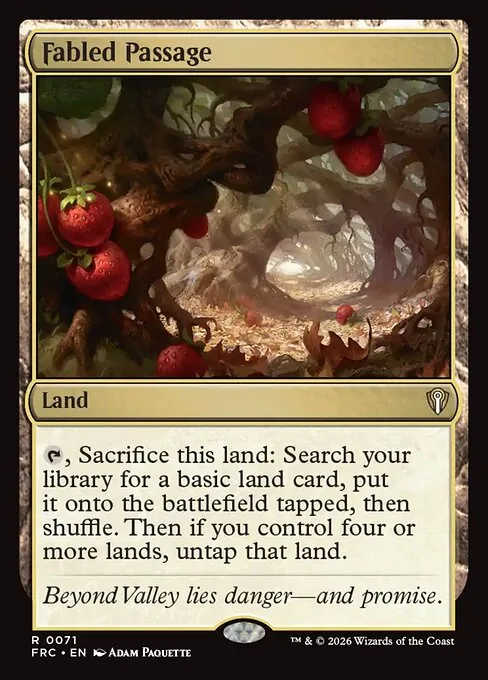 Fabled Passage's own entry is one landfall trigger, and the basic land it fetches is a second, separate trigger.
GODEEPER: This archetype is one of three top Standard decks right now. See the full breakdown of where it stands against Dimir Midrange and Izzet Spellementals. Standard Metagame Tier List: Top 3 Decks →
Step-by-Step: Building Your Manabase for Maximum Landfall Triggers
1. Count your fetch and sacrifice lands. Start by counting the fetch or sacrifice lands in your build that produce a second land entry. Each such card can represent two landfall events, but only if the land it finds or enables actually enters the battlefield. Compare that extra trigger to the tempo cost of the land and to the number of payoffs that can use it.
2. Choose your aggro or value lean. Decide whether your 75 is trying to create early pressure or grind through repeated land entries. Count cheap payoffs for the aggressive plan, then reserve enough slots for larger engines if you want a late-game plan. Do not fill the deck with expensive cards simply because they are powerful; they need to fit the turns your lands can support.
3. Smooth the curve before fixing colors. Because the deck is mono-green, your manabase does not need to solve a two-color or three-color requirement. Prioritize opening hands that can cast their spells on time, with enough lands for the value plan and enough early plays for the aggressive plan. That curve smoothness is a structural advantage over multicolor decks competing in the same format.
4. Sequence lands around the turn that matters. Plan whether a normal land should enter before a fetch land, whether Fabled Passage should be cracked before combat, and whether saving a land drop protects a stronger later turn. If two triggers produce the same result, preserve the option that gives you more information before committing. Landfall rewards the order of your land entries, not only their total number.
5. Test the gaps against the field. Play the deck against Dimir Midrange and Izzet Spellementals, the other top Standard archetypes named alongside it by Wizards of the Coast. Look for turns where your curve is too slow, where a payoff is exposed without enough pressure, or where your manabase creates too much early tempo loss. Adjust the aggro-value balance after those games, not before them.
Why Mono-Green Works in a No-Rotation Format
There was no 2026 Standard rotation. As of writing, 18 sets are legal simultaneously, and the next rotation is scheduled for January 23, 2027. Mono-Green Landfall therefore draws from sets released across 2024, 2025, and 2026 rather than mostly from the newest release.
A large card pool gives every color more options, but it also makes consistency more valuable. A multicolor deck spends part of its manabase on producing the right colors at the right time. Mono-Green Landfall can spend more of that space on curve, landfall triggers, and lands that enter in the right order. Llanowar Elves further helps a hand deploy a larger payoff early.
That advantage is not a reason to ignore land quality or play every strong green card. A mono-colored deck can still lose to awkward sequencing, too many expensive spells, or a mismatched plan. Its mana simply starts from a simpler baseline, leaving more room to choose cards for how they function together instead of using slots to patch color requirements.
Tips for Piloting the Deck
-
Track the next land entry. Before playing a land, check which payoff benefits most from the entry and whether a later fetch land would create a better sequence. The right land is sometimes the one that preserves a second trigger for combat.
-
Know your clock. If your list leans aggressive, make the opponent answer the board early. Do not turn every game into a race to cast the largest payoff when your cheap creatures can force awkward blocks or removal first.
-
Protect the value turn. If your list leans toward Mossborn Hydra and other longer-game payoffs, avoid spending a double-trigger land just because it is available. Wait for a turn where both entries change the board or create a meaningful attack.
-
Mulligan for a plan, not a pile. A hand with several strong cards is not automatically keepable. Look for the first play, the next land entry, and the point where your hand either applies pressure or begins generating value.
GODEEPER: Building any Standard manabase starts from the same land-count math, whether you're mono-colored or splashing a third color. MTG Mana Base Guide: The Land Count Formula Explained →
Frequently Asked Questions
What is landfall in MTG?
Landfall is a triggered ability that checks whenever a land enters the battlefield under your control. The trigger can happen from a normal land play, a fetched land, or another effect that puts a land onto the battlefield. In Mono-Green Landfall, those repeated entries grow creatures or generate value.
Is Mono-Green Landfall good in Standard right now?
Yes, it is one of the top three Standard archetypes identified for the September 2026 RCQ season in Wizards of the Coast's Metagame Mentor article. That ranking does not supply a win rate, so treat it as evidence of relevance, not a promise. Your build still needs testing against the field.
What does Fabled Passage do?
Fabled Passage is a land that can find a basic land. Its own entry creates one landfall event, and the basic it finds creates another, so one activation can provide two triggers. It enters untapped only when you control four or more other lands, which makes early sequencing and tempo decisions matter.
Why play mono-green instead of a 2-color deck?
Mono-green gives you a more consistent manabase because your lands do not need to cover multiple colors. That frees deck-building space for curve and landfall sequencing, and it reduces awkward draws in a format with 18 legal sets. Two-color decks may gain broader effects, but they pay for that range with fixing demands.
Should my list be all-in aggro?
Not necessarily. Cheap landfall creatures and Llanowar Elves can create fast pressure, but Mossborn Hydra and other value payoffs let the deck keep scaling when the first attack is answered. Most lists blend the plans. Choose whether your 75 is primarily trying to end games early or win through repeated landfall triggers.
When should I crack Fabled Passage?
Crack it when the second land entry changes the turn, such as before combat when another landfall trigger improves your attack. If the extra trigger is not urgent, holding Passage can preserve a future burst of value. Always account for whether entering tapped early will cost more than the trigger is worth.
Related Reading
- MTG Format Legality Explained: why no 2026 Standard rotation happened and what that means for deckbuilding.
- MTG Basics Complete Guide: the foundational hub covering colors, mana bases, and deck building fundamentals.
- MTG Keyword Abilities Explained: what trample and other combat keywords on cards like Mossborn Hydra actually do.
References
Was this guide helpful?
About the author

Commander & Standard Deck Analyst
Commander and cEDH grinder covering deckbuilding, precons, and the Standard/Commander metagame. Plays out of a local game store scene, reads spoilers the day they drop.
- Weekly Commander night regular, 6+ years
- Tracks EDHREC/MTGGoldfish data for every article
- Covers every Standard-legal set + Commander precon on release
Keep reading
Izzet Spellementals Standard Deck Guide (September 2026)
Guides · 12 min
Standard Metagame Tier List: Top 3 Decks (Sept 2026)
Guides · 11 min
MTG Standard Format Guide: Rotation, Archetypes, Meta
Guides · 4 min
Reality Fracture Standard Preview: 2 Cards to Watch
Guides · 11 min
MTG Format Legality Explained: Standard vs Commander
Guides · 10 min
Bury MTG Meaning, Plus Extort and Discover Explained
Guides · 11 min
MTG Board Wipes Explained: How They Work and When to Cast
Guides · 10 min
cEDH Meaning in MTG: What Competitive Commander Actually Is
Guides · 11 min
Disclaimer
This article is published for informational and entertainment purposes. It does not constitute professional financial, legal, or technical advice. Game performance, online services, patch schedules, and store listings change. Verify critical details (pricing, system requirements, regional availability) with publishers and storefronts before you buy. Affiliate links, where present, help support our editorial work and are labelled in our affiliate disclosure.